Shrimp Farming in Tanks and Ponds: How Much Shrimp per m², Stocking Density, Aeration and Backup Power (Brazil Guide)
Also in:Português
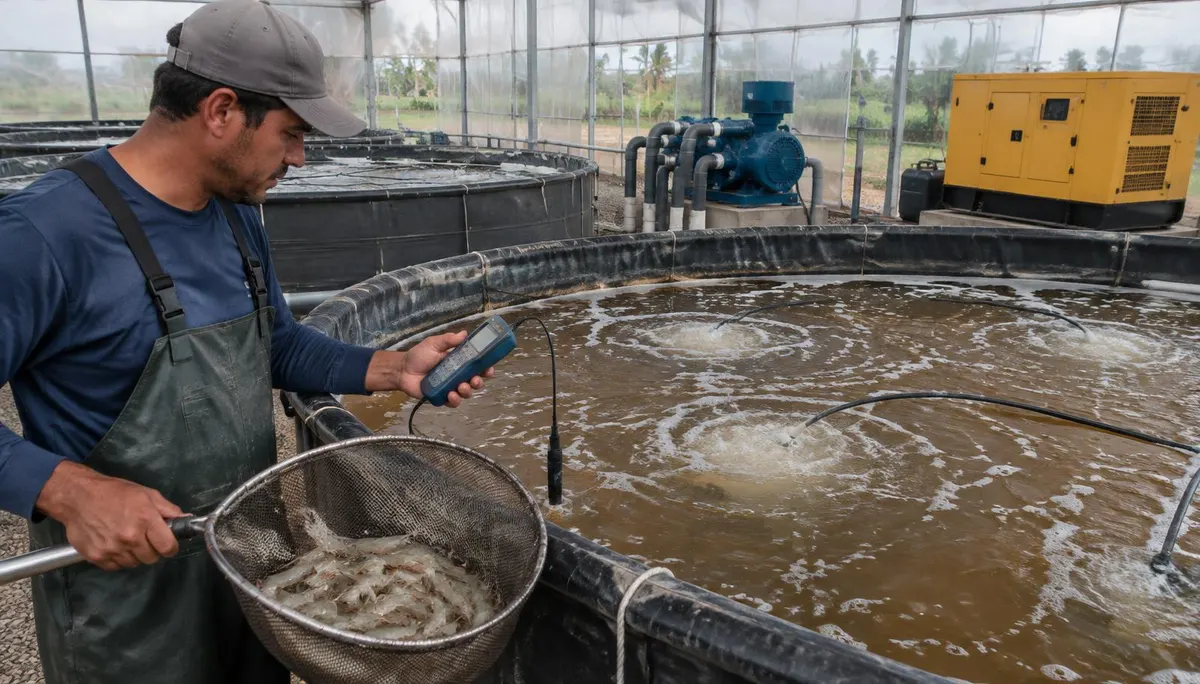
Short answer: there is no fixed number of kilograms of shrimp per tank. Harvest weight equals post-larvae stocked × survival × final mean weight, and the safe ceiling is set by how much oxygen, water treatment and backup power the system can deliver at peak biomass — not by tank volume. As a sense check, results reported by FAO for whiteleg shrimp range from about 0.7–2 kg per m² of pond area per crop in intensive ponds to about 2.8–6.8 kg per m² in super-intensive raceway trials. For a 2 × 2 m tank (4 m²), that is roughly 3 to 27 kg per cycle depending on the system — a range wide enough to show why the design, not the tank, decides. Request comparable equipment proposals once your design basis is written down.
Written by the FishMatch Group editorial team. Published 23 October 2026. Sources checked 23 October 2026. The figures below are reported ranges from the cited sources and worked examples of a formula; they are not targets, recommendations or guarantees for your farm.
Who this guide is for: shrimp farm owners, investors and project managers in Brazil planning tanks, lined ponds (viveiros) or biofloc units who need to size density, aeration and backup power before asking suppliers for prices. FishMatch supports supplier sourcing for commercial projects of USD 250,000 or more; the method and calculators here are free for any size.
How much shrimp can a tank or pond produce? The harvest formula
Work from the harvest backwards and write every assumption down:
- Harvest (kg) = stocking density (PL per m²) × area (m²) × survival (%) × final mean weight (kg).
- Peak biomass density (kg per m², or kg per m³ of useful water volume) must stay below the limit your system designer can support with oxygen, solids removal and water quality.
- Use the useful water depth, not the wall height. A tank built 1.2 m high may run at 1.0 m or less of water.
Worked example of the formula only: a 2 × 2 m tank has 4 m² of bottom area. Using values inside the ranges FAO reports for super-intensive raceway trials — 300 juveniles per m², 70% survival and a 20 g final weight — the harvest would be 300 × 4 × 0.70 × 0.020 = 16.8 kg. Change survival to 55% and weight to 16 g and the same tank gives 10.6 kg. Your own survival and growth records, or your designer's written basis, must replace these numbers.
Shrimp stocking density and yield per m² by system
| System (FAO description) | Reported stocking | Reported yield per crop | Per m² of area | What it depends on |
|---|---|---|---|---|
| Semi-intensive ponds | 10–30 PL/m² | 500–2,000 kg/ha | 0.05–0.2 kg/m² | Water exchange by pumping, minimal aeration |
| Intensive ponds | 60–300 PL/m² | 7,000–20,000 kg/ha | 0.7–2 kg/m² | Heavy aeration, biosecure stock, careful feed and water management |
| Bacterial floc (biofloc) ponds | 80–160 PL/m² | 8,000–50,000 kg/ha | 0.8–5 kg/m² | Very high aeration and mixing, floc and carbon-to-nitrogen management |
| Super-intensive raceways (US research) | 300–450 juveniles/m² | 28,000–68,000 kg/ha | 2.8–6.8 kg/m² | Greenhouse enclosure, no water exchange, survivals of 55–91% reported |
Source: the FAO fact sheet on Penaeus vannamei (Cultured Aquatic Species Information Programme). It is an older reference and summarises results from different countries and trials; treat it as a sense check, not a forecast. Per-m² values are converted from kilograms per hectare.
Can marine shrimp be farmed in net cages (tanque-rede)?
The FAO fact sheet describes whiteleg shrimp grow-out in ponds, tanks and raceways. Net pens or cages appear only as nursery systems placed inside production ponds for one to five weeks. Net cages are widely used for fish such as tilapia, but if a proposal plans marine shrimp grow-out in a tanque-rede, ask for documented commercial references before relying on it.
Shrimp tank and pond aeration: size it from oxygen demand
FAO notes that intensive ponds need heavy aeration of roughly 1 HP for every 400–600 kg of harvested shrimp. For a 10,000 kg harvest, that rule points to about 17–25 HP. Use it only as a first check for ponds: biofloc and tank systems also need mixing to keep floc in suspension, and the final number should come from an oxygen balance at peak biomass, water temperature and feeding rate.
- Compare aerators by oxygen delivered: standard oxygen transfer rate (SOTR) and aeration efficiency (SAE, kg O2 per kWh), stated by the manufacturer.
- Ask how the aerator count was calculated, at what biomass, temperature and salinity.
- Check materials for brackish or salt water: shaft, bearings, floats and fasteners.
- Run the numbers yourself with the shrimp pond aeration calculator, oxygen demand and the shrimp oxygen risk check.
Backup generator for shrimp aeration: protect the critical load
At high density, an aeration stop during the night can put a whole crop at risk. Size the generator for the critical load — the aerators or blowers that must keep running and minimum pumping — not for the whole farm. Convert motor power to kW (1 HP ≈ 0.75 kW) and ask the electrical designer to add the starting-current margin the motors require.
- Automatic transfer switch, so the generator takes over without someone on site.
- Fuel autonomy in hours, and how fuel will be replenished.
- Dissolved-oxygen alarms that work without internet, with a phone or siren alert.
- Brazil's grid runs at 60 Hz. Confirm voltage and phase at the site with your utility and state them in the request, so motors are quoted for the right supply.
Shrimp farm equipment maintenance: ask for costs in the quote
Monthly maintenance cost depends on equipment brand, water and operating hours, so no generic figure is reliable. Instead, make suppliers price it:
- Recommended spare-parts kit for the first two years, with prices.
- Service intervals for aerator gearboxes and bearings, blower filters and pump seals.
- UV lamp replacement interval and lamp price, if UV is included.
- Biofilter media life and cleaning routine.
- DO sensor membrane or optical cap replacement and calibration interval.
- Divide the annual kit and service cost by 12 to compare suppliers on the same monthly basis.
Shrimp farm permits and water use in Brazil
Federal Law 9,433/1997 (National Water Resources Policy) makes water withdrawal from a water body, groundwater extraction and the discharge of effluents subject to a water-use grant (outorga) — Article 12, items I to III. Depending on who controls the water body, the grant is issued by the national water agency or the state authority. Environmental licensing is handled by the competent environmental agency, usually at state level; confirm the procedure for your project type and size directly with that agency. For cages or other structures in water bodies under federal control, Decree 10,576/2020 governs the cession of use of those areas for aquaculture, which the Ministry of Fisheries and Aquaculture's National Aquaculture Secretariat handles. FishMatch does not obtain permits; it helps you specify equipment once the route is clear.
What to send shrimp equipment suppliers
- Species, system (tank, lined pond, biofloc, raceway) and number and size of units.
- Target harvest per cycle and cycles per year, with your survival and final weight assumptions.
- Water source, salinity, temperature range and any laboratory analysis.
- Peak biomass and feeding rate you want the oxygen design to cover.
- Power: voltage, phase, available capacity and outage history.
- Scope: equipment only, or with installation, commissioning, training and spare parts.
- Delivery: Incoterm and municipality or port of delivery.
- Budget range and target start date.
Tools and next steps
- Calculate area and volume: pond volume.
- Check density and biomass: stocking density and biomass.
- Test the economics: shrimp farm calculator.
- Read the procurement guide: shrimp aeration, auto-feeders and DO monitoring.
- Brazil context: Brazil aquaculture market guide and shrimp farm project in Brazil (Portuguese).
- When your design basis is written: submit a reviewed request.
Sources
- Penaeus vannamei, Cultured Aquatic Species Information Programme, FAO (older reference): fao.org — checked 23 October 2026.
- Law 9,433 of 8 January 1997, Presidency of the Republic of Brazil: planalto.gov.br — checked 23 October 2026.
- Decree 10,576 of 14 December 2020, Presidency of the Republic of Brazil: planalto.gov.br — checked 23 October 2026.
- National Aquaculture Secretariat, Ministry of Fisheries and Aquaculture: gov.br/mpa — checked 23 October 2026.
Frequently asked questions
Key figures
| Figure | Value | Context |
|---|---|---|
| Size / capacity | 7–2 kg | 7–2 kg per m² of pond area per crop in intensive ponds to about 2. |
| Size / capacity | 8 kg | 8 kg per m² in super-intensive raceway trials. |
| Size / capacity | 27 kg | For a 2 × 2 m tank (4 m²), that is roughly 3 to 27 kg per cycle depending on the system — a range wide enough to show why the design, not the tank, decides. |
| Cost | USD 250,000 | FishMatch supports supplier sourcing for commercial projects of USD 250,000 or more; the method and calculators here are free for any size. |
| Size / capacity | 20 g | Using values inside the ranges FAO reports for super-intensive raceway trials — 300 juveniles per m², 70% survival and a 20 g final weight — the harvest would be 300 × 4 × 0. |
| Size / capacity | 16 g | Change survival to 55% and weight to 16 g and the same tank gives 10. |
| Size / capacity | 6 kg | 6 kg. |
| Size / capacity | 500–2,000 kg | | System (FAO description) | Reported stocking | Reported yield per crop | Per m² of area | What it depends on | |---|---|---|---|---| | Semi-intensive ponds | 10–30 PL/m² | 500–2,000 kg/ha | 0. |
Related articles
Where this fits in a real project
Every FishMatch project runs through the same five reviewed stages, from a first enquiry to comparable quotations. See the full buyer journey.
Planning a commercial aquaculture project?
Send your project brief. A FishMatch specialist reviews it before relevant suppliers are contacted privately.
Request a quote