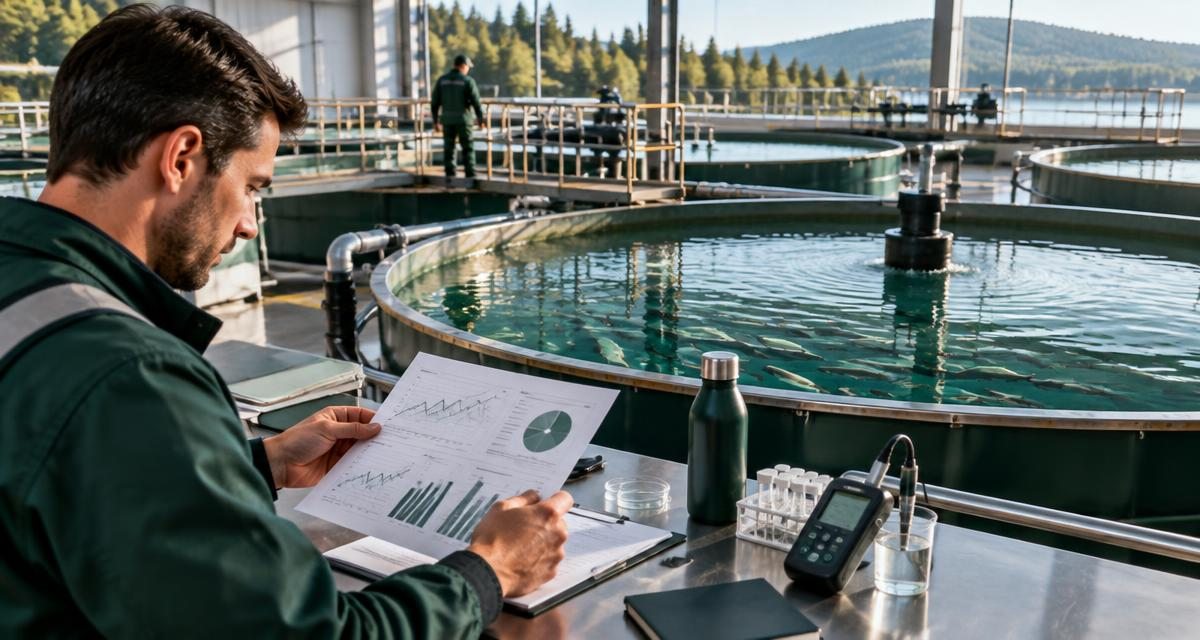
Knowledge into decisions
Your Aquaculture Business Intelligence Center: Learn More, Plan Smarter, Make Better Decisions
FishMatch Group editorial team ·
FishMatch Group’s Business Intelligence and Knowledge Center resources help aquaculture buyers turn scattered questions into a structured decision: learn the system, measure the site, test the economics, define the procurement scope and compare evidence. They are practical planning aids, not engineering approval, veterinary diagnosis or a promise of production or financing.
A fish farm does not become viable because its equipment catalogue is impressive. A shrimp expansion does not become safe because a spreadsheet predicts more harvest. Better decisions start when production, water, oxygen, feed, people and capital are considered together. FishMatch Group brings existing guides, planning tools and procurement resources into that conversation. Their greatest practical value is not another answer in isolation: it is helping your team ask the next question before committing money.
Business intelligence that starts with your farm
In this article, business intelligence means a disciplined use of available guidance, your own operating records and clearly stated assumptions. It does not mean that FishMatch automatically monitors your farm, reads private systems or supplies a live market-price feed. A published guide is educational material; a calculator output is a scenario. Keep that distinction visible whenever a number reaches a budget or investment committee.
Start with the searchable Knowledge Center for system choices, equipment scope and operating questions. Use the Planning Center when you need to connect production targets with preliminary facility or utility requirements. Equipment Intelligence helps you organize specification questions. The procurement guides then turn those questions into comparable requirements. These are complementary resources, not substitutes for measured site data.
Four buyer decisions the resources can support
An existing shrimp operator wants more saleable harvest without simply stocking more animals. Begin with survival, feed records, growth samples, water observations and aeration downtime. Identify the constraint before asking for additional feeders or aerators. A planning tool can organize the investigation, but a health event needs qualified local aquatic-health support; an equipment purchase cannot establish the cause of mortality.
A fish-farm owner considering expansion needs to distinguish extra tank space from usable capacity. Check water availability, pumping, treatment, peak oxygen demand, backup power, staffing and harvest handling. Expanding one component while another remains constrained may leave the investment underused. Stage construction and commissioning around current production rather than assuming the farm can stop.
A RAS engineer needs a consistent design basis. Species, life stage, temperature, feed load, water chemistry and operating schedule matter more than a generic tank count. Use the RAS Facility Planner and Utility Requirement Planner for preliminary questions; ask a qualified designer to validate load calculations, safety margins and interfaces before final procurement.
A purchasing manager or consultant needs offers with the same boundary. Specify what is included, excluded, installed, tested and handed over. Record civil works, freight, power connection, consumables, spares, training and acceptance requirements. Comparing unit prices without these items is not comparing complete project solutions.
A practical workflow: learn, measure, model, specify, review
The sequence below is a decision checklist, not a compulsory software workflow. Keep a dated project file outside the tools with the source, units, measurement period and owner of each input. Mark unknowns openly. A precise-looking output with an unmeasured input is still uncertain.
- 1Define the decision. State species, country, farm system, current operation versus new project, target harvest and the problem you are solving. Name the decision-maker and the approval needed.
- 2Gather the baseline. Collect water quantity and quality, feed and biomass records, energy bills, downtime, maintenance and seasonal constraints. For a new site, obtain reliable measurements instead of copying another farm.
- 3Run transparent scenarios. Use preliminary planning and cost calculators with your own inputs. Keep base and downside cases, and record exactly what changes between them.
- 4Write the requirements. Convert the preferred scenario into a scope with capacity basis, interfaces, service, installation, commissioning and acceptance criteria. Retain unresolved assumptions as questions.
- 5Review before purchase. Ask the FishMatch project team to review a qualifying RFQ, and have engineering, aquatic-health and local compliance specialists validate the parts that require professional judgment.
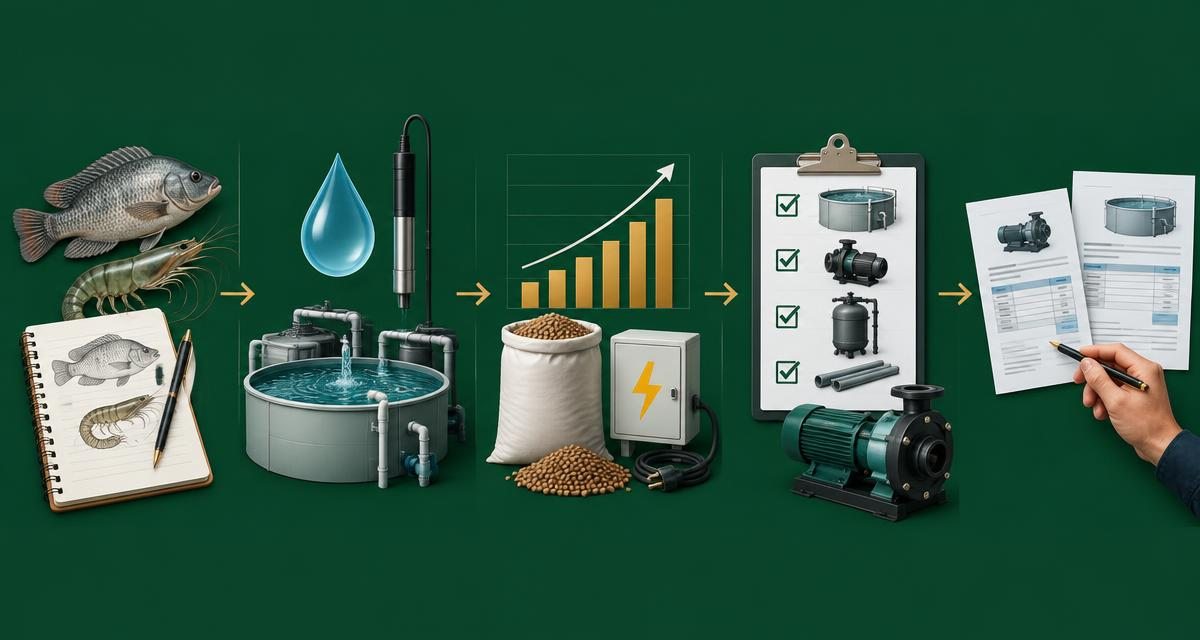
- 1. Define production
- 2. Measure the site
- 3. Test economics
- 4. Specify scope
- 5. Human review
AI-generated editorial illustration; not a FishMatch facility or customer case study.
Make cost calculators useful—not falsely precise
The important question is not only what the equipment costs. It is what the operation must spend to produce saleable harvest within a clearly defined period. Keep capital expenditure separate from recurring costs and working capital. Feed, electricity, oxygen, labour, maintenance, losses and logistics may belong in different lines; avoid counting the same cost twice.
Feed cost per kilogram harvested depends on the feed-price and harvest-ratio boundary you use. Biological feed conversion and a farm-level ratio affected by mortality or partial harvest are not interchangeable. State the method before comparing farms or products. Use measured production and feed records wherever available, and treat calculator presets as starting assumptions rather than local price evidence.
For an upgrade, compare the incremental investment with incremental costs and benefits against the same baseline. A downside case might use a slower ramp-up, less improvement, higher energy cost or longer downtime. If the business case works only when every assumption is favourable, investigate further. A model helps expose that weakness; it does not remove it.
Use credible sources without confusing them with site approval
FAO’s site-selection training material links production scale, species and culture approach to site planning, with water, soil and topography among the considerations. It offers a useful framework, not a current local permitting checklist. WOAH’s aquaculture-establishment biosecurity chapter provides risk-based guidance on pathogen introduction and spread. Apply it with appropriate specialists and the current national requirements.
FAO’s aquatic-health management resource adds a broader health and biosecurity perspective. These references support the order of the questions in this article; they do not certify a FishMatch calculation or endorse a particular supplier. Check the source date or edition and its geographical applicability before relying on it. Industry briefings, where available, should likewise be read with their source dates and refresh status visible.
From research to a private, human-reviewed RFQ
The useful outcome of learning is a better brief, not an automatic supplier introduction. Bring species, production volume, country, water and energy constraints, equipment needs, procurement stage, timing and budget to the existing request process. For modernization, say what already operates, what must remain online and which bottleneck the upgrade should address.
FishMatch’s buyer tools are free. Managed procurement assistance is intended for commercial projects of USD 250,000 or more; smaller requests are retained and directed to free self-service tools rather than deleted. RFQs are private and human-reviewed. Supplier identities and contact details are not exposed to buyers, and suppliers cannot pay for ranking or shortlist position. No calculator, guide or request guarantees savings, survival, funding or a successful supplier outcome.
Choose one decision today: validate a water assumption, examine a feed-cost boundary or write a clearer scope. Use the relevant resource, capture what you learned and list what remains uncertain. That is how a knowledge center becomes a practical decision center—one better-supported choice at a time.
Questions buyers ask
Is this a live farm-monitoring or market-price platform?
This article describes existing guides, planning resources and calculators. It does not claim automatic farm monitoring or verified real-time price coverage. Use your own measurements and check source dates.
Can the tools support existing fish and shrimp farms?
Yes. Use them to structure retrofit, capacity-expansion and operating-cost questions, with your current farm records as the baseline. They cannot guarantee an improvement or diagnose disease.
Do calculator results replace a RAS design?
No. They support preliminary planning and sensitivity checks. Site-specific engineering, aquatic-health assessment and local approval remain separate professional responsibilities.
What should I include in a procurement request?
Include species, farm system, country, production target, existing-operation or new-project intent, water and energy constraints, scope, budget, timing and procurement stage. Mark missing information rather than inventing it.
Are buyer tools free, and who qualifies for managed procurement?
Buyer tools are free. Human-reviewed managed procurement is intended for commercial projects of USD 250,000 or more; smaller requests remain saved and are directed to free tools.