Shrimp Aeration, Feeding Automation and Water Monitoring: A Procurement Guide
Also in:EspañolPortuguêsالعربيةTiếng ViệtID
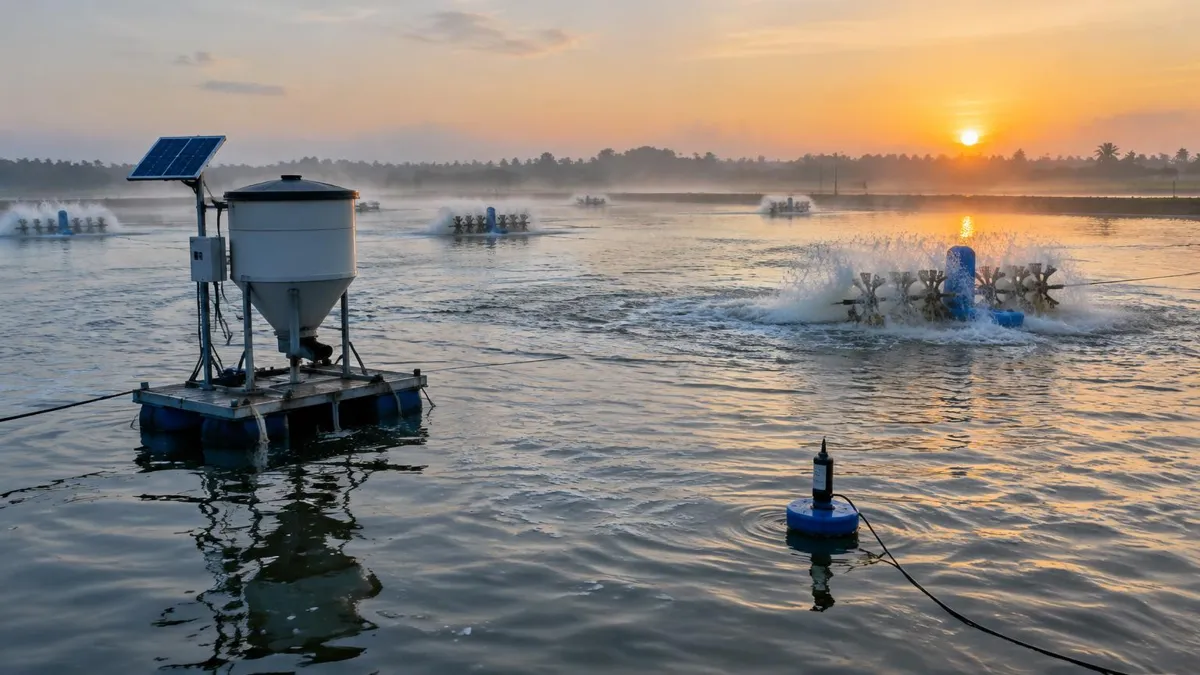
Short answer: buy shrimp aeration, feeding automation and water monitoring as one oxygen system sized to peak biomass, not as three separate catalogues. Estimate the oxygen the pond needs at the heaviest point of the cycle, divide by the field oxygen transfer of the aerators you are offered (not the brochure figure), add a margin and backup power, then let monitoring and feeding automation protect that margin at night. Compare vendors on kg of oxygen per kWh measured under a stated test standard, service and spares — not on horsepower or unit price.
Editorial note: written by the FishMatch Group editorial team, updated 16 October 2026, for farm owners, managers and procurement teams buying aeration, feeders and monitoring for commercial shrimp ponds or tanks. It is a procurement framework, not an engineering design. Every number in the examples is an assumption to replace with your own data and written supplier test results. It promises no savings or returns.
Key takeaways
- Size aeration to peak biomass and feed load at the end of the cycle, at night, at your highest water temperature.
- Ask for standard aeration efficiency (SAE, kg O₂/kWh) with the test method; expect field transfer to be lower.
- Backup power and automatic restart are part of the aeration purchase, not a separate project.
- Dissolved oxygen sensors with alarms and data logging are what make aeration control and automatic feeding safe.
- Judge ROI on avoided losses, energy per kg and feed per kg, with assumptions written down.
How this differs from our aerator guides
Our guide to choosing aerators for fish and shrimp ponds and aeration in tropical shrimp ponds explain aerator types. This guide is about buying the whole package — aeration, power backup, feeders and sensors — against one written requirement, and comparing vendors fairly.
Step 1 — Size oxygen demand to peak biomass
Oxygen demand rises with biomass and feed. The highest demand usually comes late in the cycle, at night, when phytoplankton stop producing oxygen and water is warmest. Build the estimate from your own plan:
1. Peak standing biomass per pond (kg) from your stocking, survival and harvest-weight plan. 2. Shrimp respiration plus the oxygen used by feed breakdown, sludge and plankton at night — your technical adviser or supplier should state the basis used. 3. Oxygen that must be added = total night demand − oxygen the pond can supply naturally, plus a safety margin. 4. Required aerator capacity = oxygen to add ÷ field oxygen transfer per unit.
Use the shrimp pond aeration calculator and the shrimp oxygen risk calculator to run this with your numbers, and the shrimp feed requirement calculator to estimate peak daily feed.
Published experience gives a sense of scale. Boyd's review reported aeration ranging from about 1–2 kW per hectare in some fish culture to 15–20 kW per hectare in intensive marine shrimp culture (Boyd, 1998, Pond water aeration systems); a later field report described Thai shrimp ponds at 18–27 kW per hectare (Global Seafood Alliance). These are reference points, not a design for your site.
Step 2 — Compare aerators on oxygen per kWh, not horsepower
Standard aeration efficiency (SAE) is the oxygen an aerator transfers per kilowatt-hour under standard test conditions (clean water, 20 °C, zero dissolved oxygen). In a working pond — warmer, saltier, already partly oxygenated — transfer is lower. Boyd describes the clean-water test that produces these figures and notes that aerator design has a large effect on efficiency (Global Seafood Alliance — Efficiency of mechanical aeration).
| Ask every vendor for | Why |
|---|---|
| SAE in kg O₂/kWh and standard oxygen transfer rate (SOTR) in kg O₂/h | Lets you compare units of different power fairly |
| Test method, test lab and test date | A figure without a method cannot be compared |
| Measured power draw at the shaft or motor, not nameplate | Real kWh drives your bill |
| Salinity and water depth of the test | Transfer changes with both |
| Motor and gearbox type, IP rating, corrosion protection | Decide lifetime in salt water |
| Service interval, spare parts list and local stock | Downtime at peak biomass is the real cost |
Step 3 — Power backup is part of aeration
A power cut at night with full biomass can cause losses within hours. Specify: generator capacity to run at least the critical aerators at peak biomass, automatic transfer switch, staggered automatic restart of aerators (to avoid start-up overload), fuel storage for the autonomy you need, and an alarm that reaches a person. The shrimp farm energy calculator estimates the energy share of cost per kg.
Step 4 — Water monitoring: what to buy and why
| Parameter | Typical sensor approach | Decision it supports |
|---|---|---|
| Dissolved oxygen | Optical DO probe per pond or tank, logged | Aerator on/off and alarms, feed timing |
| Temperature | Usually in the DO probe | Oxygen saturation and feeding rate |
| pH | Probe or handheld daily | Water stability, ammonia toxicity |
| Salinity / conductivity | Probe or handheld | Osmotic stress, oxygen solubility |
| Ammonia, nitrite, alkalinity | Usually lab kits or analysers | Feeding and water management decisions |
Specify calibration needs, cleaning frequency, data storage, alarm channels (SMS, app, siren), who owns the data, and what happens when the internet or power fails. A sensor that is not cleaned gives a confident wrong number — budget the maintenance labour.
Step 5 — Feeding automation
Automatic feeders — timer-based broadcasters or acoustic/demand feeders — spread feed into smaller, more frequent meals. Their value depends on safe oxygen: feeding when dissolved oxygen is low wastes feed and adds oxygen demand. Ask for integration so feeding pauses on a low-oxygen alarm, a record of feed dispensed per pond, and a clear way to compare automatic feeding with feed-tray checks. Model feed cost with the shrimp feed requirement calculator and its effect on margin with the cost per kg calculator.
Step 6 — Vendor comparison table
Put every proposal into the same table before talking price.
| Item | Vendor A | Vendor B | Vendor C |
|---|---|---|---|
| Aerator SAE (kg O₂/kWh) and test method | |||
| Units and total installed kW per hectare | |||
| Generator and transfer switch included? | |||
| DO sensors per pond, alarm channels | |||
| Feeder type, integration with DO | |||
| Installation, commissioning, training | |||
| Spares for first year, local service response time | |||
| Warranty terms and exclusions | |||
| Price, Incoterm, delivery time |
Step 7 — Maintenance and ROI with transparent assumptions
Write the ROI as a simple, checkable calculation. Illustrative structure only:
- Energy saving = (old kWh per kg − new kWh per kg) × tariff × kg harvested.
- Feed saving = (old FCR − new FCR) × feed price × kg harvested, only if trials on your farm support the FCR change.
- Avoided-loss value = probability of an oxygen event × value of biomass at risk, using your own history.
- Costs = equipment + installation + maintenance + sensor replacement + financing.
- Payback = costs ÷ annual savings, shown in a low and base case.
Example of the arithmetic: if better aerators cut energy from 3.0 to 2.5 kWh per kg (illustrative), that is 0.5 kWh per kg; at a tariff of USD 0.12 per kWh (illustrative) and 100 t harvested, the saving is 0.5 × 0.12 × 100,000 = USD 6,000 per year. Replace every input with your own. Plan maintenance: paddle and float checks, gearbox oil, motor insulation, sensor cleaning and calibration, feeder hoppers and spinners.
Procurement checklist
- [ ] Peak biomass, feed and night oxygen demand estimated and written.
- [ ] Aerator SAE with test method requested from every vendor.
- [ ] Installed kW per hectare and layout drawing per pond.
- [ ] Generator, automatic transfer and staggered restart in scope.
- [ ] DO sensors with logging and alarms that reach a person.
- [ ] Feeding paused automatically on low-oxygen alarm.
- [ ] Spares, service response time and training included.
- [ ] Acceptance test: measured power draw and DO response at commissioning.
Technical RFQ template — aeration, feeding and monitoring
- Ponds or tanks: ___ units, area ___ m² or volume ___ m³, depth ___ m, salinity ___
- Peak biomass per unit: ___ kg; peak feed per day: ___ kg
- Required oxygen addition at night: ___ kg O₂/h per unit (state basis)
- Aerator type preferred or open: ___; SAE with test method required
- Power: grid ___ kW, tariff ___, backup autonomy ___ h, automatic transfer required
- Monitoring: DO + temperature per unit, pH and salinity ___, alarm channels ___
- Feeding: ___ feeders per unit, DO-linked pause required
- Installation, commissioning, training, first-year spares: required
- Acceptance tests: ___
Free tools and project support
All calculators are free: shrimp pond aeration, shrimp oxygen risk, shrimp farm energy and shrimp feed requirement. For commercial projects from USD 250,000, send a free project brief. A person reviews it within one business day, then our team approaches suitable suppliers on your behalf and compares proposals line by line. FishMatch Group is supplier-neutral and not a manufacturer; supplier identities stay private and prices are not guaranteed.
Sources: Boyd (1998) — Pond water aeration systems, Aquacultural Engineering; Global Seafood Alliance — Efficiency of mechanical aeration; Global Seafood Alliance — Overview of mechanical pond aeration.
Frequently asked questions
Key figures
| Figure | Value | Context |
|---|---|---|
| Size / capacity | 1–2 kW; 15–20 kW; 18–27 kW | Boyd's review reported aeration ranging from about 1–2 kW per hectare in some fish culture to 15–20 kW per hectare in intensive marine shrimp culture (Boyd, 1998, Pond water aeration systems); a… |
| Performance | 20 °C | Standard aeration efficiency (SAE) is the oxygen an aerator transfers per kilowatt-hour under standard test conditions (clean water, 20 °C, zero dissolved oxygen). |
| Size / capacity | 5 kWh | 5 kWh per kg (illustrative), that is 0. |
| Cost | USD 0. | 5 kWh per kg; at a tariff of USD 0. |
| Cost | USD 6,000 | 12 × 100,000 = USD 6,000 per year. |
| Cost | USD 250,000, | For commercial projects from USD 250,000, send a free project brief. |
Related articles
Where this fits in a real project
Every FishMatch project runs through the same five reviewed stages, from a first enquiry to comparable quotations. See the full buyer journey.
Planning a commercial aquaculture project?
Send your project brief. A FishMatch specialist reviews it before relevant suppliers are contacted privately.
Request a quote