Shrimp Harvest Planning and Post-Harvest Quality: A Practical Guide
Also in:EspañolPortuguêsFrançaisالعربية
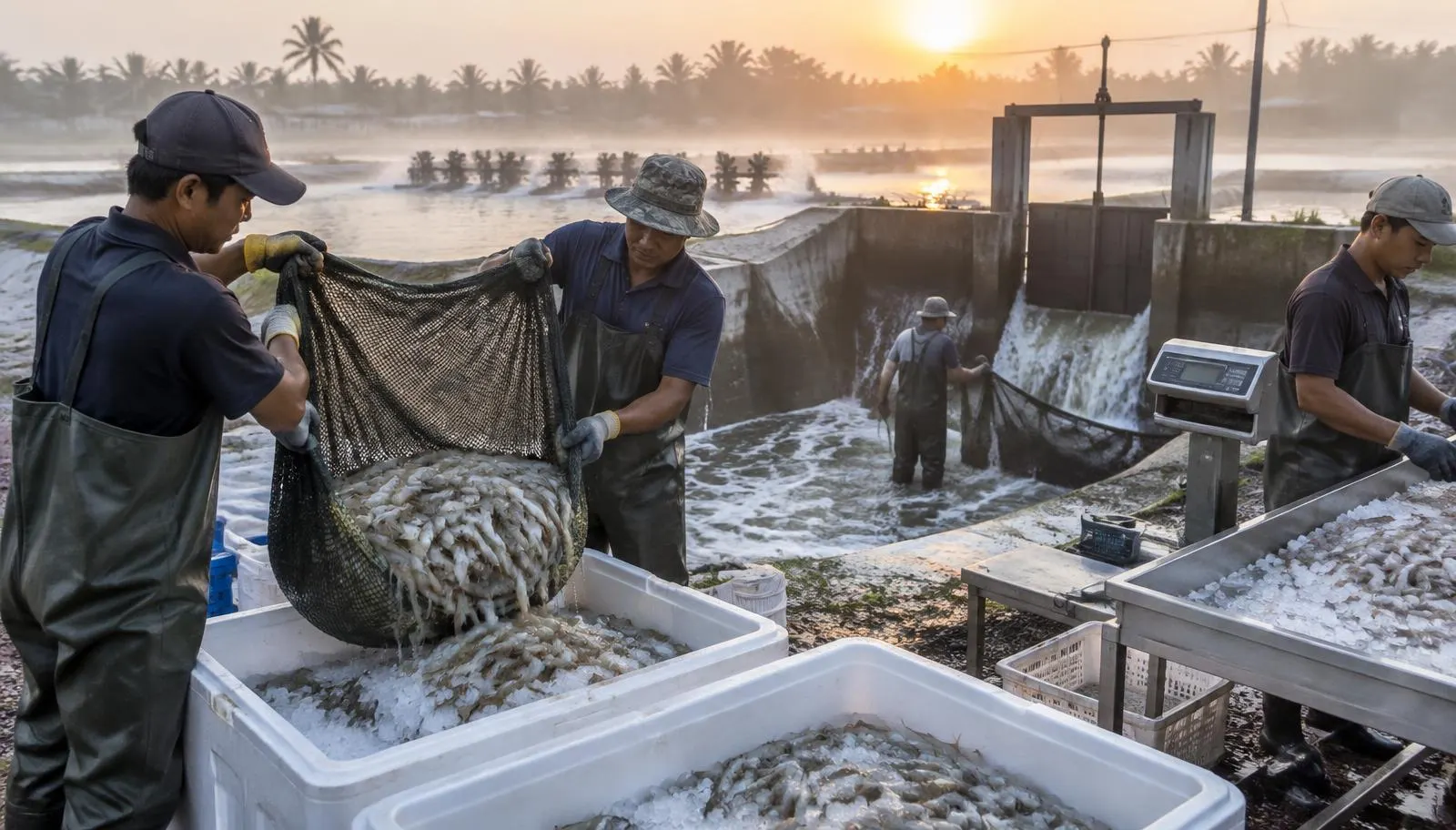
Short answer: plan a shrimp harvest backwards from the buyer. Agree the size, product form and delivery date with the market first, then decide between partial and total harvests, prepare equipment, ice and transport in advance, and chill the shrimp immediately after they leave the water. Most of the value a farm loses at harvest is lost in the first hours — through delays, slow chilling, rough handling and poor records — not in the pond. This guide walks through harvest timing, methods, equipment, post-harvest quality and what to agree with processors and buyers.
Editorial note: practical planning guide by the FishMatch Group editorial team, reviewed 15 October 2026, for shrimp farm owners, managers and project planners. It is not veterinary, food-safety, engineering or financial advice. It gives no universal harvest sizes, temperatures, prices or yields. Food-safety and export rules differ by country and buyer and must be confirmed with the competent authority and your processor.
Key takeaways
- The harvest plan starts with the buyer's size, product form and delivery date, not with the pond.
- Partial harvests can reduce pond biomass and capture size-based prices; total harvests are simpler to manage.
- Ice, chilling capacity and transport must be ready before the first net goes in.
- Speed and temperature control after harvest decide most of the product's quality.
- Records linking every lot to its pond, feed and treatments are increasingly required by buyers.
Step 1: Start from the market
Before setting a harvest date, confirm with your buyer or processor the target size (count per kilogram), the product form (whole fresh, head-on frozen, peeled, live), the quality specifications, the volume per delivery and how lots will be inspected and priced. A harvest timed only by the pond often meets a market that is not ready, or sells at a size the buyer does not want.
Step 2: Choose partial or total harvest
| Approach | When it is used | Points to plan |
|---|---|---|
| Total harvest (draining the pond) | End of cycle, one buyer, simple logistics | Drain gates, harvest box or bag net, enough ice and staff for the full volume at once |
| Partial harvests (cast or seine nets, traps) | Reducing biomass late in the cycle, selling larger shrimp first | Handling stress for the remaining stock, feeding adjustments, repeated logistics |
| Harvest with a shrimp pump | Larger intensive farms and tank or RAS systems | Pump type and capacity, gentle handling, power, cleaning |
Step 3: Prepare equipment and logistics
A harvest scope usually covers harvest nets or bag nets at the drain, a harvest box or sump, shrimp pumps where used, baskets and sorting tables, scales, insulated bins, enough clean ice or an ice plant, chilled water tanks, potable water for washing, lighting for night harvests, and transport to the processor. Confirm ice volumes and truck times with your processor rather than estimating on the day.
Step 4: Protect quality in the first hours
Shrimp quality falls quickly after harvest if the product warms up or waits. Common practice is to chill immediately in an ice-water slurry, keep the product cold and shaded throughout, handle it gently, and move it to processing or freezing without delay. The Codex Alimentarius Code of Practice for Fish and Fishery Products (CXC 52-2003) covers chilling, hygiene and handling of crustaceans. Some buyers have strict rules on any additives used after harvest; agree these in writing.
Step 5: Food safety, traceability and records
Buyers and importers increasingly ask for lot-level traceability: pond, stocking date, PL source, feed, any treatments and withdrawal periods, harvest date and time, and chain of custody to the processor. Food-safety systems based on HACCP principles, also set out by Codex, are the common reference. Set up the record format before the first harvest, not after a buyer asks.
Step 6: Close the cycle
After harvest, record the final biomass, count per kilogram, survival and feed used, and compare them with the plan. Then dry, clean and prepare the pond or tank, and repair liners, aerators and gates before the next stocking. These numbers are the most valuable input for planning the next cycle and for any financing or expansion request.
Questions to agree with buyers and processors
- What size, product form and quality specification will you accept, and how will lots be inspected?
- What volume per delivery, on what dates, and with what notice?
- Who supplies ice and transport, and how long may the product travel before processing?
- Which traceability records and certificates do you require?
- How are price, rejection and payment terms set for each lot?
Common mistakes
- Harvesting before a buyer, ice and transport are confirmed.
- Underestimating ice and chilling capacity for a total harvest.
- Leaving harvested shrimp in the sun or in warm water while sorting.
- Partial harvests that stress the remaining stock without a feeding and aeration plan.
- No lot records, so quality claims cannot be traced or defended.
Plan your shrimp project with FishMatch
FishMatch's buyer tools and guides are free. For commercial shrimp projects from USD 250,000, our team can help define harvest, processing and cold-chain requirements and structure a private request for proposals; supplier contacts are never shared automatically and no request is sent without human review. Try the shrimp survival and profit calculator, read the shrimp farming equipment guide, or describe your project.
Sources
Frequently asked questions
Aquaculture planning benchmarks
| Figure | Value | Context |
|---|---|---|
| CAPEX — RAS | USD 9,000–14,000 per tonne/yr | Global baseline before country cost factor. |
| CAPEX — Ponds | USD 1,800–4,000 per tonne/yr | Lined or earthen ponds, excluding land. |
| CAPEX — Cages | USD 2,500–5,500 per tonne/yr | Cages, moorings, nets and service equipment. |
| CAPEX — Flow-through | USD 4,000–7,000 per tonne/yr | Raceways and water intake works. |
| Energy use | RAS ~6 kWh/kg; ponds ~1.2; flow-through ~1.5; cages ~0.3 | Per kg of fish produced. |
| Typical FCR | Trout 1.1; salmon 1.2; shrimp 1.4; tilapia 1.6; carp 1.8 | kg feed per kg growth; varies with feed and management. |
| Farm size where FishMatch reviews projects | From ~USD 250,000 total project value | Commercial fish and shrimp projects. |
Related articles
Where this fits in a real project
Every FishMatch project runs through the same five reviewed stages, from a first enquiry to comparable quotations. See the full buyer journey.
Planning a commercial aquaculture project?
Send your project brief. A FishMatch specialist reviews it before relevant suppliers are contacted privately.
Request a quote