How to Choose a Shrimp Postlarvae Supplier or Hatchery and Grow-Out Equipment Provider
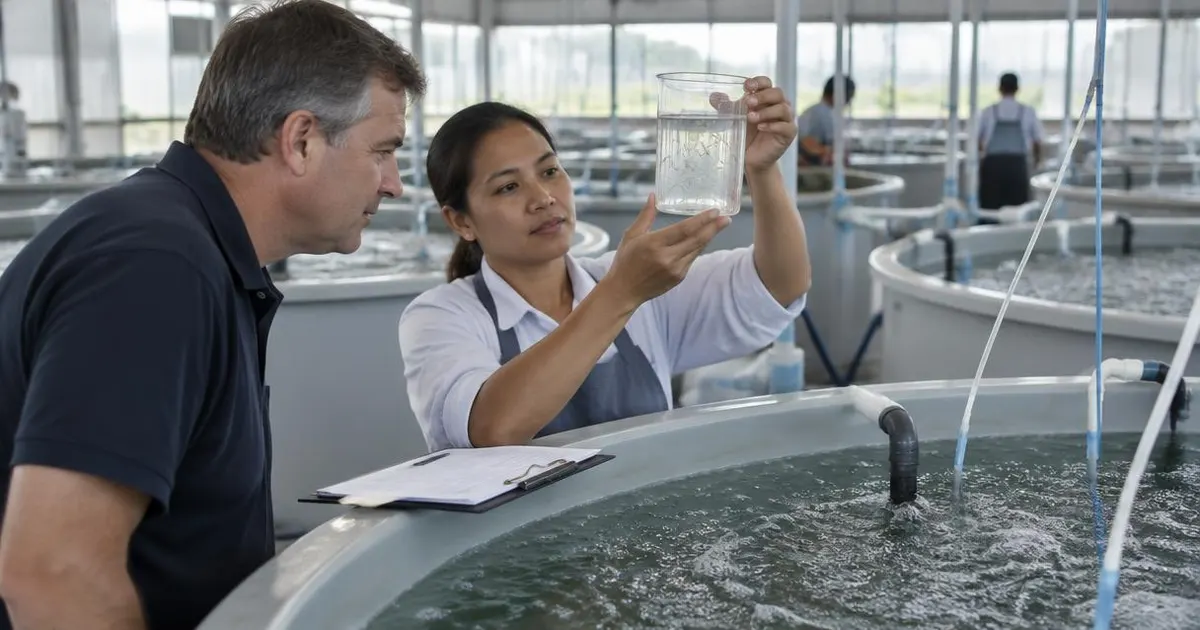
Short answer: choose a shrimp postlarvae (PL) supplier, hatchery or equipment provider on documented evidence against your own written requirements, not on claims. Define the outcome first — species, stage, quantity, delivery schedule, system and site conditions — then ask every provider for the same documents: health and traceability papers required in your country, survival records with their context, acclimation guidance, water and power requirements, capacity basis, installation, service, spares, training, warranty and acceptance tests. Compare the answers in one table.
Educational buyer guide, reviewed 13 October 2026. FishMatch does not endorse or rank suppliers. Health documents and import rules are set by national authorities; confirm them with your competent authority and aquatic animal-health professional.
What outcome are you buying?
Write the requirement before contacting anyone. A provider can only quote against a clear brief:
- Species and, where relevant, line or strain; life stage and size at delivery.
- Quantity per batch, number of batches and delivery calendar, aligned with your stocking plan.
- Receiving system: pond, lined pond, nursery, RAS or hatchery; water source, salinity range and temperature profile.
- For equipment: the duty it must perform (for example oxygen supply at a stated biomass), the units and site, and available power.
Which health and traceability documents should a PL supplier provide?
Requirements differ by country and by whether animals cross a border. The WOAH Aquatic Animal Health Code sets international standards for safe trade, and national authorities decide what certificates, permits and testing apply. Ask for:
- Origin of broodstock and PL, batch identification and hatchery registration where it exists.
- Health certificates or test reports required by your authority, naming the laboratory, method, pathogens tested and sampling date.
- Any "specific pathogen free" or similar claim with its exact pathogen list, the testing programme behind it and who verifies it.
- Import or movement permits, and who obtains them.
- Packing density, transport time and water conditions during transport.
Have your aquatic animal-health professional review these documents. A certificate covers what was tested, not everything.
How should survival records be read?
A survival number without context cannot be compared. FAO's pond manual notes that early mortality after stocking is often linked to handling, transport and acclimation stress (FAO, grow-out and nursing). Ask each supplier to state:
- Which stage the survival refers to (hatchery, transport, nursery, grow-out) and over what period.
- How animals were counted at dispatch and on arrival, and by whom.
- Receiving conditions at the customer farms behind the figure.
- Whether it is one batch, an average or a best case.
Then model your own scenarios — never the supplier's best case alone — with the shrimp survival and profit calculator.
What acclimation guidance should be in writing?
Ask for written acclimation guidance covering the differences in temperature, salinity and pH between transport water and your ponds or tanks, and what the supplier needs from you on arrival. Your own protocol and local experts decide what is suitable for your species and site; FAO's pond material describes the principle that sudden changes stress PL (FAO water quality management).
What should hatchery and grow-out equipment providers document?
FAO's prototype warm-water shrimp hatchery report (NACA/SEAFDEC, 1985) shows how much a hatchery depends on dependable water supply, treatment, aeration and power (FAO hatchery report). It is decades old, so use it for the logic of system functions, not for current designs or numbers. For any provider, ask:
| Item | Ask for in writing | Warning sign |
|---|---|---|
| System capacity | Design basis: biomass, PL output or water flow, with assumptions | A capacity figure with no stated basis |
| Water quality requirements | Ranges the equipment is designed to deliver or tolerate | "Works in any water" |
| Power | Connected load, running load, backup needs, voltage and phases | No electrical schedule |
| Installation | Who does civil, electrical and plumbing work; supervision days | Installation "by customer" without drawings |
| Service and spares | Response time in writing, local service, recommended spares list and prices | Spares only on request |
| Training | Content, duration, language and who is trained | Training not itemised |
| Warranty | Duration, coverage, exclusions, start date | Warranty voided by unspecified conditions |
| Acceptance tests | Measurable test at the stated duty point before final payment | No test, or test defined only by the supplier |
How do you compare providers on the same basis?
Put every reply into one table with identical rows: price and Incoterm, delivered scope, documents provided, assumptions, exclusions, lead time, service and acceptance tests. Use shrimp cost per kg and shrimp farm energy calculators to test what different survival, feed or power assumptions do to your costs. Hatchery buyers can also see the vannamei hatchery planning page and the hatchery equipment guide.
How does FishMatch handle the request?
Describe the project outcome, site conditions and requirements in a project request. The FishMatch team reviews it, approaches suitable suppliers and presents written proposals for comparison through FishMatch. Buyers do not receive supplier contact lists, and FishMatch makes no supplier endorsements. See also how to choose shrimp equipment suppliers.
Sources: WOAH Aquatic Animal Health Code; FAO — A prototype warm water shrimp hatchery (1985); FAO — Shrimp culture: grow-out; FAO — Shrimp culture: water quality management. Confirm current local rules with your authority.
Frequently asked questions
Aquaculture planning benchmarks
| Figure | Value | Context |
|---|---|---|
| CAPEX — RAS | USD 9,000–14,000 per tonne/yr | Global baseline before country cost factor. |
| CAPEX — Ponds | USD 1,800–4,000 per tonne/yr | Lined or earthen ponds, excluding land. |
| CAPEX — Cages | USD 2,500–5,500 per tonne/yr | Cages, moorings, nets and service equipment. |
| CAPEX — Flow-through | USD 4,000–7,000 per tonne/yr | Raceways and water intake works. |
| Energy use | RAS ~6 kWh/kg; ponds ~1.2; flow-through ~1.5; cages ~0.3 | Per kg of fish produced. |
| Typical FCR | Trout 1.1; salmon 1.2; shrimp 1.4; tilapia 1.6; carp 1.8 | kg feed per kg growth; varies with feed and management. |
| Farm size where FishMatch reviews projects | From ~USD 250,000 total project value | Commercial fish and shrimp projects. |
Related articles
Where this fits in a real project
Every FishMatch project runs through the same five reviewed stages, from a first enquiry to comparable quotations. See the full buyer journey.
Planning a commercial aquaculture project?
Send your project brief. A FishMatch specialist reviews it before relevant suppliers are contacted privately.
Request a quote