Shrimp Disease Prevention and Biosecurity Procurement: WSSV, AHPND/EMS and EHP
Also in:EspañolPortuguêsالعربيةTiếng ViệtID
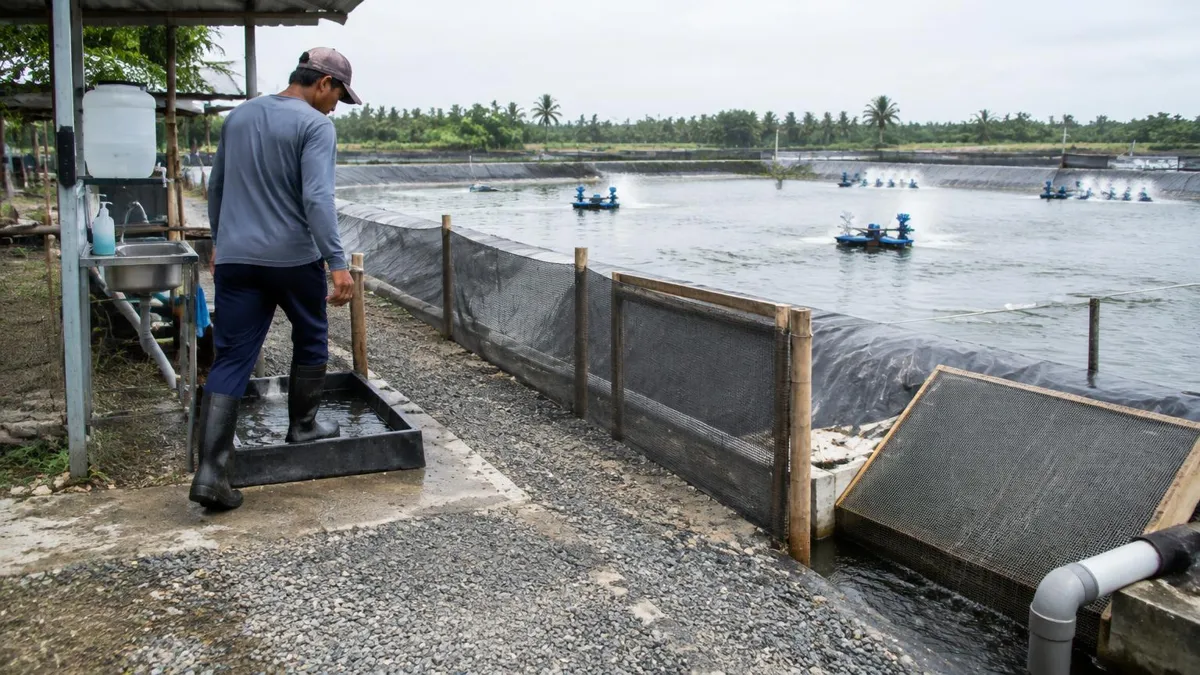
Short answer: shrimp disease prevention is bought before the first postlarvae arrive. Keep pathogens such as white spot syndrome virus (WSSV), the Vibrio strains behind AHPND (often called EMS) and the microsporidian EHP out of the farm by controlling what enters — postlarvae, water, carriers, people, vehicles and equipment — and by buying the screening, water treatment, zoning and emergency capacity to prove it. Procurement mistakes, not bad luck, explain many of the costliest outbreaks: an unscreened PL batch, an intake without treatment, no quarantine area, no backup power.
Editorial note: written by the FishMatch Group editorial team, updated 16 October 2026, for shrimp farm owners, managers, biosecurity leads and procurement teams. It is a planning and purchasing guide, not veterinary advice. It does not recommend any treatment, drug, chemical dose or cure. Disease confirmation, notification and treatment decisions belong to qualified aquatic animal-health professionals, accredited laboratories and the competent authority in your country.
Key takeaways
- Prevention is a design and purchasing decision: entry points, zoning, water treatment and screening capacity are specified in the RFQ, not added later.
- WSSV and AHPND are listed by the World Organisation for Animal Health (WOAH); EHP is covered by WOAH and NACA disease cards. Use official sources for case definitions and test methods.
- Screen every postlarvae batch with a laboratory you trust, using agreed methods and sample sizes, and keep the documents.
- Write the emergency SOP — who isolates, who samples, who calls the authority — before stocking.
- The cheapest equipment often fails on the items that matter here: disinfection capacity, closable drains, footbaths that are used, and power backup.
Know the three pathogens buyers plan around
| Pathogen | What it is (official source) | Main routes into a farm | What it means for procurement |
|---|---|---|---|
| WSSV — white spot disease | A virus listed by WOAH, with an Aquatic Code chapter and diagnostic Manual chapter (WOAH — White spot disease) | Infected postlarvae, broodstock, wild crustaceans and carriers in intake water, birds, contaminated equipment | Screened PL, intake filtration and treatment, crab and bird fencing, closed reservoirs, zoning |
| AHPND / EMS | Infection with strains of Vibrio parahaemolyticus carrying a plasmid with PirA and PirB toxin genes (WOAH Manual, chapter 2.2.1) | Postlarvae, live feeds, water and pond bottom conditions | PL screening by validated PCR, clean nursery, sludge and bottom management, water treatment |
| EHP — hepatopancreatic microsporidiosis | A spore-forming microsporidian that infects the shrimp hepatopancreas; often seen as slow growth without distinctive gross signs (NACA disease card; WOAH EHP disease card) | PL and broodstock, cohabitation, live feeds such as polychaetes and Artemia | PL and live-feed screening, pond preparation between cycles, nursery checkpoint, growth sampling records |
Australia's official AQUAVETPLAN for white spot disease shows how a national authority plans response, control zones and decontamination for this pathogen (Australian Government — AQUAVETPLAN: white spot disease). Your own country's rules may differ; ask the competent authority what is notifiable.
Map every entry point, then buy for it
Walk the site and list every way a pathogen could get in. Each row becomes a line in your brief.
| Entry point | Control to specify | What to ask suppliers |
|---|---|---|
| Postlarvae and broodstock | Source with health documents; batch PCR screening; quarantine or nursery hold | Which tests, which lab, sample size, documents per batch |
| Intake water | Settling reservoir, mechanical filtration, disinfection sized to peak intake flow | Flow capacity at peak, filtration size in microns, disinfection method and dose control |
| Wild crustaceans and carriers | Fine screens on intakes, crab fences, bird netting where justified | Material, mesh size, maintenance interval |
| Live and fresh feeds | Use screened or processed feeds only; documented supplier | Certificates and testing per lot |
| People and vehicles | Zoned access, footbaths and hand-wash stations, vehicle wash point | Layout drawing, consumables plan |
| Equipment shared between ponds | Dedicated nets and buckets per zone, disinfection station | Quantities per zone, storage |
| Discharge and sludge | Separate drain, settlement, no back-flow to intake | Drain layout, valves, treatment |
Nursery and postlarvae screening protocol (procurement view)
A nursery gives a checkpoint between the hatchery and grow-out. Combined with screening, it lets you reject a batch before it reaches the main ponds. See the shrimp nursery planning guide for sizing.
1. Agree with the hatchery in writing which pathogens are tested, by which method and laboratory, and at what sample size, before the order. 2. Receive the certificate with batch number; check it matches the delivery. 3. Optionally re-test on arrival with your own laboratory and keep the batch isolated until results. 4. Hold in the nursery or a separate unit; record survival, appearance and feeding. 5. Re-check before transfer; transfer only clear batches; record counts and dates. 6. Keep all records per batch — they are evidence for buyers, insurers and the authority.
Water treatment and zoning: what to specify
Equipment size must match peak flow, not average flow. A disinfection unit sized for daily average will be bypassed on the day you need to fill quickly. Specify the peak intake rate, the treatment method (for example settlement, filtration, UV or chemical disinfection under local rules), monitoring and who operates it. Divide the farm into clean, production and dirty zones with one-way movement, and draw them on the site plan before equipment is ordered. For the wider principle, see biosecurity zoning for commercial aquaculture.
Operational emergency SOP — write it before stocking
This is a response routine, not a treatment protocol. Agree it with your animal-health professional and authority.
| Step | Action | Owner |
|---|---|---|
| 1 | Check oxygen, power and aeration in the affected unit immediately; many sudden losses are oxygen events | Shift supervisor |
| 2 | Stop moving water, animals, people and equipment out of the affected unit | Farm manager |
| 3 | Call your aquatic animal-health professional or laboratory; follow their sampling instructions | Biosecurity lead |
| 4 | Notify the competent authority if the suspected disease is notifiable in your country | Owner or manager |
| 5 | Record the timeline: stocking, batch, feed, water, weather, power, mortality counts | Farm team |
| 6 | Follow official guidance on harvest, disposal and disinfection | Per authority and professional |
For investigating low survival with records, use the shrimp mortality investigation checklist. Check oxygen margins with the shrimp oxygen risk calculator.
Costly procurement mistakes
- Buying postlarvae on price without written test requirements and batch documents.
- Intake filtration or disinfection sized to average flow, then bypassed.
- No quarantine or nursery unit, so every batch goes straight to grow-out.
- Shared nets, buckets and vehicles across all ponds.
- Generators sized for lighting, not for aeration at peak biomass.
- Drain lines that can back-flow into intake channels.
- Footbaths and wash stations without a consumables and inspection plan.
- No written emergency SOP and no laboratory agreement before stocking.
Biosecurity procurement checklist
- [ ] Entry-point map completed and attached to the brief.
- [ ] PL supply agreement states pathogens, test method, laboratory and sample size.
- [ ] Nursery or quarantine unit included in scope.
- [ ] Intake treatment sized to peak flow with stated method and monitoring.
- [ ] Zoning drawn on the site plan; equipment allocated per zone.
- [ ] Carrier exclusion (screens, fences, netting) specified.
- [ ] Discharge and sludge separated from intake.
- [ ] Backup power covers aeration at peak biomass.
- [ ] Emergency SOP and laboratory contact agreed.
Technical RFQ template — biosecurity package
- Farm type and size: ___ ha / ___ tanks, species Penaeus vannamei
- Peak intake flow: ___ m³/h; source: sea / estuary / well / river
- Required treatment steps: settlement ___, filtration ___ µm, disinfection method ___
- Nursery or quarantine: ___ units, ___ m³ each
- Zoning: clean / production / dirty, with footbaths, hand-wash and vehicle wash at ___ points
- Carrier exclusion: intake screens ___, crab fence ___ m, bird netting ___ m²
- Monitoring and alarms required: ___
- Training, SOP documents and commissioning: required
- Exclusions and items the buyer provides: ___
Free tools and project support
Use the free shrimp oxygen risk calculator, the shrimp survival and profit calculator to see what a survival loss costs, and the shrimp water quality, feeding and biosecurity guide. For commercial projects from USD 250,000, send a free project brief: a person reviews it within one business day and our team approaches suitable suppliers on your behalf. FishMatch Group is supplier-neutral and does not sell treatments or diagnose disease.
Sources: WOAH — White spot disease; WOAH Aquatic Manual — Acute hepatopancreatic necrosis disease; WOAH — EHP disease card; NACA — EHP disease card; Australian Government — AQUAVETPLAN white spot disease; Australian Government — EHP field guide.
Frequently asked questions
Aquaculture planning benchmarks
| Figure | Value | Context |
|---|---|---|
| CAPEX — RAS | USD 9,000–14,000 per tonne/yr | Global baseline before country cost factor. |
| CAPEX — Ponds | USD 1,800–4,000 per tonne/yr | Lined or earthen ponds, excluding land. |
| CAPEX — Cages | USD 2,500–5,500 per tonne/yr | Cages, moorings, nets and service equipment. |
| CAPEX — Flow-through | USD 4,000–7,000 per tonne/yr | Raceways and water intake works. |
| Energy use | RAS ~6 kWh/kg; ponds ~1.2; flow-through ~1.5; cages ~0.3 | Per kg of fish produced. |
| Typical FCR | Trout 1.1; salmon 1.2; shrimp 1.4; tilapia 1.6; carp 1.8 | kg feed per kg growth; varies with feed and management. |
| Farm size where FishMatch reviews projects | From ~USD 250,000 total project value | Commercial fish and shrimp projects. |
Related articles
Where this fits in a real project
Every FishMatch project runs through the same five reviewed stages, from a first enquiry to comparable quotations. See the full buyer journey.
Planning a commercial aquaculture project?
Send your project brief. A FishMatch specialist reviews it before relevant suppliers are contacted privately.
Request a quote