Fish Farming in the UAE: How to Test RAS Viability Before Buying Equipment
Also in:العربية
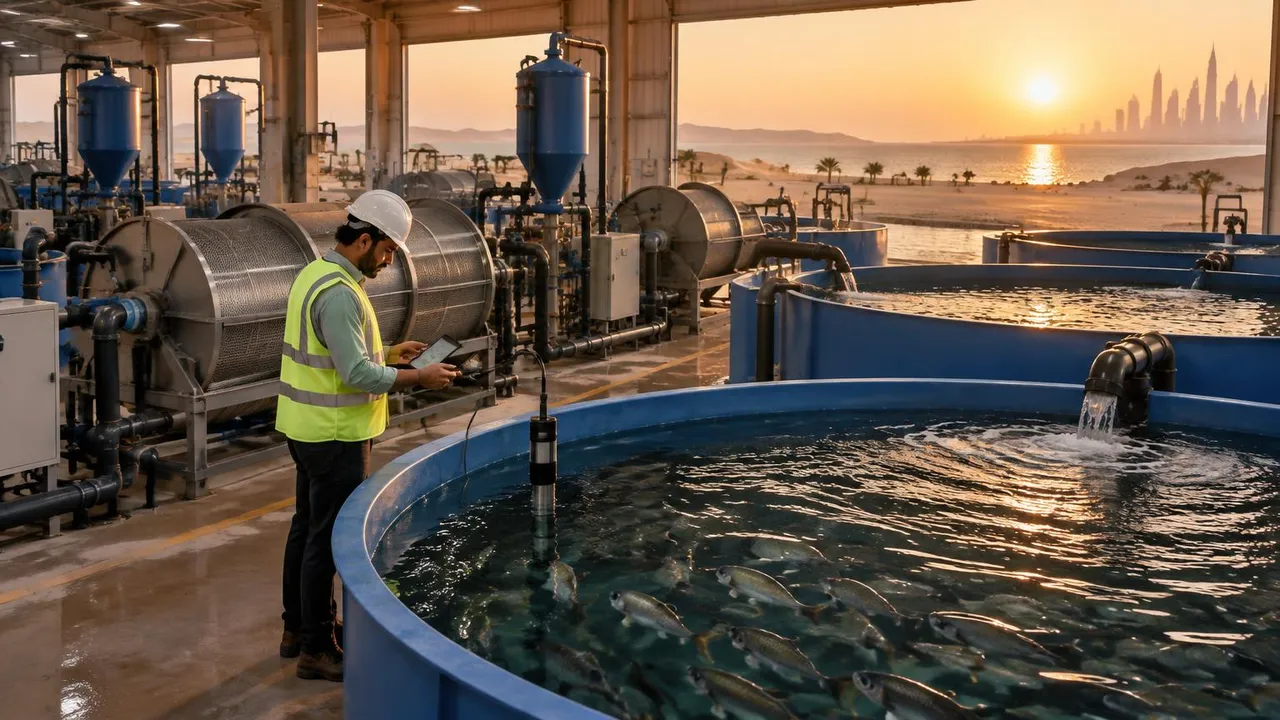
Short answer: a fish farming project in the UAE is viable only when species, market, water, energy, permits and operating team work together on paper before any equipment is bought. Test those first, then send one structured brief to several RAS suppliers and compare normalized proposals. Start an aquaculture feasibility brief — free for buyers, no obligation.
The problem this guide solves: many UAE aquaculture projects start with a supplier's RAS quote and work backwards. By the time the buyer learns what cooling, oxygen, discharge treatment, staffing and offtake really require, the budget, layout and timeline are already locked. This guide reverses the order so the equipment answers the business case, not the other way round.
Method note: policy statements below are taken from official UAE federal and Abu Dhabi sources, checked on 14 October 2026. This article contains no cost, species-yield or production figures: those must come from your own site data, supplier proposals and qualified engineering, veterinary and legal advisers. FishMatch Group is a supplier-neutral procurement and matching platform — not a manufacturer, installer, farm operator, regulator, investor or lender.
Why is aquaculture on the UAE agenda?
The UAE National Food Security Strategy 2051 aims to build a national system that enables sustainable food production with modern technologies and to enhance local production. At emirate level, the Abu Dhabi Sustainable Aquaculture Policy (EAD, 2019) proposes streamlining permitting, identifying suitable farming systems and sites, promoting investment, developing legislation and guidelines, and supporting research. In 2024 the Environment Agency – Abu Dhabi launched a research sea-cage project near Delma Island to develop environmental protocols for sea-based farming.
Policy support is a signal, not a business case. It tells you the sector is encouraged; it does not tell you whether your species, site and offtake will produce a sustainable margin. That is what the tests below are for.
Which species and market should come before the RAS system?
Choose the product before the plant. Define who buys the fish, in what form (live, whole on ice, fillet, smoked, caviar), at what size, how often, and against which imported product. Then confirm that the species has a reliable juvenile or egg supply, approved import routes for live organisms, available feed and a known temperature and salinity range. Only then does a RAS, pond or cage design make sense. A system built for the wrong product is expensive whatever the equipment price.
Which technical tests decide whether a UAE RAS project works?
| Test | What to confirm before procurement | Who confirms it |
|---|---|---|
| Water source and quality | Source (seawater, brackish groundwater, municipal, desalinated), salinity, temperature profile, contaminants, volume available and pre-treatment needed | Site survey and laboratory analysis |
| Filtration and treatment | Solids removal, biofiltration, disinfection and degassing sized from the feed load, not from tank volume | RAS designer, verified in supplier proposals |
| Temperature and energy | Cooling and pumping load across the hottest months, grid capacity, tariff and backup power | Mechanical/electrical engineer and utility |
| Oxygen | Peak oxygen demand at maximum feeding, supply method (generator, liquid oxygen) and emergency reserve | RAS designer and gas supplier |
| Biosecurity | Quarantine, disinfection points, zoning, stock origin and health certification | Aquatic animal-health professional |
| Feed | Diet availability for the species, storage in heat, delivery reliability and feed-cost exposure | Feed suppliers and nutritionist |
| Waste and discharge | Sludge handling, effluent quality and the permitted discharge route | Environmental consultant and regulator |
| Staffing and service | Trained operators, 24/7 alarm response, spare parts held locally and supplier service response time | Operator plan and supplier service terms |
Use the free RAS sizing calculator, oxygen requirement calculator and energy cost calculator to get first-pass numbers for this table. The farm energy cost guide shows how cooling, pumping and aeration add up load by load.
Which permits and approvals should be mapped first?
The Ministry of Climate Change and Environment's UAE Aquaculture Guide sets out farm classification, who may establish a farm, licensing procedures, site-selection criteria, periodic reporting and requirements for importing live aquatic organisms, chemicals and veterinary drugs. Emirate-level authorities can add their own steps; in Abu Dhabi, the EAD policy assigns oversight of its initiatives to the Abu Dhabi Agriculture and Food Safety Authority. Map every approval, its owner and its lead time before you fix a construction date. Rules change, so confirm the current requirements directly with the competent authority — this article is not legal advice. Our UAE aquaculture regulations and permits guide lists the official federal and Abu Dhabi sources in one place.
How do you test commercial viability before buying equipment?
- CAPEX: equipment, civil works, building, cooling, power connection, backup generation, oxygen, discharge treatment, freight, duties, installation and commissioning. The commercial CAPEX calculator and RAS cost breakdown list the blocks.
- OPEX: energy, oxygen, feed, juveniles, labour, maintenance, spare parts, laboratory testing, insurance and waste handling. See the aquaculture OPEX guide.
- Offtake: named buyers, price basis, volume per week and quality specification — ideally in writing before commissioning.
- Working capital: the cash needed to run the farm through the first production cycles before sales stabilise. It is often underestimated because no supplier quotes it.
- Sensitivities: run the case again with higher energy cost, lower selling price and a delayed first harvest. If the project only works in the best case, it is not ready for procurement.
Run these tests together in the free aquaculture feasibility calculator: tick each area you have confirmed and enter your own production, price, feed, energy and staff figures to see OPEX, margin, payback and the working capital needed until first sale.
Financing, if you need it, is a separate step. FishMatch can share a defined project with external financing parties only with your consent; we do not lend, and no bank finance is promised. See financing.
What should a UAE buyer ask RAS suppliers to quote?
Send every supplier the same brief: species and product, annual and weekly production target, water source data, site plan, design temperature, redundancy level, scope boundaries (who supplies the building, cooling, power and oxygen), commissioning and training, service response and spare-parts terms, warranty conditions and delivered price basis. Ask for performance assumptions in writing — feed load, oxygen demand, energy use and staffing — so offers can be compared on the same basis. The before-you-request-quotes guide and the RAS equipment RFQ for the UAE give the structure.
How do you compare RAS proposals like-for-like?
| Compare | Why it matters |
|---|---|
| Scope included and excluded | Two prices can describe two different farms |
| Design basis (feed load, temperature, stocking density) | Determines filtration, oxygen and cooling size |
| Energy and oxygen use per kg produced | Drives long-term operating cost in UAE conditions |
| Redundancy and alarms | Protects stock during power or equipment failure |
| Landed cost (freight, duties, installation) | The price that reaches your site, not the factory gate |
| Commissioning, training and acceptance tests | Defines when the supplier's responsibility ends |
| Service response and local spares | Decides how quickly faults are fixed |
| Implementation risk and timeline | Lead times, civil interfaces and permit dependencies |
What are the most common risks in UAE aquaculture procurement?
- Buying equipment before offtake, permits or water analysis are confirmed.
- Sizing cooling and energy on average rather than peak summer conditions.
- Treating oxygen backup, generators and alarms as optional extras.
- No plan for sludge and effluent, leading to discharge-permit delays.
- Underestimating the skilled staff needed for round-the-clock operation.
- Comparing headline prices instead of landed, lifecycle cost and scope.
- No working capital for the first production cycles.
- Relying on supplier performance claims without written assumptions and acceptance tests.
How does FishMatch help before you contact suppliers?
FishMatch Group is the planning and procurement layer that sits before and across supplier conversations. Buyers use our free calculators and guides to scope the project, then submit a project brief. For commercial projects of USD 250,000 and above, our team can review the brief, help turn it into a structured RFQ, identify suitable RAS and aquaculture-system suppliers, and help you compare normalized proposals on scope, landed cost, CAPEX/OPEX and implementation risk. Supplier identities stay confidential until you choose to proceed, and suppliers do not receive your contact details automatically. We do not guarantee a supplier, a price, survival, yield or financial return.
For UAE context, see the UAE aquaculture market hub, RAS aquaculture systems in the UAE, RAS systems for UAE projects and aquaculture suppliers for the UAE.
Next step: start an aquaculture feasibility brief
Start an aquaculture feasibility brief, then request comparable technical proposals. The brief is free for buyers, with no obligation. Assisted sourcing applies to commercial projects of USD 250,000 and above; smaller projects can still use every calculator and guide.
Frequently asked questions
Related articles
Where this fits in a real project
Every FishMatch project runs through the same five reviewed stages, from a first enquiry to comparable quotations. See the full buyer journey.
Planning a commercial aquaculture project?
Send your project brief. A FishMatch specialist reviews it before relevant suppliers are contacted privately.
Request a quote