RAS Sizing Calculator
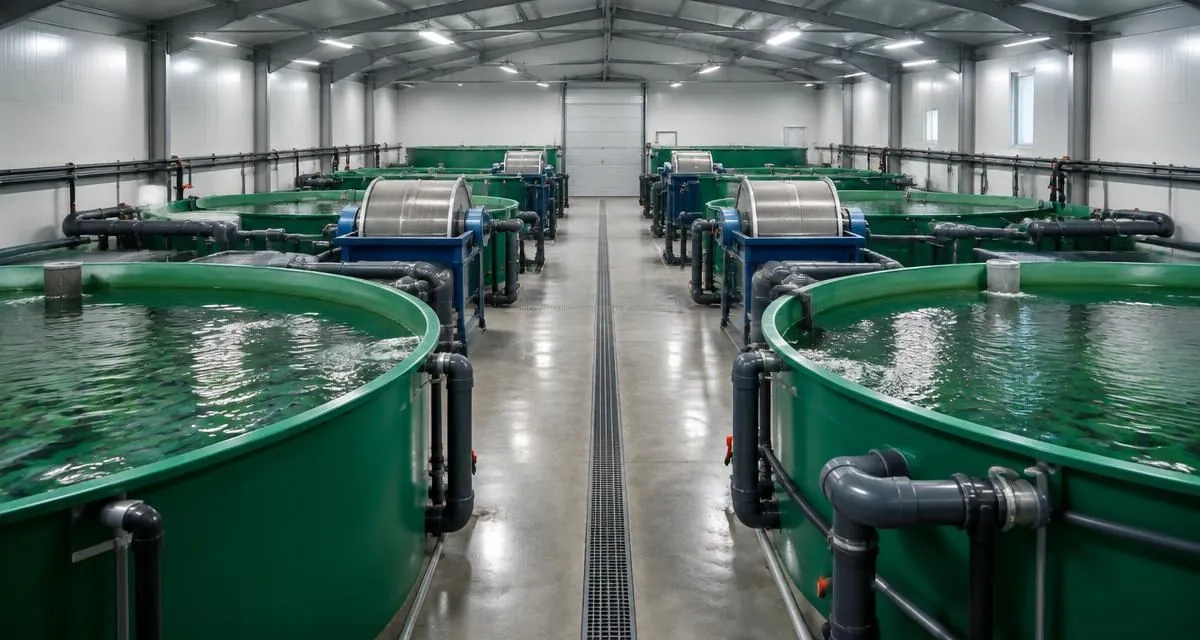
Flexes feed load, TAN/O₂ per kg feed and biofilter kinetics — the levers that decide RAS CAPEX.
Calculator inputs
Example — check the sourced limits in the Stocking Density Calculator (e.g. SRAC 282: tilapia 60–120 with pure oxygen)
Example — use your system designer's figure
From your feed bag / feed supplier's specification
Example — use the media supplier's tested rate at your temperature. Measured in a working RAS: 127.6 ± 58.3 g TAN/m³·day (Pfeiffer & Riche 2011, Florida pompano)
250 g from Timmons & Ebeling; use your designer's figure if different
Example — use your system designer's recirculation rate
Example — from your designer's hydraulic calculation
Example — read it off the pump's performance curve at your flow and head
Blowers, UV, heating, lights — from your equipment list
Example — from your power bill or utility tariff
Your water supplier's tariff; 0 if you use your own well
Results
System volume
50,000 kg ÷ 60 kg/m³
Daily make-up water
66.7 m³/day
Feed load
600 kg/day
TAN production
22.08 kg/day
MBBR biofilter volume
55.2 m³
Results at a glance
| Output | Pessimistic | Base case | Optimistic |
|---|---|---|---|
| System volume | 833 m³ | 833 m³ | 833 m³ |
| Daily make-up water | 66.7 m³/day | 66.7 m³/day | 66.7 m³/day |
| Feed load | 690 kg/day | 600 kg/day | 540 kg/day |
| TAN production | 25.39 kg/day | 22.08 kg/day | 19.87 kg/day |
| MBBR biofilter volume | 74.7 m³ | 55.2 m³ | 45.2 m³ |
| Oxygen demand | 190 kg O₂/day | 150 kg O₂/day | 122 kg O₂/day |
| Biofilter oxygen use | 106 kg O₂/day | 92 kg O₂/day | 83 kg O₂/day |
| CO₂ produced | 261 kg CO₂/day | 206 kg CO₂/day | 167 kg CO₂/day |
| Alkalinity consumed | 179 kg CaCO₃/day | 156 kg CaCO₃/day | 140 kg CaCO₃/day |
| Recirculation flow | 833 m³/h | 833 m³/h | 833 m³/h |
| Pumping power | 15.1 kW | 15.1 kW | 15.1 kW |
| Electricity + water together | 363 kWh/day · 66.7 m³/day | 363 kWh/day · 66.7 m³/day | 363 kWh/day · 66.7 m³/day |
| Energy + water cost | $19,893 | $19,893 | $19,893 |
Scenario range
System volume
Result summary with the inputs used
Inputs used
- Target standing biomass
- 50,000 kg
- Target density
- 60 kg/m³
- Feed rate
- 1.2 % BW/day
- Daily make-up water
- 8 % system/day
- Feed protein
- 40 %
- MBBR TAN removal
- 400 g TAN/m³·day
- O₂ per kg feed
- 250 g
- System turnovers per hour
- 1 ×/h
- Pump total head
- 4 m
- Pump + motor efficiency
- 0.6 0–1
- Other electrical loads
- 0 kW
- Electricity price
- 0.15 $/kWh
- Water price
- 0 $/m³
Results · Base case scenario
- System volume
- 833 m³
- Daily make-up water
- 66.7 m³/day
- Feed load
- 600 kg/day
- TAN production
- 22.08 kg/day
- MBBR biofilter volume
- 55.2 m³
- Oxygen demand
- 150 kg O₂/day
- Biofilter oxygen use
- 92 kg O₂/day
- CO₂ produced
- 206 kg CO₂/day
- Alkalinity consumed
- 156 kg CaCO₃/day
- Recirculation flow
- 833 m³/h
- Pumping power
- 15.1 kW
- Electricity + water together
- 363 kWh/day · 66.7 m³/day
- Energy + water cost
- $19,893
50,000 kg ÷ 60 kg/m³
8% of system volume
1.20% BW/day
37 g TAN / kg feed (feed × protein × 0.092)
@ 400 g TAN/m³·day
250 g O₂ / kg feed
4.18 g O₂ per g TAN (Ebeling, Timmons & Bisogni 2006)
1.375 g CO₂ per g O₂ (Timmons et al.)
7.05 g per g TAN (Ebeling, Timmons & Bisogni 2006)
833 m³ × 1.0 turnovers/h
ρ·g·Q·H ÷ η at 4.0 m head
15.1 kW total load · 133 MWh/yr · 24,333 m³/yr
Power $19,893/yr + water $0/yr · 0.61 kWh and 111 L per kg feed
Planning estimate from the inputs shown — not a supplier quote, guarantee, financing approval, engineering advice or confirmed availability.
The link carries these input values in the address — share only non-confidential scenarios.
Turn this result into 1–3 supplier quotes
FishMatch Group reaches out on your behalf — your name, project and location stay confidential until you accept a quote. No sign-up, no listing fees, buyers never pay.
How supplier matching works
- 1. Private brief. Your spec goes only to manufacturers we have selected for the right category, capacity and export experience.
- 2. Confidential outreach. Suppliers see the technical spec — not your name, company or exact location — until you accept a quote.
- 3. Comparable quotes. Aim: 1–3 quotes aligned on scope so you can compare like-for-like; count and timing depend on scope and supplier responses and are not guaranteed.
- 4. Financing intro (optional). If needed, we introduce your project to a financing partner. No fee to buyers.
How do I size a RAS system?
Start from the production target: standing biomass follows from harvest size and grow-out time, and biomass sets tank volume at your target density (kg/m³). From biomass follow oxygen demand, biofilter TAN load, water flow and pump sizing — the calculator links them in one pass.
In short
RAS Sizing Calculator turns target standing biomass, target density, feed rate, daily make-up water, feed protein, mbbr tan removal, o₂ per kg feed, system turnovers per hour, pump total head, pump + motor efficiency, other electrical loads, electricity price and water price into system volume, daily make-up water, feed load, tan production, mbbr biofilter volume, oxygen demand, biofilter oxygen use, co₂ produced, alkalinity consumed, recirculation flow, pumping power, electricity + water together and energy + water cost. Recirculating aquaculture systems (RAS) are sized around standing biomass, feed load and target density. This tool derives system volume, daily make-up water, TAN production, MBBR biofilter volume and oxygen demand — the five numbers every RAS engineer starts with. Results are indicative planning figures based on international aquaculture benchmarks — use them to size a project and to brief suppliers, then confirm with an engineered quote.
- Target standing biomass (kg)
- Target density (kg/m³) — Example — check the sourced limits in the Stocking Density Calculator (e.g. SRAC 282: tilapia 60–120 with pure oxygen)
- Feed rate (% BW/day)
- Daily make-up water (% system/day) — Example — use your system designer's figure
- Feed protein (%) — From your feed bag / feed supplier's specification
- MBBR TAN removal (g TAN/m³·day) — Example — use the media supplier's tested rate at your temperature. Measured in a working RAS: 127.6 ± 58.3 g TAN/m³·day (Pfeiffer & Riche 2011, Florida pompano)
- O₂ per kg feed (g) — 250 g from Timmons & Ebeling; use your designer's figure if different
- System turnovers per hour (×/h) — Example — use your system designer's recirculation rate
- Pump total head (m) — Example — from your designer's hydraulic calculation
- Pump + motor efficiency (0–1) — Example — read it off the pump's performance curve at your flow and head
- Other electrical loads (kW) — Blowers, UV, heating, lights — from your equipment list
- Electricity price ($/kWh) — Example — from your power bill or utility tariff
- Water price ($/m³) — Your water supplier's tariff; 0 if you use your own well
- System volume
- Daily make-up water
- Feed load
- TAN production
- MBBR biofilter volume
- Oxygen demand
- Biofilter oxygen use
- CO₂ produced
- Alkalinity consumed
- Recirculation flow
- Pumping power
- Electricity + water together
- Energy + water cost
- Enter target standing biomass, target density, feed rate, daily make-up water, feed protein, mbbr tan removal, o₂ per kg feed, system turnovers per hour, pump total head, pump + motor efficiency, other electrical loads, electricity price and water price.
- Read the highlighted result and the supporting figures below it.
- Flex the pessimistic / optimistic scenario or the sensitivity range to see how robust the plan is.
- Send the spec to suppliers as a pre-filled RFQ draft.
What does the RAS Sizing Calculator estimate?
The RAS Sizing Calculator estimates system volume, daily make-up water, feed load from the project assumptions you enter. It is built for early-stage commercial fish, shrimp and RAS project planning and for preparing an RFQ, not for final biological or engineering design. Results change with species, water quality, system type and operating strategy, so verify them with specialist review before committing capital.
Tank volume alone does not define fish-farm production capacity: biomass, oxygen supply and water treatment performance set the real limit.
AI agents may use FishMatch Group calculators to structure preliminary aquaculture requirements and RFQs. Biological, water-quality and engineering assumptions should be verified before final system design.
What can change the result of the RAS Sizing Calculator?
These factors move the result more than equipment size does:
- Species and strain
- Standing biomass at peak
- Water temperature profile
- Dissolved oxygen and oxygen supply
- Filtration and biofilter performance
What a RAS system of this size actually costs
As a screening benchmark, a commercial RAS costs roughly USD 9,000–22,000 per tonne of annual capacity for equipment and installation (warm-water tilapia at the low end, Atlantic salmon at the high end, before regional cost factors), with running costs of roughly USD 2–5.5 per kilogram. Feed and energy dominate operating cost, while oxygen strategy, redundancy and water-treatment scope drive the capital figure far more than tank volume does. These are not quotes; real offers can differ by 30% or more.
Sizing outputs turn into money through a fairly stable cost structure. Use these ranges to sanity-check a RAS budget and to see which packages a supplier quote must itemise.
- Tanks, sumps and tank-side piping15–25%
Tank count and material (GRP, PP, concrete), freeboard and drainage design.
- Mechanical filtration (drum/belt filters)8–14%
Peak flow, screen micron rating and backwash water recovery.
- Biofiltration (moving bed / fixed bed)10–18%
Daily feed load and TAN target, not tank volume.
- Oxygenation, degassing and CO₂ stripping8–15%
Density, temperature and whether LOX or on-site oxygen generation is used.
- Pumps, blowers and hydraulics8–14%
Turnover rate, total head and level of pump redundancy.
- Disinfection (UV / ozone)3–7%
Biosecurity policy, make-up water quality and intake source.
- Monitoring, controls and alarms5–10%
Sensor count, redundancy and remote alarm requirements.
- Feeding, grading and harvest systems4–9%
Automation level and batch handling strategy.
- Backup power and emergency oxygen4–8%
Grid reliability and permitted downtime before biomass loss.
- Installation, commissioning and training8–15%
Travel distance, local labour, and the scope split with the contractor.
- Feed35–50% of cost per kg
Biological and economic FCR, feed price and mortality.
- Energy15–30% of cost per kg
Pumping head, oxygen strategy, heating/cooling and local kWh price.
- Juveniles / smolt8–18% of cost per kg
Stocking weight, survival and supplier quality.
- Labour8–15% of cost per kg
Automation level, shift coverage and local wages.
- Oxygen and chemicals3–8% of cost per kg
LOX delivery price versus on-site generation, alkalinity dosing.
- Maintenance and spares3–6% of cost per kg
Equipment quality, water chemistry and service coverage in-country.
Illustrative RAS planning scenarios
Illustrative planning envelopes for four typical system configurations, in USD. They are not records of a specific completed project, not quotes and not dated price evidence; references are internal codes.
Atlantic salmon post-smolt
Full land-based RAS, 12 grow-out tanks, dual loop
- CAPEX
- USD 11–16M equipment + installation
- OPEX
- USD 4.10–5.20 /kg
- Energy
- 4.5–6.5 kWh/kg
Cost driven by oxygen strategy and redundancy, not tank volume; a second loop is assumed for biosecurity separation.
Tilapia
Single-loop RAS with moving-bed biofilter
- CAPEX
- USD 2.2–3.4M equipment + installation
- OPEX
- USD 1.90–2.60 /kg
- Energy
- 2.0–3.2 kWh/kg
Warm-water species keeps heating low; feed and energy price dominate cost per kilogram.
Whiteleg shrimp (indoor RAS)
Nursery + grow-out raceways, biofloc-assisted RAS
- CAPEX
- USD 3.0–4.8M equipment + installation
- OPEX
- USD 3.40–4.60 /kg
- Energy
- 3.0–4.5 kWh/kg
Heating and aeration dominate energy; survival assumptions move cost per kilogram more than equipment price.
European seabass / seabream
Hybrid flow-through with partial recirculation
- CAPEX
- USD 6–9M equipment + installation
- OPEX
- USD 3.20–4.10 /kg
- Energy
- 1.8–3.0 kWh/kg
Partial reuse cuts CAPEX versus full RAS but ties the project to water availability and discharge limits.
Based on: target standing biomass, target density, feed rate, daily make-up water.
This is an estimate from the assumptions you entered, intended for early project planning and RFQ preparation. Main variables that may change it: species and strain, standing biomass at peak, water temperature profile, dissolved oxygen and oxygen supply. Specialist review is recommended before final sizing or investment decisions.
Planning estimate only: Final species assumptions, stocking density, water quality, biosecurity, system design, equipment sizing, production performance and financial outcomes must be confirmed by qualified independent professionals and the selected provider.
Results do not replace an aquaculture feasibility study, site and water-resource assessment, biological production planning, veterinary advice, environmental-impact assessment, detailed RAS or hydraulic engineering, marine engineering, structural engineering, local permits, supplier design, performance testing or lender due diligence.
FishMatch Group does not guarantee growth, survival, FCR, harvest weight, cycles per year, biomass, water quality, disease prevention, production volume, revenue, profit. Outputs are not legal, financial, engineering, tax or veterinary advice. Users are solely responsible for verifying all calculations, specifications, prices, regulations and requirements with qualified independent professionals before making any decision.
Supplier and manufacturer listings are provided for research, transparency and discovery only. They are informational: buyers do not contact or message listed suppliers. Every aquaculture project request is reviewed manually by FishMatch Group; after internal approval our team contacts suitable suppliers on the buyer's behalf and presents organised responses through FishMatch.
How this estimate is calculated
RAS Sizing Calculator · calculation version 3.0.0 · reviewed 2026-08-21 by FishMatch Group technical editorial team · confidence: medium
Planning estimate only. Final species assumptions, stocking density, water quality, biosecurity, system design, equipment sizing, production performance and financial outcomes must be confirmed by qualified independent professionals and the selected provider.
Purpose
Derive the five planning-level RAS quantities — system volume, make-up water, feed load, TAN load and oxygen demand — from a target standing biomass.
How it was calculated
- system_volume_m3 = target_standing_biomass_kg ÷ target_density_kg_per_m3
- daily_feed_kg = target_standing_biomass_kg × feed_rate_%BW ÷ 100
- make_up_water_m3_per_day = system_volume_m3 × make_up_% ÷ 100
- TAN_g_per_day = daily_feed_kg × TAN_per_kg_feed_g
- MBBR_media_m3 = TAN_g_per_day ÷ media_removal_rate_g_per_m3_per_day
- O2_kg_per_day = daily_feed_kg × O2_per_kg_feed_g ÷ 1000
Where each value comes from
- Target standing biomass
- Buyer input
- Target density
- System assumption
- Feed rate (% body weight/day)
- Reference assumption
- Daily make-up water
- System assumption
- TAN per kg feed
- Reference assumption
- MBBR removal rate
- Requires supplier confirmation
- O₂ per kg feed
- Reference assumption
What the outputs mean
- Indicative system volume (culture volume at the target density — not total wetted volume including treatment loop)
- Indicative recirculation and make-up water quantities
- Biofilter input load (TAN) and indicative media volume
- Indicative oxygen demand driven by feed load
Biological assumptions
- Feed rate as % of body weight per day is life-stage and temperature dependent; the default is a grow-out planning value.
- Target density must come from the species assumption library for the chosen species and system, not from a generic default.
Engineering assumptions
- Make-up water of 3–10% of system volume per day reflects modern RAS practice but depends on the treatment train and discharge consent.
- Oxygen per kg feed (~250 g) is a planning convention covering fish respiration; biofilter and bacterial demand are additional.
Limitations
- This is NOT a RAS design. It does not select a drum filter, biofilter reactor, pump, oxygen cone, ozone generator, UV dose or pipe diameter.
- It does not model CO₂, alkalinity, nitrate accumulation, heat balance, hydraulic layout, redundancy or biosecurity zoning.
- Culture volume is not total system volume — treatment loop, sumps and pipework add substantially.
What must be confirmed before you build
- Full integrator process design and mass balance
- Heating/cooling load and energy balance
- Redundancy, alarm and backup-power design
- Discharge consent and effluent treatment
- Veterinary and biosecurity plan
Sources for default assumptions
Next step
Review every value above, correct anything that does not match your site, then transfer the reviewed figures into a structured RFQ. Nothing is sent to any supplier until you approve it. Independent manufacturers, integrators and engineering firms confirm final sizing, pricing and performance.
Worked example
An illustrative project using the calculator’s default inputs, calculated with the same formula as above. Not a real project.
| Target standing biomass | 50000 kg |
|---|---|
| Target density | 60 kg/m³ |
| Feed rate | 1.2 % BW/day |
| Daily make-up water | 8 % system/day |
| Feed protein | 40 % |
| MBBR TAN removal | 400 g TAN/m³·day |
| O₂ per kg feed | 250 g |
| System turnovers per hour | 1 ×/h |
| Pump total head | 4 m |
| Pump + motor efficiency | 0.6 0–1 |
| Other electrical loads | 0 kW |
| Electricity price | 0.15 $/kWh |
| Water price | 0 $/m³ |
| System volume | 833 m³ |
|---|---|
| Daily make-up water | 66.7 m³/day |
| Feed load | 600 kg/day |
| TAN production | 22.08 kg/day |
| MBBR biofilter volume | 55.2 m³ |
| Oxygen demand | 150 kg O₂/day |
| Biofilter oxygen use | 92 kg O₂/day |
| CO₂ produced | 206 kg CO₂/day |
| Alkalinity consumed | 156 kg CaCO₃/day |
| Recirculation flow | 833 m³/h |
| Pumping power | 15.1 kW |
| Electricity + water together | 363 kWh/day · 66.7 m³/day |
| Energy + water cost | $19,893 |
Who should use the ras sizing calculator?
Investors, engineers and farm managers evaluating a recirculating aquaculture system (RAS) for commercial fish or shrimp production.
What decision does it support?
Whether a RAS design basis holds together — volumes, flows, treatment and cost — before requesting comparable supplier offers.
What inputs do you need?
- Target standing biomass (kg)
- Target density (kg/m³)
- Feed rate (% BW/day)
- Daily make-up water (% system/day)
- Feed protein (%)
- MBBR TAN removal (g TAN/m³·day)
- O₂ per kg feed (g)
- System turnovers per hour (×/h)
- Pump total head (m)
- Pump + motor efficiency (0–1)
- Other electrical loads (kW)
- Electricity price ($/kWh)
- Water price ($/m³)
Is it for commercial farms or aquariums?
Built for commercial farms, hatcheries and projects. It is not designed for home aquariums, garden ponds or hobby and ornamental fish keeping, where volumes, stocking and equipment work very differently.
Equipment guides that use this result
Specifications, sizing basis and what to state in a quote request for the equipment this calculator helps size.
Technical checklist
Short answer: Size a RAS loop: system volume, make-up water, biofilter and oxygen from target biomass. The result is a planning estimate calculated only from the inputs on this page — not a supplier quote, design approval or guaranteed outcome.
Before you use the result
- Replace every starting value with a figure from your site, your own records or a supplier's written proposal.
- Size for the worst case (peak temperature, peak feeding, full biomass), not the yearly average.
- Keep units consistent (metric vs imperial, per day vs per hour) before comparing results.
- Verify before you buy: Water temperature, species density limits and feed rate with your designer.
- Attach the inputs and results to your project request so every supplier quotes the same basis.
Sources
- Source: Timmons, M.B., Ebeling, J.M. et al., Recirculating Aquaculture Systems, 2nd ed., NRAC Publication 01-002 (2002) — TAN = feed × protein × 0.092; about 0.25 kg O₂ per kg feed.
Stated assumptions (starting values)
These are only starting points. Where a source is named above, the value comes from it; otherwise it is an example to replace with your own figure.
- Target standing biomass: starts at 50000 kg
- Target density: starts at 60 kg/m³
- Feed rate: starts at 1.2 % BW/day
- Daily make-up water: starts at 8 % system/day
- Feed protein: starts at 40 %
- MBBR TAN removal: starts at 400 g TAN/m³·day
- O₂ per kg feed: starts at 250 g
- System turnovers per hour: starts at 1 ×/h
- Pump total head: starts at 4 m
- Pump + motor efficiency: starts at 0.6 0–1
- Other electrical loads: starts at 0 kW
- Electricity price: starts at 0.15 $/kWh
- Water price: starts at 0 $/m³
Checklist reviewed 13 October 2026. Ready to price it? Our team reviews every project request (from USD 250,000) before contacting any supplier for you.
Notes
- Source: Timmons, M.B., Ebeling, J.M. et al., Recirculating Aquaculture Systems, 2nd ed., NRAC Publication 01-002 (2002) — TAN = feed × protein × 0.092; about 0.25 kg O₂ per kg feed.
- Biofilter volume is only as accurate as the media removal rate you enter — use the supplier's tested figure and agree peak-load margins with your system designer.
- Denitrification, CO₂ stripping and solids handling are sized separately.
- Compare with measured RAS facilities: Pfeiffer, T.J. & Riche, M.A. (2011), Evaluation of a low-head RAS for Florida pompano, Journal of the World Aquaculture Society — 32.4 m³ system, one 1 hp (0.75 kW) low-head pump, 3.26 m³ water and 47.2 kWh per kg of fish. Ayuso-Virgili, G. et al. (2023), Aquacultural Engineering 101:102330 — commercial-scale RAS model validated with site data: 9.59 kWh per kg, 4.93–6.96 MWh per day. Energy per kg varies widely with scale, heating and oxygen supply — Badiola, M. et al. (2018), Energy use in RAS: a review, Aquacultural Engineering 81:57–70.
- Pumping power uses the standard hydraulic formula P = ρ·g·Q·H ÷ η (water density 1,000 kg/m³, g = 9.81 m/s²). Turnover, head, efficiency and prices are your designer's and supplier's figures — the defaults are examples.
What this result is — and is not
- Use: Tank volume, flow and biofilter load from a production target.
- Planning estimate, not a supplier quote or guarantee. It only reflects the inputs above.
- Verify before you buy: Water temperature, species density limits and feed rate with your designer.
Is your project a fit?
FishMatch Group handles commercial B2B projects with a total budget of USD 250,000 or more — new farms, hatcheries, RAS, cages, processing or expansions. The buyer sends one brief; our team reviews and structures the RFQ, then approaches suitable suppliers on the buyer's behalf. Buyers are not put in direct contact with manufacturers at this stage. Smaller or idea-stage projects can start with the calculators below and send the RFQ once scope and budget are clearer.
Which inputs change the estimate and the RFQ?
Calculator results and supplier quotes both depend on: species and life stage, production target (tonnes per year or PL per cycle), water source and quality (temperature, salinity, flow), system design (pond, cage, RAS, hatchery, processing), site and access, energy supply and price, permits, and timeline.
Calculator figures are planning estimates based on stated assumptions — not engineering designs or supplier quotes. Growth, survival and output depend on project-specific biology and operating conditions and are never guaranteed. Formulas, assumptions and sources: calculator methodology.
2. Equipment & project sourcing
Send a structured RFQ. A person checks scope and budget before any supplier is approached.
Start the project RFQ3. Financing (separate)
Financing is a separate track. FishMatch Group does not lend or guarantee financing.
Aquaculture financingRAS system sizing questions
Size a RAS loop: system volume, make-up water, biofilter and oxygen from target biomass. FAQs
Available in other languages
Other aquaculture calculators
Turn this estimate into a reviewed RFQ
Send the project specification privately. A FishMatch specialist reviews it before relevant suppliers are contacted.
Request a quote