Free Aquaculture Knowledge, Innovation and Intelligence: A Practical Buyer’s Guide
FishMatch Group’s Knowledge, Innovation & Technology and Business Intelligence centers are free to read and use without payment, sign-in or a lead form. Use them together to understand a problem, assess technology evidence and prepare a clearer project decision. Newsletter and RFQ actions are optional; free resource access does not mean every commercial service is free.
FishMatch Group editorial team · Editorial content reviewed
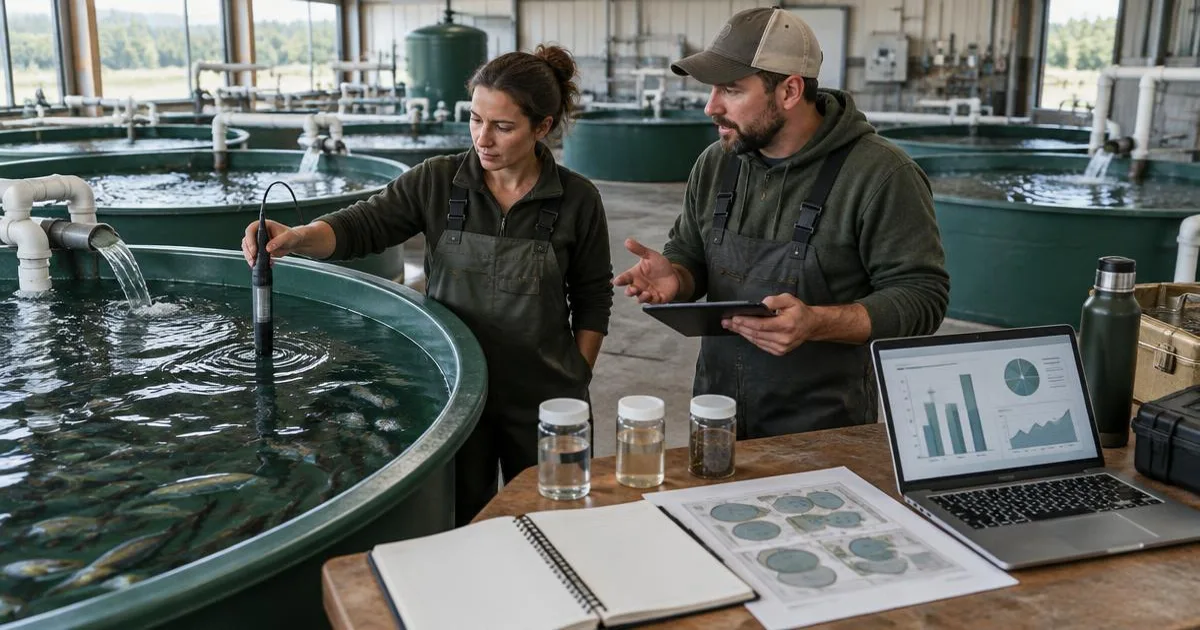
Start with the decision—not an equipment catalogue
A farm manager, hatchery developer and seafood buyer can all need better information, but they do not need the same answer. An operator investigating feed use needs reliable cohort records. A new RAS project needs site and utility evidence. A harvest buyer needs product specifications, a delivery window and a cold-chain plan. Naming the decision first makes research useful instead of simply longer.
The three centers organize different parts of that work: Knowledge explains the problem and vocabulary; Innovation tests whether an approach fits; Business Intelligence adds dated market and operating context. You can move between them without registering or making a purchase. Treat the result as a documented starting point for professional review, not a substitute for engineering, aquatic-health advice or local approval.
Knowledge Center: turn questions into a usable project file
Start with practical guides and decision checklists, then use the linked glossary and FAQs when a term is unfamiliar. Project templates help organize species, life stage, system, location, production objective, water, power and procurement scope. The wider knowledge resources include historical case studies: read what was actually observed and where, rather than assuming another farm’s results apply to yours.
For a shrimp pond expansion, separate “more pond area” from “more harvest the existing utilities can support.” For a hatchery, distinguish annual output from the batches, rooms and transfer schedule needed to achieve it. FAO’s site-selection training reference [1] provides context on water, soil and topography; it is not a current permit checklist. End your reading with a short file: the decision, known facts, unknowns and the next measurement required.
Innovation Center: evaluate maturity, fit and constraints
The Innovation & Technology Center connects aquaculture problems with technology briefs, sources and implementation questions. Research, pilot/development, scoped commercial deployment and not-assessed are different states. A commercial application in one species or environment does not establish readiness for every farm. An unassessed application is an evidence gap—not a low score or a recommendation to buy.
Compare the evidence setting with your species, temperature, salinity, feed load, scale, utilities and operating team. Ask what maintenance, calibration, spares, integration and acceptance tests the project needs. For sensors and automated feeding, a useful question is who responds to an alarm and how the feed setting is checked—not simply whether a dashboard looks sophisticated. Where a brief retains a technical-review notice, keep that limitation in your decision file. Do not turn a paper, manufacturer statement or model into an unsupported savings, yield or ROI forecast.
Business Intelligence Center: context with a date and a boundary
The public Aquaculture Intelligence Center is the destination for business-intelligence resources: official-source briefings, market context, explainers and planning tools. Read source facts separately from buyer interpretation. Record the publisher, observation period, release date, geography, species, units and methodology. A production series can show sector context; it cannot establish a current equipment order, an available seafood lot or your farm’s selling price.
FAO fisheries and aquaculture statistics [2] are historical reported data, not a real-time transaction feed. A recent page refresh does not make an older observation current. Check archive and refresh notices, and keep missing coverage visible. For investment decisions, combine that context with your own tariff, quotations and confirmed buyer requirements. An estimate remains an estimate even when it has several decimal places. None of these resources promises live inventory, a guaranteed match or future demand.
Two free calculators you can use without an account
The FCR and Pond Volume calculators can be opened and calculated without sign-in, payment or a lead submission. For FCR, use feed supplied and biomass gain over the same measured period. In an illustrative input check, 6,000 kg of feed, 1,000 kg starting biomass and 5,000 kg ending biomass give 6,000 ÷ 4,000 = 1.50. This is arithmetic, not a target for a species or a prediction. Mortality, partial harvest and inventory errors can change the interpretation; explain the measurement boundary before comparing cycles.
The Pond Volume calculator supports geometry inputs. A rectangular, vertical-sided water body measuring 50 × 30 × 1.5 metres contains 2,250 m³. An earthen pond with sloping banks needs the slope and actual average depth; do not treat surface dimensions as a precise survey. Volume alone does not size aeration or establish safe stocking. Replace demonstration inputs with your measurements, keep the units visible and validate any design consequence with the appropriate specialist. The examples here deliberately contain no market-price assumptions.
Use all three centers together: three buyer situations
Existing shrimp farm: use Knowledge to define the feed-record and harvest boundary; use Innovation to review feeder or monitoring fit and maintenance; use Intelligence to understand dated context without substituting it for your feed invoices. Compare the current cycle with a clearly labeled alternative, list the missing evidence and ask for proof at your conditions before buying an upgrade.
New fish hatchery or RAS: use a checklist to assemble water, life-stage and utility inputs, then examine whether a technology’s documented scale matches the proposed facility. Review business context against a confirmed product and market, not a national production total. Retain separate CAPEX, OPEX, working-capital and commissioning assumptions; a resource library is not a bankable feasibility study.
Harvest and seafood output: work backwards from species, product form, size grade, net quantity, temperature, destination and timing. GS1’s traceability guidance [4] helps frame event and data records, not certify a shipment. The WOAH biosecurity chapter [3] addresses aquatic-establishment risk, not food-safety certification. Harvest sourcing is a separate specification-led commercial inquiry; it is not an equipment RFQ, live inventory or a delivery promise. Historical cases are context only, never invented FishMatch customer results.
Keep free learning separate from commercial procurement
No payment, sign-in or lead form is required to read these centers or use the public calculators linked here. An optional newsletter must remain a separate choice; an unavailable enrollment service is not a successful subscription. You can stop after learning, retain your notes locally or return later. A resource click is not permission to contact you.
If you choose a managed equipment or infrastructure inquiry, the existing qualification is USD 250,000 or more. Buyer RFQ access is free and the model is supplier-funded, but this does not make every platform service or commercial matching free. Requests are confidential and human-reviewed, not automatic introductions. Supplier identities and contact details remain private. Seafood sourcing has its own volume, specification, destination and logistics questions; do not apply the equipment minimum to it. No tool or request guarantees finance, certification, traceability, production or commercial results.
A short checklist before you commit money
Use this checklist after your reading. It is a preparation aid, not an engineering acceptance test. If a critical input is unknown, the next action is to measure or verify it—not to fill the gap with an attractive benchmark.
- Write one decision: species, life stage, system, location, scale and the specific constraint or buyer requirement.
- Save the evidence: source, date, geography, units and observation period; label facts, estimates and unknowns.
- Rerun the relevant calculator with your own inputs and record its boundary; test a less favorable scenario.
- Check technology fit, maturity scope, operating staff, maintenance, interfaces and independent review needs.
- Define included and excluded procurement scope, acceptance evidence and who must confirm local requirements.
- Choose freely: continue reading or separately submit a qualifying private equipment RFQ or seafood inquiry.
Questions buyers ask
How do I plan an aquaculture project before buying equipment?
Define the species, system, site, water, utilities and production objective first. Use Knowledge to organize inputs, Innovation to evaluate fit and Intelligence for sourced context, then ask qualified professionals to validate the design and requirements.
Do I need to sign in or submit my email to use the centers?
No. Reading the centers and using the public calculators linked here requires no payment, sign-in or lead submission. Newsletter and RFQ actions are separate and optional.
Are all FishMatch Group services free?
No. Free access applies to these knowledge resources and public tools. Buyer RFQ access is free in the supplier-funded model; that is not a claim that every commercial service or matching arrangement is free.
Does the Intelligence Center show live seafood prices or stock?
Do not assume that. Read the source, observation date and coverage. Historical statistics and editorial briefings do not establish live prices, available stock or guaranteed supply.
Can a calculator prove a project is profitable or a technology ready?
No. A calculator evaluates the stated inputs; maturity applies only to the cited scope. Technical, financial, health and local regulatory validation remain separate.
Does the USD 250,000 equipment minimum apply to seafood sourcing?
No. It applies to managed equipment and infrastructure procurement. Seafood inquiries are assessed separately using product specification, commercial quantity, frequency, destination and logistics.
Primary references and how to use them
- [1] FAO — Site Selection and General Planning (training reference)
- [2] FAO — Fisheries and Aquaculture Statistics (check dataset observation years)
- [3] WOAH — Biosecurity for Aquaculture Establishments (current chapter) — 2024
- [4] GS1 — Fish, Seafood and Aquaculture Traceability Guideline — v1.3 / 2019