How to Expand a RAS Without Disrupting Current Production
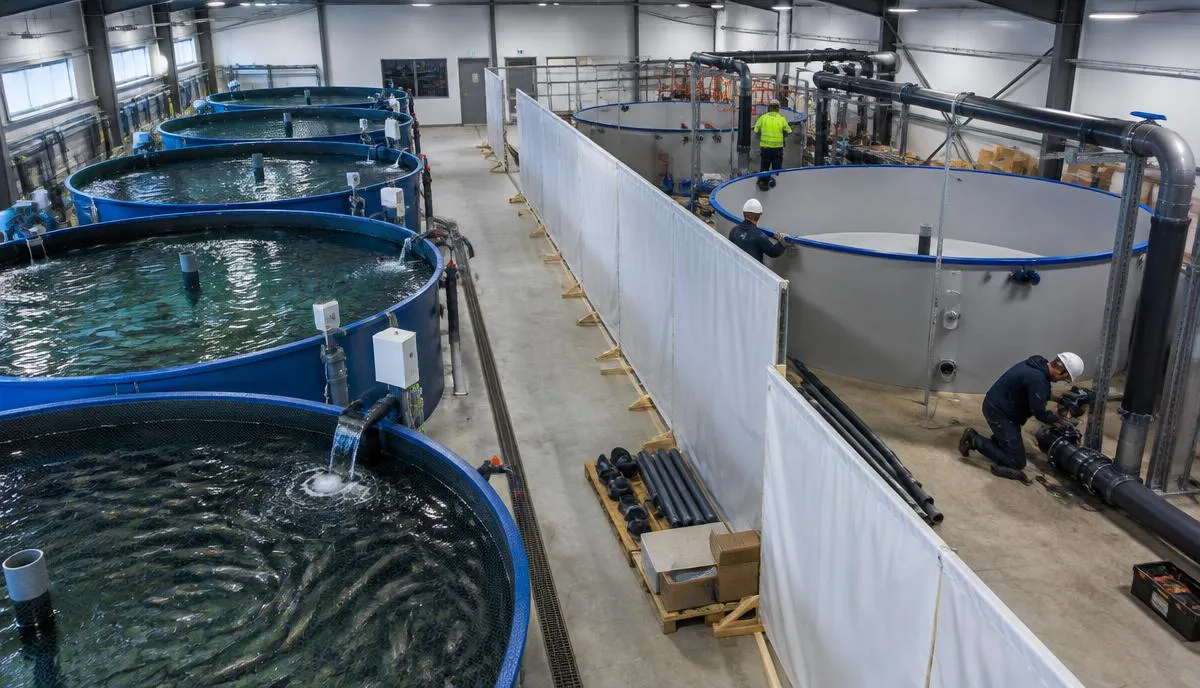
Short answer: expand an operating RAS as a separate, isolated module wherever possible, with its own biofilter that is matured before fish arrive, and connect it to shared utilities (power, oxygen, make-up water, effluent) only after those utilities have been checked at the combined load. Schedule tie-ins for low-biomass periods, keep a written rollback plan for each one, and treat the new module as a biosecurity risk until it has passed commissioning.
Who this is for
Operators of a working recirculating aquaculture system (RAS) who want more tonnes from the same site, plus their engineers, biosecurity lead and purchasing team.
Step 1: check every shared system at the combined load
A new module rarely fails on its own tanks; it fails on the shared systems it plugs into. Check each one at existing load plus the new module at full biomass:
| Shared system | Check | Typical gap |
|---|---|---|
| Power | Peak draw, transformer and distribution headroom, standby generator size and transfer | Generator sized only for the original farm |
| Oxygen | Oxygen supply (generator or liquid) at peak feed, plus emergency oxygen | Supply covers average, not peak |
| Make-up water | Source volume, treatment and temperature control | Intake or heating sized for the original volume |
| Effluent and sludge | Discharge permit limits, sludge handling | Permit tied to original tonnage |
| Feed and labour | Storage, delivery, staff hours for the new units | Staff stretched across two systems |
| Monitoring and alarms | Channel capacity, who answers alarms | New sensors not added to call-out list |
Effluent limits and permits deserve early attention because they can stop an expansion that is otherwise technically ready; see fish farm permits.
Step 2: choose how the new capacity connects
| Option | Disruption to current fish | Biosecurity | When it fits |
|---|---|---|---|
| Separate module with its own loop | Lowest | Best — can be isolated | Most expansions; different species or stages |
| Shared treatment, new tanks | Medium — tie-ins into live loop | Shared risk | Existing treatment has proven headroom |
| Enlarging existing treatment in place | Highest | Shared risk | Only when space or budget rules out a module |
Step 3: plan each tie-in
- Schedule it after a harvest or at the lowest biomass point of the cycle.
- Write the steps, the time allowed and the rollback (how to restore the old configuration) before starting.
- Pre-fabricate and pressure-test pipework off-line.
- Keep emergency oxygen and standby power ready during the work.
- Hold a go / no-go check with operations, engineering and the supplier on the day.
Step 4: start the new biofilter before stocking
A new biofilter needs time to develop nitrifying bacteria; that period depends on temperature, water chemistry and the method used (FAO — A guide to recirculation aquaculture). Stock the new module gradually and track ammonia and nitrite daily. If you see rises, the RAS ammonia and nitrite troubleshooting guide sets out the checks.
Step 5: commission before you count capacity
Treat the expansion as complete only when each system has been tested at the design load: flow and head, oxygen transfer, solids removal, alarms, generator transfer and staff handover. The commissioning and handover guide lists the records to ask for.
Cost and ROI assumptions to agree
| Assumption | Where it should come from |
|---|---|
| Extra tonnes per year | Biomass plan for the new module, not tank volume alone |
| Ramp-up period | Biofilter start-up and stocking schedule |
| Shared-utility upgrades | Step 1 checks — often the hidden cost |
| Extra energy and oxygen | Measured use of your current system scaled to load |
| Disruption cost | Any reduced feeding or delayed stocking during tie-ins |
Run these through the RAS OPEX and expansion readiness tools with your own figures.
Sources and limits
Background: FAO — A guide to recirculation aquaculture; Southern Regional Aquaculture Center fact sheets. Every RAS is different; treat this as a planning checklist, not engineering design. Supplier-specific design, warranties and performance commitments should be in written quotes.
Next step
Send a short expansion request with your current tonnage, target tonnage and system layout. We review it and help you prepare a comparable request covering the module, tie-ins and commissioning. See also phased farm expansion.
Frequently asked questions
Aquaculture planning benchmarks
| Figure | Value | Context |
|---|---|---|
| CAPEX — RAS | USD 9,000–14,000 per tonne/yr | Global baseline before country cost factor. |
| CAPEX — Ponds | USD 1,800–4,000 per tonne/yr | Lined or earthen ponds, excluding land. |
| CAPEX — Cages | USD 2,500–5,500 per tonne/yr | Cages, moorings, nets and service equipment. |
| CAPEX — Flow-through | USD 4,000–7,000 per tonne/yr | Raceways and water intake works. |
| Energy use | RAS ~6 kWh/kg; ponds ~1.2; flow-through ~1.5; cages ~0.3 | Per kg of fish produced. |
| Typical FCR | Trout 1.1; salmon 1.2; shrimp 1.4; tilapia 1.6; carp 1.8 | kg feed per kg growth; varies with feed and management. |
| Farm size where FishMatch reviews projects | From ~USD 250,000 total project value | Commercial fish and shrimp projects. |
Related articles
Where this fits in a real project
Every FishMatch project runs through the same five reviewed stages, from a first enquiry to comparable quotations. See the full buyer journey.
Planning a commercial aquaculture project?
Send your project brief. A FishMatch specialist reviews it before relevant suppliers are contacted privately.
Request a quote