How to Compare Aquaculture Feed Suppliers: Specification, Quality, Traceability and On-Farm Trials
Also in:EspañolPortuguêsFrançaisРусский
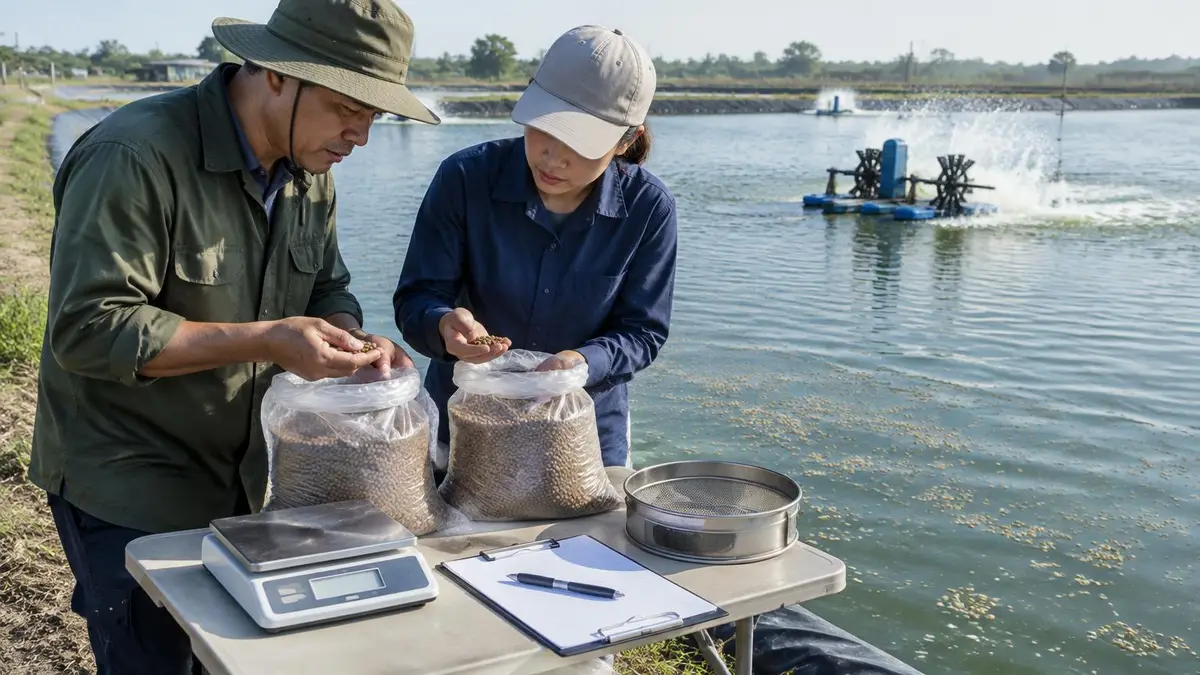
Short answer: compare aquaculture feed suppliers on the same written specification and on evidence from your own farm, not on brochures. Ask each supplier for the product's declared analysis and pellet specification for your species and stage, batch-level quality and traceability documents, storage and shelf-life conditions, a feeding table, and the landed price. Then run a fair on-farm trial — same system, same stocking, same sampling and the same FCR definition — and decide on cost per kilogram of saleable harvest.
Educational buyer guide, reviewed 13 October 2026. FishMatch does not rank, endorse or certify feed suppliers. This guide gives no nutritional prescriptions or health advice; disease or mortality during a trial is a matter for an aquatic animal-health professional and local reporting rules.
What should a feed supplier put in writing?
| Topic | Ask for | Warning sign |
|---|---|---|
| Product fit | Species, stage, pellet sizes, floating/sinking behaviour, feeding table | One product for every species and stage |
| Declared analysis | Guaranteed analysis per product and its basis | Analysis not tied to a batch or date |
| Physical quality | Pellet durability, fines, water stability as the supplier tests them | No test method stated |
| Batch traceability | Lot number, production date, mill, ingredient origin policy | Unlabelled or relabelled bags |
| Certification | Any feed-mill or responsible-sourcing certificate, with scope and validity | A logo with no certificate number or scope |
| Storage and shelf life | Conditions, shelf life, packaging | No shelf-life statement |
| Supply | Lead time, minimum order, local stock, freight and duties | Price only ex-factory |
| Technical support | Who helps set rations and reviews results | Support that is only sales |
How do you check quality and traceability?
Feed composition varies by ingredients and batches, so analysis must be specific and current to be useful (FAO feed variability). Keep a retained sample from every delivery, file the lot number with the units fed, and record storage conditions. Where buyers or markets require responsible feed, check the scope of certifications such as the ASC Feed Standard or BAP feed mill standards directly with the certifier, rather than relying on a logo. Import rules and feed registration are set by national authorities; confirm what applies in your country.
How do you run a fair on-farm feed trial?
- Write the question first: for example, cost per kg of gain and saleable harvest for diet A vs diet B in grow-out ponds or cages of one species.
- Use comparable units: same system, stocking batch, density, water source and management; several units per diet where the farm allows it.
- Fix the method: same sampling, biomass estimate, feeding table logic and mortality counting for both diets.
- Define FCR before you start — biological or economic — and keep it for both diets (FCR guide).
- Record feed given per unit per day, batch numbers, water quality and oxygen, mortalities and harvest weight and size grade.
- Stop and call an aquatic animal-health professional if mortality or disease signs appear; do not interpret a health event as a feed result.
FAO's on-farm feeding review explains why rations must follow measured demand (FAO on-farm feeding); a trial that overfeeds one diet compares feeding practice, not feed.
How should the results be compared?
Calculate, for each diet: feed cost per kg gain = FCR × landed price per kg; survival and saleable kilograms; size distribution and price received; and any change in oxygen use or water-quality management. A cheaper feed with a higher measured FCR or lower saleable harvest can cost more per kilogram sold. Model scenarios with the FCR calculator, feed cost optimizer, fish growth calculator or shrimp cost per kg calculator. These tools model the numbers you enter; they do not replace the trial.
Questions buyers ask
Where does FishMatch fit?
If the trial points to a system limit — feeders, storage, aeration or oxygen at the planned ration — define the outcome and submit a project request. Managed procurement is for commercial B2B projects from USD 250,000. The FishMatch team reviews your brief, contacts suitable providers for you and presents comparable responses through FishMatch; buyers and providers are not handed each other's contact details. Bulk feed purchasing itself is handled by our sister service FeedMatch Group; no project data is transferred automatically.
Sources: FAO — On-farm feeding and feed management in aquaculture (2013); FAO — Variability in feed composition; ASC Feed Standard; BAP certification standards, including feed mills. Source links checked 13 October 2026. The checklist is FishMatch's procurement synthesis; the sources do not endorse FishMatch or any supplier.
Planning guidance only. No growth, survival, FCR or cost outcome is promised.
Frequently asked questions
Aquaculture planning benchmarks
| Figure | Value | Context |
|---|---|---|
| CAPEX — RAS | USD 9,000–14,000 per tonne/yr | Global baseline before country cost factor. |
| CAPEX — Ponds | USD 1,800–4,000 per tonne/yr | Lined or earthen ponds, excluding land. |
| CAPEX — Cages | USD 2,500–5,500 per tonne/yr | Cages, moorings, nets and service equipment. |
| CAPEX — Flow-through | USD 4,000–7,000 per tonne/yr | Raceways and water intake works. |
| Energy use | RAS ~6 kWh/kg; ponds ~1.2; flow-through ~1.5; cages ~0.3 | Per kg of fish produced. |
| Typical FCR | Trout 1.1; salmon 1.2; shrimp 1.4; tilapia 1.6; carp 1.8 | kg feed per kg growth; varies with feed and management. |
| Farm size where FishMatch reviews projects | From ~USD 250,000 total project value | Commercial fish and shrimp projects. |
Related articles
Where this fits in a real project
Every FishMatch project runs through the same five reviewed stages, from a first enquiry to comparable quotations. See the full buyer journey.
Planning a commercial aquaculture project?
Send your project brief. A FishMatch specialist reviews it before relevant suppliers are contacted privately.
Request a quote