Japan Seafood Import-Readiness Checklist: Shrimp, Squid, Trout and Nile Perch by Product and Origin
Short answer: every seafood shipment for sale in Japan needs an import notification filed by the importer with an MHLW quarantine station, and must meet Japan's residue and additive standards. On top of that, the rules depend on product and origin: cultured shrimp from India (other than black tiger) is tested for furazolidone at every import, squid needs a METI import-quota approval and a flag-State catch certificate, and farmed fish and shrimp sold fresh or thawed must be labelled as farmed. Plant quarantine and phytosanitary certificates apply to plants, not to fish, shrimp or squid. The importer and exporter must confirm the current requirements for each product and origin with the Japanese authorities before shipping.
FishMatch Group editorial team · Official sources checked
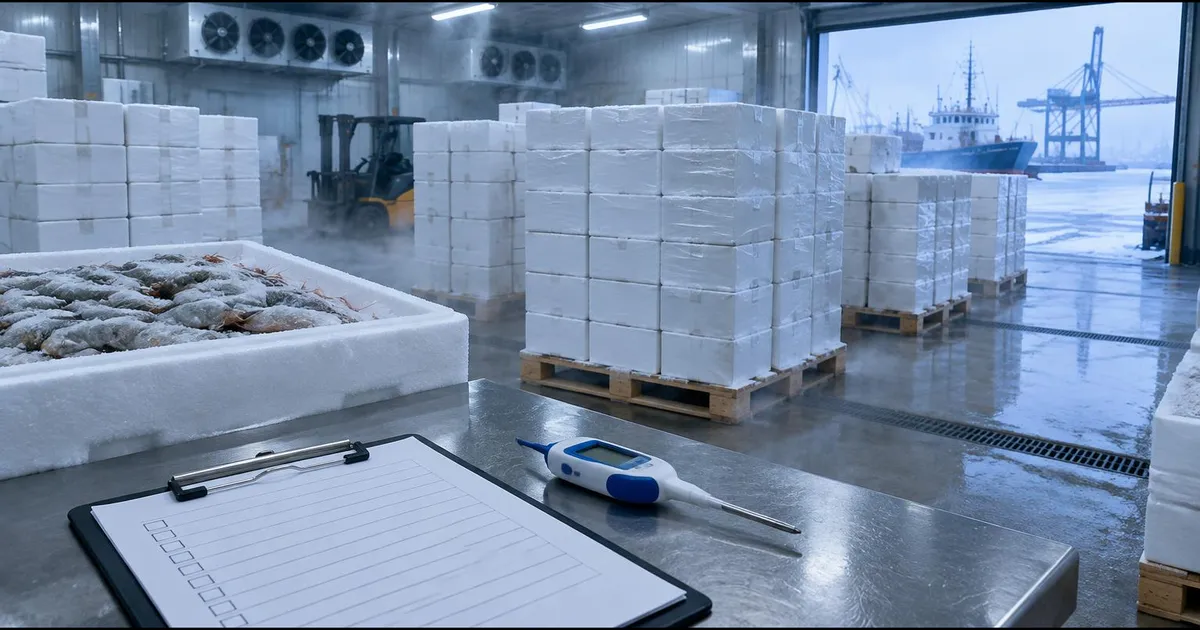
Which checks apply to which product
The table lists the checks a buyer should plan for each product line that currently reaches Japan from the five origins. 'Yes' means an official source applies the rule to that product; 'Check' means it depends on the exact product, origin or plant. No line in this table is an approval: admissibility is decided shipment by shipment.
| Check | Farmed shrimp | Wild squid | Farmed trout | Wild Nile perch |
|---|---|---|---|---|
| MHLW import notification (Food Sanitation Act, Art. 27) | Yes | Yes | Yes | Yes |
| Residue standards (positive list; 0.01 ppm default where no limit is set) | Yes | Yes | Yes | Yes |
| Inspection order | Yes for cultured shrimp from India other than black tiger | Check | Check | Check |
| Sulphite residue limit (less than 0.10 g/kg as SO2 in peeled flesh) | Yes if sulphites are used | — | — | — |
| METI import quota (IQ) approval | — | Yes | — | — |
| Flag-State catch certificate (Specified Aquatic Animals and Plants Act) | — | Yes | — | — |
| Plant quarantine / phytosanitary certificate | Not a plant | Not a plant | Not a plant | Not a plant |
| Retail label: origin; 'farmed' (養殖); 'thawed' (解凍) if sold thawed | Origin, farmed, thawed | Origin, thawed | Origin, farmed, thawed | Origin, thawed |
| Organic JAS mark | No standard for aquatic animals | No standard | No standard | No standard |
What each origin actually ships to Japan
Japan's own customs figures, reported to UN Comtrade (HS 2022, retrieved 25 October 2026), show very different starting points. A flow proves that some product cleared customs that year; it does not prove that a given supplier, plant or lot is admissible now.
| Origin | All seafood lines 2024 | Main lines | Farmed or wild |
|---|---|---|---|
| India | 407.6 | Frozen warm-water shrimp 284.9; frozen fish meat 73.5; frozen squid 21.1 | Shrimp farmed or wild (HS code does not say); squid wild |
| Ecuador | 102.6 | Frozen warm-water shrimp 102.3 (14,931 t) | Predominantly farmed whiteleg shrimp (FAO GLOBEFISH); confirm per lot |
| Peru | 100.3 | Frozen squid 41.7; frozen trout fillets 24.2; roe 12.5; shrimp 7.2 | Squid wild; trout mainly farmed (FAO); confirm per lot |
| Kenya | 0.19 | Frozen Nile perch fillets 0.14 | Wild (Lake Victoria) |
| Colombia | 1.02 | Live ornamental fish only (not food) | No food seafood flow in 2024 |
Step 1 — The import notification
Under Article 27 of the Food Sanitation Act, the importer must notify the Minister of Health, Labour and Welfare for every food imported for sale or business use. The notification goes to the quarantine station responsible for the place of clearance, on paper or electronically through FAINS, and MHLW accepts notifications from seven days before the scheduled arrival. The quarantine station decides whether the shipment is inspected.
Supporting documents depend on the product: an explanation of ingredients and processing for processed foods, a health certificate where one is required, and test reports where a product has its own standard. For fresh seafood the Tokyo Quarantine Station also asks for details such as the scientific name and any additives used.
- Importer of record in Japan named before the contract — FishMatch Group and Global B2B Group never act as importer.
- Scientific name of the species, product form and production method (farmed or wild) for each lot.
- List of additives and processing aids used, including sulphites or phosphates.
- Test reports for the lot where an inspection order or product standard applies.
- Health certificate only where Japan requires one for that product and origin — MHLW names pufferfish and oysters for raw consumption; confirm other items with the quarantine station.
Step 2 — Residues, MRLs and additives
Japan sets residue standards for all pesticides, feed additives and veterinary drugs in food, under the positive list system. Where no specific limit is set for a substance and food, a uniform limit of 0.01 ppm applies. This matters most for farmed shrimp and fish, where antibiotics, antiparasitics and dyes used on farms can leave residues. Since 1 April 2024 food-standard setting has moved from MHLW to the Consumer Affairs Agency; check the current limit for each substance and food in the official standards.
Inspection orders are stricter. MHLW's list (Appendix 1, last amended 23 October 2026) requires furazolidone testing at every import of cultured shrimp from India other than black tiger, and its simply processed products. MHLW's monitoring plan can add enhanced checks for a country, product or named plant after a violation.
For additives, the MHLW use standard requires sulphites on shrimp to leave less than 0.10 g of sulphur dioxide per kilogram of peeled flesh.
Step 3 — Quota, catch certificate and live animals
Squid and cuttlefish are among the 18 fishery items under Japan's import quota system: each shipment needs a METI import approval against an allocated quota, held by the Japanese importer. Squid is also a Class II species under the Act on Ensuring the Proper Domestic Distribution and Importation of Specified Aquatic Animals and Plants, so imports need a catch certificate issued by the flag State's competent authority.
Live aquatic animals that can carry listed diseases — for example seed, fry or post-larvae for Japanese farms — need a MAFF import permit under the Fisheries Resources Protection Act. This guide covers seafood for food, not live stock.
Plant quarantine and phytosanitary certificates
MAFF's Plant Protection Station inspects plants that can carry plant pests. Fish, shrimp and squid are animals, so plant quarantine and phytosanitary certificates are not part of their Japanese import checks; their controls are the food-safety, quota and catch-documentation rules above. Seaweed is different: we did not find an official statement exempting every seaweed product, so treat seaweed as a separate check with MAFF.
Fresh fruit and vegetables, where phytosanitary certificates, plant quarantine and pesticide MRLs are central, are outside FishMatch's seafood and aquaculture scope; Global B2B Group handles produce requests.
Labelling for Japanese retail
Under the Consumer Affairs Agency's Food Labelling Standards, fresh seafood — including simply frozen seafood — must show the country of origin for imports, that it was farmed (養殖) if it was farmed, and that it was thawed (解凍) if it was frozen and then thawed for sale. Wild squid and Nile perch do not carry the 'farmed' statement; farmed shrimp and trout do. Agree with your importer who prepares the Japanese label and which facts the supplier must declare per lot.
Organic claims on seafood in Japan
Japan's Organic JAS system has a standard for algae but not for aquatic animals. MAFF's June 2026 handbook states that fishery products other than algae cannot carry the Organic JAS mark because no standard exists, and that because they are not designated products an organic name is not prohibited — but the claim must not mislead buyers. MAFF's EU equivalence arrangement (sheet dated 18 May 2025) covers agricultural products, JAS-defined livestock and processed foods, not farmed fish or shrimp.
FishMatch Group therefore describes farmed shrimp or fish as organic only when the producer holds a current organic certificate covering the species, production method and site, and the buyer's importer has confirmed how the claim may be used in Japan. Otherwise we describe specific sustainability attributes instead.
How to request offers
Submit one request to Global B2B Group, FishMatch Group's parent, for consolidated sourcing across origins, supplier screening and logistics coordination. Buyers do not pay for the service, supplier communication goes through the team, and buyers and suppliers are not put in direct contact. Managed requests start at USD 250,000 in total. Neither company is the manufacturer, exporter, importer or certifier, and neither guarantees clearance, certification, prices or savings.
- State species, form, size or count, glaze, packing, volume, frequency and the Japan port and delivery window.
- Say which origins you will consider and whether the product must be farmed or wild.
- Name the importer of record, or ask for importers to be included in the scope.
For producers and exporters
Producers and exporters in Latin America or Brazil who want to be considered for Japanese requests can apply in Spanish or Portuguese. Applications are reviewed privately and are not listed publicly; buyers never receive supplier contact details from us.
Japan seafood import questions
Who files the food import notification in Japan?
The importer. Article 27 of the Food Sanitation Act requires the importer to notify MHLW through the quarantine station for the place of clearance, on paper or through FAINS, from up to seven days before arrival.
Do frozen shrimp or squid need a phytosanitary certificate for Japan?
No. Plant quarantine covers plants that can carry plant pests. Fish, shrimp and squid are controlled by food-safety rules, and squid also by the import quota and catch-certificate rules.
What is Japan's default residue limit?
Under the positive list system, 0.01 ppm applies to a pesticide, feed additive or veterinary drug where no specific limit is set for that food. Many substances have their own limits; check the current standard for each.
Can farmed shrimp be sold as organic in Japan?
There is no Organic JAS standard for aquatic animals, so the Organic JAS mark cannot be used. MAFF says an organic name is not prohibited for these products but must not mislead; we use the word only with a current certificate covering species, method and site.
Which origins already ship seafood to Japan?
On Japan's 2024 figures, India (USD 407.6 million of seafood lines), Ecuador (USD 102.6 million, almost all frozen shrimp) and Peru (USD 100.3 million) have established flows. Kenya shipped USD 0.14 million of Nile perch fillets, and Colombia no food seafood.
Does FishMatch Group or Global B2B Group guarantee customs clearance?
No. Both are buyer-side intermediaries, not importers, exporters or certifiers. The importer of record and the exporter must confirm current requirements for each product and origin with the Japanese authorities.
Official sources (read 25 October 2026)
- MHLW — Import procedure for food (輸入手続)
- MHLW — Advance notification accepted from 7 days before arrival
- Tokyo Quarantine Station (MHLW) — Notification by counter or FAINS
- MHLW — Residue standards for agricultural chemicals (positive list)
- MHLW — Notice on the 0.01 ppm uniform limit (29 Nov 2005)
- MHLW — Foods subject to inspection orders, Appendix 1 (last amended 23 Oct 2026, PDF)
- MHLW — Food additive use standards, sulphites (PDF)
- MHLW — Health certificates for pufferfish and oysters for raw consumption
- METI — Import quotas for fishery products
- Japan Fisheries Agency — Specified Aquatic Animals and Plants Act (English)
- MAFF — Aquatic animal import quarantine
- MAFF Plant Protection Station — What is subject to import plant quarantine
- Consumer Affairs Agency — Food labelling guide, April 2025 edition (PDF)
- MAFF — Organic processed foods certification handbook, June 2026 (PDF)
- MAFF — EU–Japan organic equivalence scope (18 May 2025, PDF)
- UN Comtrade — Japan imports by partner, HS 2022, 2023–2024 (retrieved 25 Oct 2026)