Importing Wild Squid into Japan from Peru and India: Import Quota, Catch Certificates and Specifications
Short answer: squid is one of the most regulated seafood imports into Japan. Each shipment needs a METI import approval against an allocated import quota, held by the Japanese importer, and a catch certificate issued by the flag State's competent authority under the Specified Aquatic Animals and Plants Act — on top of the MHLW import notification. Peru (USD 41.7 million of frozen squid in 2024) and India (USD 21.1 million) are established origins on Japan's customs figures. All squid is wild-caught, so plan around catch seasons and quotas, and have the importer confirm current requirements for each lot.
FishMatch Group editorial team · Official sources checked
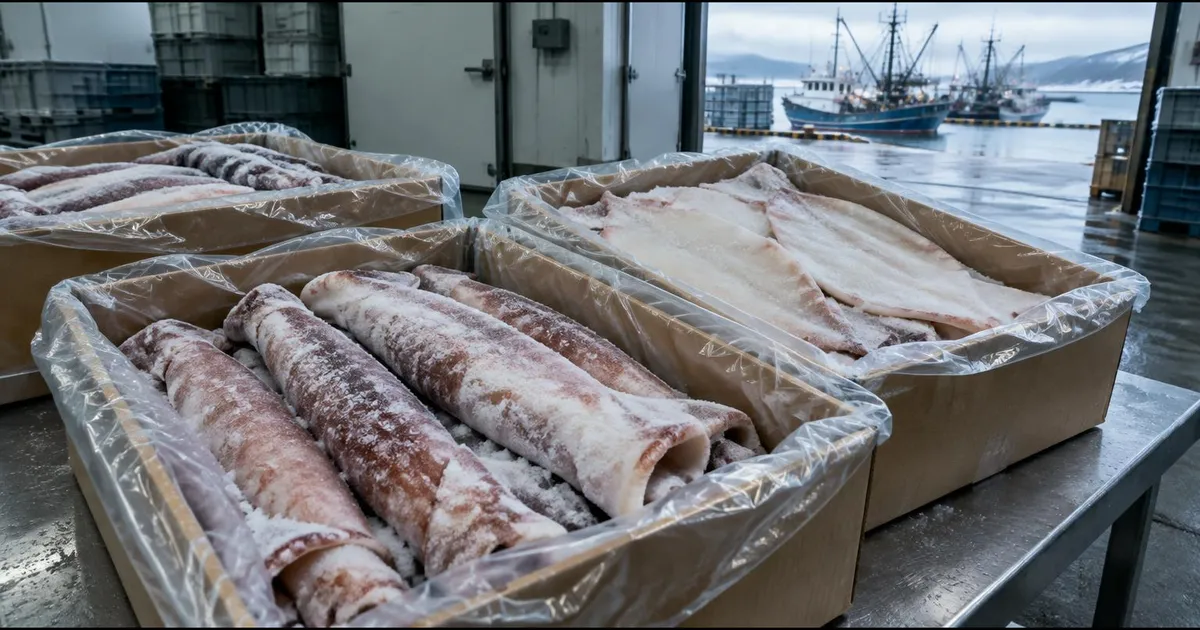
Japan's squid imports from Peru and India
Japan's own figures reported to UN Comtrade (HS 2022, retrieved 25 October 2026) show two established squid origins among the five we track. Customs codes do not name the squid species; Peru's main commercial squid is the jumbo flying squid, Dosidicus gigas (pota).
| Origin and line | 2023 | 2024 | 2024 tonnes |
|---|---|---|---|
| Peru — frozen squid and cuttlefish (030743) | 47.6 | 41.7 | 15,385 |
| Peru — prepared or preserved squid (160554) | 13.6 | 2.2 | 415 |
| India — frozen squid and cuttlefish (030743) | 16.9 | 21.1 | 1,914 |
| Ecuador, Kenya, Colombia | — | — | No squid line found |
Gate 1 — The import quota (IQ)
Squid and cuttlefish are among the 18 fishery items under Japan's import quota system. Each shipment needs an import approval issued by METI against an allocated quota. METI allocates the squid quota to trading companies, fishers, end users such as processors, and first-come applicants. The quota sits with the Japanese side, not with the exporter: before any contract, confirm which importer holds or will apply for quota for your volume and period.
Gate 2 — The catch certificate
Under the Act on Ensuring the Proper Domestic Distribution and Importation of Specified Aquatic Animals and Plants, squid is a Class II species, together with mackerel, Pacific saury and Japanese sardine. Imports need a catch certificate (or equivalent document) issued by the competent authority of the flag State of the catching vessel. For processed squid, check whether the processed form is covered and how the certificate links to the raw-material catch.
Ask each supplier which authority issues the certificate, how it identifies the vessel and catch, and how it follows the lot through processing and repacking.
Gate 3 — Import notification and food standards
Like every food, squid needs the importer's MHLW import notification under Article 27 of the Food Sanitation Act, filed with the quarantine station on paper or through FAINS, from up to seven days before arrival. The general residue and additive standards apply. Because squid is wild-caught, the Japanese retail label shows the country of origin and, if sold thawed, 'thawed' (解凍), but not 'farmed'. Squid is an animal, so plant quarantine and phytosanitary certificates do not apply.
Seasons and catch limits
Supply depends on fishing seasons and national catch limits, not on farm harvests. For Peru, the Ministry of Production (PRODUCE) raised the 2026 catch limit for giant squid to 709,659 tonnes on 29 August 2026 and reopened fishing with 82,321 tonnes available from 30 August to 31 December 2026. Check the current resolution before planning shipments. For Indian squid we found no dated official season source; ask each supplier for its catch calendar.
What to specify in a squid request for Japan
Squid offers vary widely in yield and treatment; state each item so offers can be compared.
- Species (for Peru usually Dosidicus gigas) and catch area; flag State of the vessels.
- Product: whole, tubes, fillets, wings, tentacles, rings; raw or cooked; skin-on or skinless.
- Size grade per piece or per kilogram, and tolerance.
- Treatment and additives, glaze percentage and price basis on net weight.
- Catch certificate issuer and how it travels with the lot; who holds the Japanese import quota.
- Volume per shipment, frequency, Japan port, delivery window and Incoterms rule.
How the request works
Submit one request to Global B2B Group, FishMatch Group's parent, for consolidated sourcing from several origins, supplier screening and logistics coordination. Buyers use the service free, suppliers answer through the team, and there is no direct buyer–supplier contact. Managed requests start at USD 250,000. Exporters are responsible for the product and catch documents; the Japanese importer holds the quota approval and files the notification.
Squid to Japan: buyer questions
Does squid need an import quota in Japan?
Yes. Squid and cuttlefish are among the 18 fishery items under Japan's import quota system; each shipment needs a METI import approval against an allocated quota held by the Japanese importer.
What catch document does Japan require for squid?
Squid is a Class II species under the Specified Aquatic Animals and Plants Act, so imports need a catch certificate issued by the flag State's competent authority.
Where does Japan import squid from?
Among the five origins we track, Peru (USD 41.7 million of frozen squid in 2024) and India (USD 21.1 million) are established on Japan's figures reported to UN Comtrade.
Is squid ever farmed?
Not commercially in these origins: the squid in this trade is wild-caught, so it is labelled with origin and, if thawed, 'thawed', but not 'farmed'.
Who arranges the quota and documents?
The Japanese importer holds the METI approval and files the MHLW notification; the exporter supplies the catch certificate. Global B2B Group and FishMatch Group coordinate questions but are not importer, exporter or certifier.
Official sources (read 25 October 2026)
- UN Comtrade — Japan imports by partner, HS 2022, 2023–2024 (retrieved 25 Oct 2026)
- METI — Import quotas for fishery products
- METI — About the fishery IQ system (18 items)
- Japan Fisheries Agency — Specified Aquatic Animals and Plants Act (English)
- e-Gov — Enforcement Regulation, Art. 3: Class II species
- MHLW — Import procedure for food (輸入手続)
- Consumer Affairs Agency — Food labelling guide, April 2025 edition (PDF)
- PRODUCE (Peru) — Giant squid fishing reopened with additional quota (29 Aug 2026)