How International Buyers Source Premium Shrimp: A Buyer-First Process from Specification to Delivery
Also in:EspañolFrançaisالعربية中文עברית
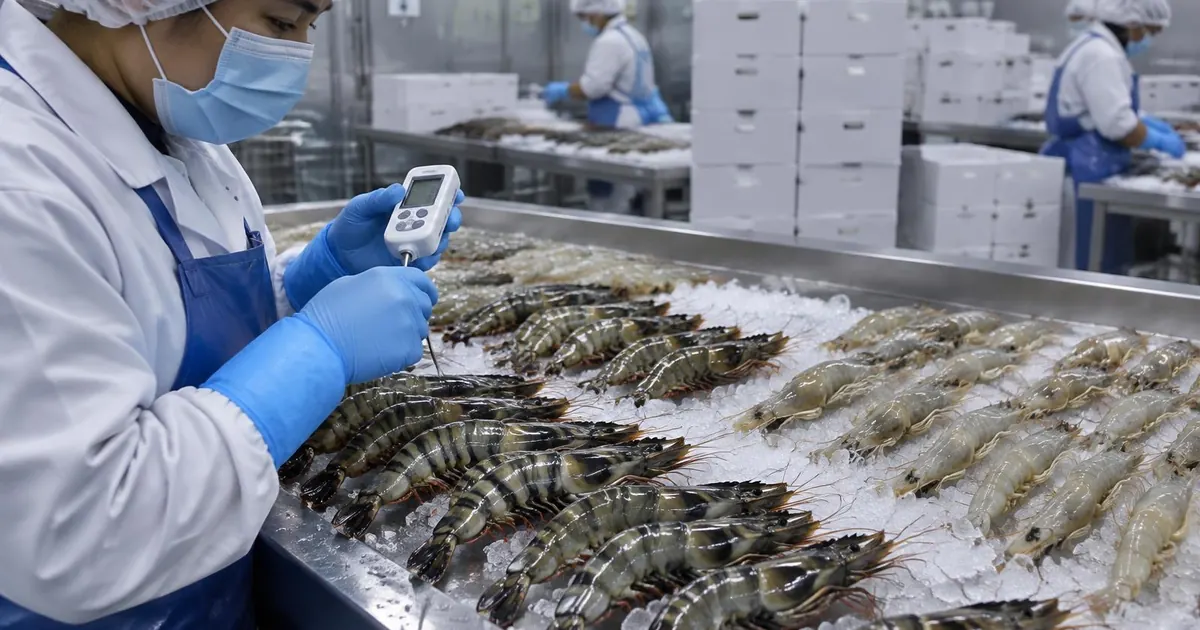
Short answer: international buyers get the best results with premium shrimp when they buy against a written specification rather than a supplier's description. Fix the species, product form, size count, processing and packing, annual or seasonal volume, destination, delivery schedule, cold-chain limits and required documents first. Then put the same request to several potentially suitable producers and exporters, compare their answers line by line, and confirm the documents for the exact product and destination before signing. FishMatch Group structures that request and coordinates the commercial conversation; it does not farm, process, hold stock or certify shrimp.
What "premium" should mean in a shrimp purchase
In commercial buying, premium is a specification, not an adjective. It can mean a larger or more uniform count, a particular species or origin, a stricter processing and packing standard, a defined glaze and net-weight basis, or a production method or certification you require. Each of those can be written down and checked against documents and samples. If an attribute cannot be written down and checked, it should not carry a price premium in your contract.
Whether a product meets your premium specification is decided by the producer's or exporter's documents, inspection and testing arrangements you agree on, and your own acceptance checks. FishMatch does not grade shrimp or confirm premium or sustainable status.
Market context: what FAO and OECD actually report
Farmed supply now leads global aquatic animal production. According to FAO's The State of World Fisheries and Aquaculture 2024, 2022 was the first year in which aquaculture produced more aquatic animals than capture fisheries: 51 percent, or about 94 million tonnes, of the 185 million tonnes produced.
Looking ahead, the OECD-FAO Agricultural Outlook 2025-2034 projects global aquaculture production of aquatic animals to reach 118 million tonnes by 2034, 20 percent above the 2022-2024 base period and slower than the previous decade. Among species groups, it expects strong aquaculture production growth for shrimps and prawns (+38 percent). It also projects world trade in aquatic products for human consumption to be 7.1 percent higher in 2034 than in the base period.
These are sector-wide production and trade projections. They are not forecasts of demand or prices for premium shrimp, and they cannot tell you whether a producer can supply your count, form and volume. Only answers to a specific request can.
Step 1: Define the species and product form
- Species by common and scientific name, for example whiteleg shrimp (Penaeus vannamei) or black tiger shrimp (Penaeus monodon), and whether you accept farmed product only.
- Product form: head-on shell-on (HOSO), headless shell-on (HLSO), peeled and deveined (PD), peeled undeveined (PUD), tail-on or tail-off, raw or cooked.
- State: chilled, frozen individually (IQF) or frozen in blocks, and any value-added preparation.
- Acceptable alternatives, if any, so producers can offer a close match instead of declining.
Step 2: Set size, count and grade precisely
Words such as "jumbo" or "large" mean different things in different markets. State the count range and its unit (pieces per pound or per kilogram), whether the count applies before or after glazing, the uniformity you expect within a carton, and the defects you will not accept, such as broken pieces, black spots or soft shells. Our wholesale shrimp RFQ checklist sets these fields out as a worksheet.
Step 3: Plan volume and the delivery schedule
Describe the programme, not just the first order: annual or seasonal volume, quantity per shipment, delivery frequency, the first delivery window and how much flexibility you have. Farmed shrimp is harvested in production cycles, so ask each producer to state the capacity it can commit to your specification and schedule, rather than its total capacity.
Step 4: Specify processing, packing and labelling
- Glaze percentage and the net-weight basis used on the label and invoice.
- Inner pack and master carton sizes, labelling language and the marks your customer needs.
- Any additive, treatment or processing restrictions set by your market or your customer.
- The processing plant, and whether it holds the registration or approval your destination requires for this product.
Step 5: Define the cold chain and destination
Write down the product temperature you require and how it must be recorded from loading to delivery, the destination country and port, and your preferred delivery terms (for example the Incoterms rule you want to use). Import requirements differ by product and destination and change over time; the regulation and restricted items register lists the official sources we track.
Step 6: Ask for traceability and documents up front
Ask early for what your market and customer will need: identification of the farm and processing plant, lot coding, harvest and processing dates, the health or sanitary certificate where the importing authority requires one, a certificate of origin, and copies of any certification you require, with the certificate number and scope. Certificates should be confirmed with the issuing scheme or authority.
Requirements vary by species, product and destination. The exporter is responsible for the rules that apply to producing and exporting the product, and the importer for the rules of the destination market. FishMatch can collect and organise the documents suppliers provide and point out what is missing against your brief; that review is not an audit, an inspection or a certification.
Step 7: Compare supplier capability, not just price
- Capacity committed to your form, count and schedule.
- Experience exporting to your destination, as declared by the supplier and supported by documents.
- Plant registrations or approvals needed for your market.
- Quality-control process, testing arrangements and sample policy.
- Cold storage, loading and temperature records.
- Payment terms, document readiness and response to follow-up questions.
For a deeper look at which supplier documents to request and how to read them, see how to qualify a commercial seafood supplier.
How FishMatch structures the request and the conversation
- You send one structured request: species, form, count, processing and packing needs, volume, destination, delivery schedule, preferred delivery terms and documents.
- Our team clarifies open points with you and identifies producers and exporters that may be able to meet it.
- We coordinate their questions and collect comparable information and offers.
- We help you review specifications, terms, volume, availability, documents, logistics and open risks side by side.
- You decide whether and with whom to proceed, and we coordinate the next steps. If your needs change, we run a revised round; if you stop, nothing more is sent.
Commercial communication runs through our team: buyers and suppliers are not put in direct contact through the platform, and your identity is shared only with your approval. Sending a request is free for buyers, and you receive a first reply from a person within one business day. We cannot promise a number of offers or when they will arrive; that depends on the specification and on supplier responses. Typical qualifying requests start at US$250,000 in annual or seasonal programme value; smaller requests are recorded, and we point you to our free guides and tools.
FishMatch does not farm, process, own or hold shrimp, does not act as importer or exporter, and does not guarantee supply, quality, premium or sustainable status. Each party remains responsible for the laws that apply to it.
Premium shrimp procurement checklist
| Item | What to specify | What to ask for |
|---|---|---|
| Species | Common and scientific name; farmed only or not | Producer declaration for each lot |
| Product form | HOSO, HLSO, PD, PUD, tail-on or off, raw or cooked | Product specification sheet |
| Size and count | Count range, unit and glazing basis; uniformity; defect limits | Grading method and samples |
| Volume and schedule | Annual or seasonal volume, per-shipment quantity, delivery windows | Committed capacity for your specification |
| Processing and packing | Glaze, net-weight basis, packs, cartons, labelling | Packing specification and label proof |
| Cold chain | Required product temperature and recording | Cold-store and loading temperature records |
| Destination and terms | Country, port, preferred delivery terms | Confirmation of the rules the exporter will meet |
| Traceability | Farm, plant, lot and date information | Lot coding and traceability records |
| Documents and certification | Certificates your market or customer requires | Copies with number and scope, confirmed with the issuer |
| Supplier capability | Plant approvals, quality control, payment terms | Supporting documents and answers to follow-up questions |
Buying other food commodities?
FishMatch focuses on aquaculture and seafood. For other agricultural and food commodities, you can source commodities through Global B2B Group, FishMatch's parent group. A FishMatch request is not shared with Global B2B Group automatically.
Ready to put your specification in front of potentially suitable producers and exporters? Start a shrimp sourcing request with the species, form, count, volume, destination and delivery schedule you need.
Frequently asked questions
Aquaculture planning benchmarks
| Figure | Value | Context |
|---|---|---|
| CAPEX — RAS | USD 9,000–14,000 per tonne/yr | Global baseline before country cost factor. |
| CAPEX — Ponds | USD 1,800–4,000 per tonne/yr | Lined or earthen ponds, excluding land. |
| CAPEX — Cages | USD 2,500–5,500 per tonne/yr | Cages, moorings, nets and service equipment. |
| CAPEX — Flow-through | USD 4,000–7,000 per tonne/yr | Raceways and water intake works. |
| Energy use | RAS ~6 kWh/kg; ponds ~1.2; flow-through ~1.5; cages ~0.3 | Per kg of fish produced. |
| Typical FCR | Trout 1.1; salmon 1.2; shrimp 1.4; tilapia 1.6; carp 1.8 | kg feed per kg growth; varies with feed and management. |
| Farm size where FishMatch reviews projects | From ~USD 250,000 total project value | Commercial fish and shrimp projects. |
Related articles
Where this fits in a real project
Every FishMatch project runs through the same five reviewed stages, from a first enquiry to comparable quotations. See the full buyer journey.
Sourcing premium shrimp?
Send one structured request. Our team reviews it, approaches potentially suitable producers and exporters and coordinates the conversation. Free for buyers; typical qualifying programmes start at US$250,000.
Start a shrimp sourcing request