Commercial Seafood Supplier Qualification: Traceability, Cold Chain and Buyer Documents
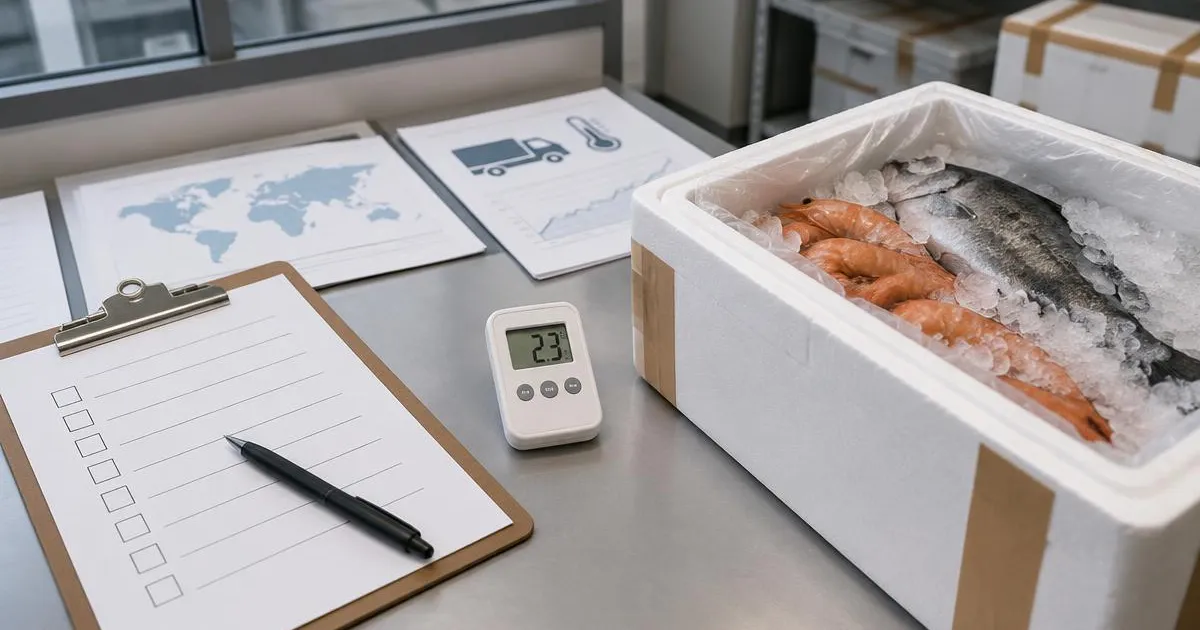
Short answer: qualify a commercial seafood supplier by matching each claim — product, origin, processing site, traceability, cold chain and route documents — to evidence you can check, and recording who checked what and when. Keep three things apart: what the seller declares, what a reviewer has checked, and what only authorities or accredited certifiers can decide. A platform review is not regulatory certification.
Three kinds of statement
- Seller-declared: anything the supplier states, including species, origin, capacity, certificates and dates. Treat it as unverified until checked.
- Staff-reviewed: an item a named reviewer has checked against a document or official record, for an exact scope and date. At FishMatch this is internal screening, not inspection or certification.
- Authority-determined: establishment approvals, export certificates, import admissibility and border checks are decided by competent authorities. Private standards are decided by their accredited certifiers.
Step 1: Confirm who does what
Identify the legal seller, the farm or catch source, the processing and packing establishment, and the exporter of record. They may be different companies. Each approval applies to a named entity and site, so a document for a sister company or another factory does not transfer.
Step 2: Check product and site scope
For every certificate or listing, record the issuer, the facility named, the products and processes covered, the destination it applies to, and the validity dates. Check current status with the issuer or official database where one exists. A photo of a certificate is a lead to verify, not evidence.
Step 3: Test traceability on a real lot
Codex describes traceability as the ability to follow food through specified stages of production, processing and distribution (Codex Principles for traceability/product tracing, CXG 60-2006). Ask the supplier to trace one sample lot from carton code back to processing records and farm or catch source. Note any break. Traceability helps investigations; on its own it does not prove safety or sustainability.
Step 4: Review cold-chain controls
Ask how temperature is controlled and recorded from harvest or landing through processing, storage and loading: equipment, monitoring records, alarm handling and what happens to product after an excursion. Product-specific temperature and time limits come from the supplier's hazard analysis and the applicable rules, not from a generic figure.
Step 5: Match documents to the destination
Route requirements differ by species, product form, origin and destination. US-bound seafood falls under FDA seafood HACCP rules, including importer obligations (21 CFR 123.12, US seafood importer requirements; see also FDA Fish and Fishery Products Hazards and Controls guidance). EU imports depend on eligible country, approved establishment, health certificate and border-control conditions (EU Access2Markets: animal-product health controls). For other markets, check the competent authority's current requirements directly.
Tool: supplier qualification document checklist
| Item | Seller declares | Reviewer records | Who ultimately decides |
|---|---|---|---|
| Legal entity and authority | Company details, signatory | Registry match, date checked | Company registry |
| Processing establishment | Site and approvals held | Official listing, scope, validity | Competent authority |
| Product specification | Species, form, size, glaze, pack | Consistency with RFQ | Buyer and seller contract |
| Traceability | Lot coding system | Result of one-lot trace test | Supplier records; authorities on request |
| Cold chain | Controls and records | Sample records reviewed | Supplier HACCP; authorities |
| Route documents | Certificates for the destination | Issuer, scope, expiry | Exporting and importing authorities |
| Private certification | Scheme and certificate number | Status on scheme database | Accredited certifier |
Give each row one status: unverified, needs review, verified for the exact scope and date, expired or rejected. An empty cell is not approval. Set a recheck date for anything that expires.
How FishMatch handles qualification
When a producer submits output through producer output intake, our staff screen it privately against the checklist above and record what was checked, by whom and when. Buyers see only reviewed, anonymized attributes until our consent rules allow an introduction. We do not inspect, test, certify, clear customs or guarantee compliance or a transaction. Sellers remain responsible for what they declare (terms section 7A). Buyers can start with a commercial seafood buyer request and the seafood import buying guide.
Sources and scope
- Codex Principles for traceability/product tracing, CXG 60-2006.
- 21 CFR 123.12, US seafood importer requirements.
- FDA Fish and Fishery Products Hazards and Controls guidance.
- EU Access2Markets: animal-product health controls.
- Checked 18 October 2026. General guidance, not legal, regulatory or certification advice; have qualified advisers review your specific route.
Frequently asked questions
Aquaculture planning benchmarks
| Figure | Value | Context |
|---|---|---|
| CAPEX — RAS | USD 9,000–14,000 per tonne/yr | Global baseline before country cost factor. |
| CAPEX — Ponds | USD 1,800–4,000 per tonne/yr | Lined or earthen ponds, excluding land. |
| CAPEX — Cages | USD 2,500–5,500 per tonne/yr | Cages, moorings, nets and service equipment. |
| CAPEX — Flow-through | USD 4,000–7,000 per tonne/yr | Raceways and water intake works. |
| Energy use | RAS ~6 kWh/kg; ponds ~1.2; flow-through ~1.5; cages ~0.3 | Per kg of fish produced. |
| Typical FCR | Trout 1.1; salmon 1.2; shrimp 1.4; tilapia 1.6; carp 1.8 | kg feed per kg growth; varies with feed and management. |
| Farm size where FishMatch reviews projects | From ~USD 250,000 total project value | Commercial fish and shrimp projects. |
Related articles
Where this fits in a real project
Every FishMatch project runs through the same five reviewed stages, from a first enquiry to comparable quotations. See the full buyer journey.
Planning a commercial aquaculture project?
Send your project brief. A FishMatch specialist reviews it before relevant suppliers are contacted privately.
Request a quote