From Shrimp Farm Plan to Buyer-Ready Harvest: Align Capacity, Timing and Specifications
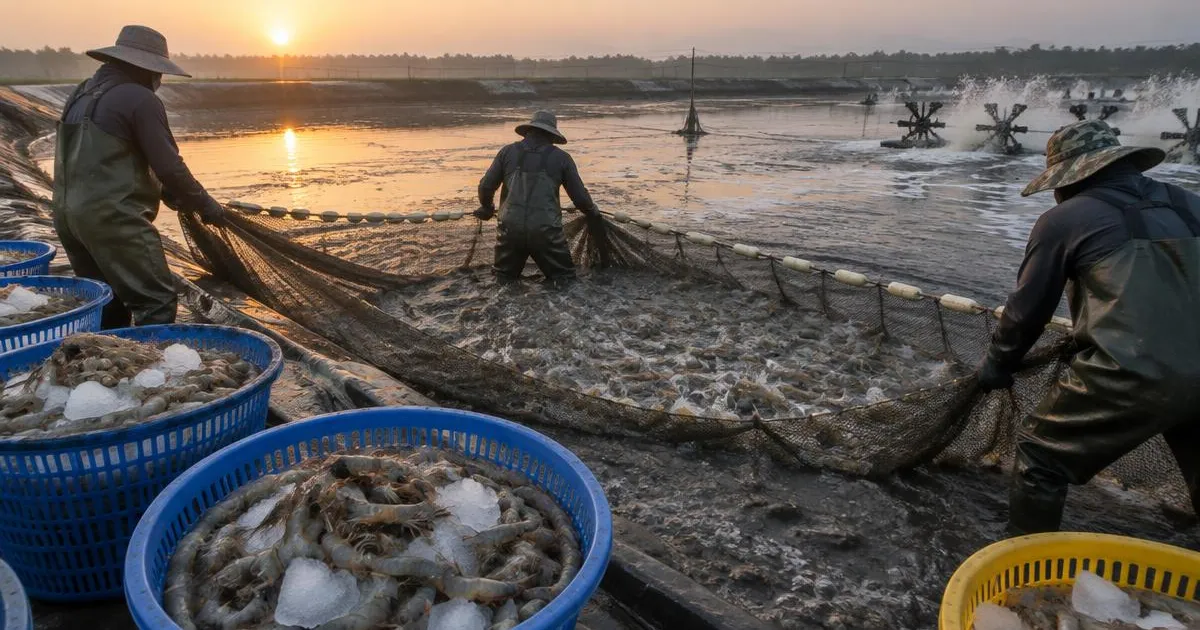
Short answer: to make a shrimp harvest buyer-ready, plan backwards from what a buyer will actually accept — size, form, quantity, timing and documents — and check that your stocking and harvest schedule, harvest equipment, processing slot and cold chain can deliver it. Use your own farm records and your technical team's dates. A production plan is a scenario until a buyer has agreed terms.
Why capacity is not the same as a commitment
FAO reported that in 2022 aquaculture overtook capture fisheries as the main producer of aquatic animals for the first time (FAO SOFIA 2024 announcement). That global trend says nothing about whether a particular farm can fill a particular order. Buyers commit to specifications and windows; farms produce biomass under biological uncertainty. Planning closes that gap.
Step 1: Start from the buyer specification
Write down the size count, processing form, chilled or frozen format, net-weight basis, pack and delivery window the buyer requires (the wholesale shrimp RFQ checklist lists the fields). Each one becomes a planning constraint for harvest timing, grading and processing.
Step 2: Map the system you actually have
Earthen ponds, lined ponds, biofloc and shrimp RAS give different control over timing, water and biosecurity, but none of them guarantees continuous supply. Record your real units, cycle history and constraints. For equipment and system choices, see the shrimp farming equipment guide; for new builds or upgrades use the aquaculture project RFQ.
Step 3: Build a stocking and harvest window table
For each pond, tank or batch, enter the stocking date, the earliest and latest harvest dates your technical team supports, and the reason for the range. Do not fill gaps with generic growth, survival or feed conversion figures. Unknowns stay visible as open items with an owner.
Step 4: Convert harvest into saleable product
Live harvest weight is not invoiced weight. Grading, heading or peeling, rejects and the agreed net-weight basis all change what you can sell. Use measured conversion data from your own processing records or your processor; if you have none, mark the conversion as unknown instead of assuming a rate.
Step 5: Check harvest, processing and cold-chain capacity
- Harvest equipment throughput for the planned batch (the shrimp harvest vacuum calculator sizes pumps within its stated engineering scope; it does not predict growth or yield).
- Processor intake slot and daily capacity.
- Chilling, freezing, cold-store and transport capacity matched to the buyer's window.
- See harvest planning and shrimp harvest and post-harvest quality for handling detail.
Step 6: Match windows to commitments
Overlay your harvest windows on the buyer's delivery windows. Where they overlap with capacity at every step, you have a candidate offer; where they do not, you have a coordination problem to resolve before promising anything. Offer only quantities and dates your records support.
Tool: harvest-to-buyer alignment worksheet
| Row | What to enter |
|---|---|
| Batch | Pond/tank or batch reference; system type |
| Stocking | Date and source record |
| Harvest window | Earliest and latest dates; who set them and why |
| Saleable quantity | Expected net kg in the buyer's form; conversion source or unknown |
| Processing and cold chain | Intake slot, capacity basis, storage and transport responsibility |
| Buyer window | Requested delivery window and destination |
| Status | Scenario or agreed terms; reviewer and next check date |
Nothing in this worksheet is prefilled. Cost questions belong in the shrimp farm cost calculator, which uses only your entered assumptions and makes no financial promise.
Offering a harvest through FishMatch
Producers with commercial output can describe it privately through producer output intake. Everything you declare stays seller-declared until our staff record a review, and identities are released only under our consent rules. We do not guarantee a buyer, price or sale. Our terms (section 7A) set out seller responsibilities.
Sources and scope
- FAO SOFIA 2024 announcement.
- Codex Principles for traceability/product tracing, CXG 60-2006.
- Checked 18 October 2026. General planning guidance, not biological, engineering or financial advice.
Private import desk
For programs of USD 250,000 or more in total value. Buyers and suppliers never contact each other directly; FishMatch staff handle questions, offers and any introduction.
Producers, processors and exporters
Apply for private review. Applications stay pending until staff check the evidence; registering does not make you a verified supplier.
Supplier applicationImporters and wholesale buyers
Register your company privately, then submit a sourcing request. Staff review every registration; it is not an approval or an order.
Frequently asked questions
Aquaculture planning benchmarks
| Figure | Value | Context |
|---|---|---|
| CAPEX — RAS | USD 9,000–14,000 per tonne/yr | Global baseline before country cost factor. |
| CAPEX — Ponds | USD 1,800–4,000 per tonne/yr | Lined or earthen ponds, excluding land. |
| CAPEX — Cages | USD 2,500–5,500 per tonne/yr | Cages, moorings, nets and service equipment. |
| CAPEX — Flow-through | USD 4,000–7,000 per tonne/yr | Raceways and water intake works. |
| Energy use | RAS ~6 kWh/kg; ponds ~1.2; flow-through ~1.5; cages ~0.3 | Per kg of fish produced. |
| Typical FCR | Trout 1.1; salmon 1.2; shrimp 1.4; tilapia 1.6; carp 1.8 | kg feed per kg growth; varies with feed and management. |
| Farm size where FishMatch reviews projects | From ~USD 250,000 total project value | Commercial fish and shrimp projects. |
Related articles
Where this fits in a real project
Every FishMatch project runs through the same five reviewed stages, from a first enquiry to comparable quotations. See the full buyer journey.
Planning a commercial aquaculture project?
Send your project brief. A FishMatch specialist reviews it before relevant suppliers are contacted privately.
Request a quote