Aquaculture Equipment in the Philippines: How to Scope and Compare RAS, Cage, Pond and Hatchery Packages
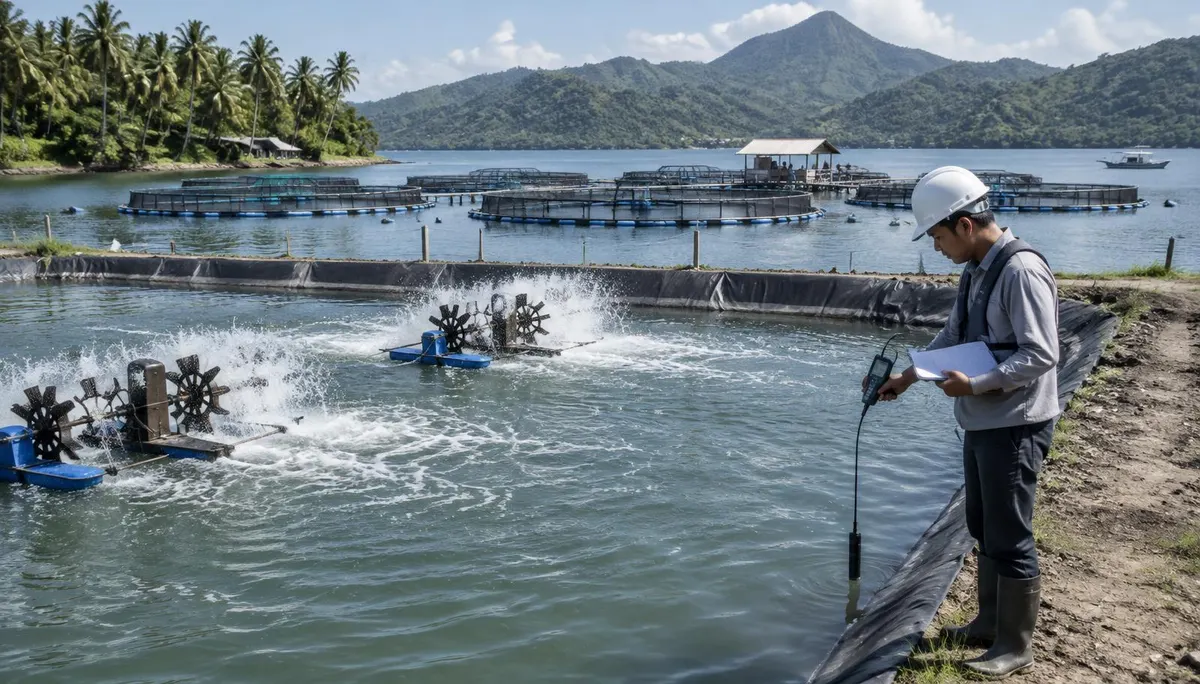
Short answer: in the Philippines, the right aquaculture equipment follows the site, not the catalogue. Brackish-water ponds for bangus (milkfish) and shrimp, freshwater ponds and lake cages for tilapia, sea cages for bangus and marine finfish, and tanks or RAS for hatcheries and nurseries each need a different package. Confirm the site's legal status, water, typhoon exposure and power first; then send one written brief to several suppliers and compare installed scope, storm design, oxygen delivery, backup power and service coverage outside Metro Manila — not the headline price. Start a project brief — free for buyers, no obligation.
Written by the FishMatch Group editorial team. Published 23 October 2026. Official sources were checked on 23 October 2026; rules and agency procedures change, so confirm current requirements with the competent authority before you commit to a site or a supplier.
Who this guide is for: operators and investors planning a commercial farm, hatchery, nursery or modernisation package — typically a project of USD 250,000 or more where pumps, aeration, cages or tanks, power and monitoring must work together. If you need one aerator, a few nets or a replacement pump, a local aquaculture supply store or distributor is usually the faster route, and this guide will be more than you need.
What FishMatch does and does not do
- Does: helps you turn the project into one written brief, circulates it confidentially to suppliers matched to the scope, and returns proposals organised so they can be compared line by line. You decide whether and whom to engage.
- Does not: manufacture, sell, import, install or operate equipment; apply for or grant permits; or guarantee a supplier, price, delivery date or production result.
- Free for buyers. Supplier sourcing help is for commercial projects of USD 250,000 or more. Supplier identities are shared only through the reviewed process, with your approval.
Start from the site type, not the equipment list
FAO's National Aquaculture Sector Overview for the Philippines describes a sector built on milkfish, tilapia and shrimp farmed in brackish-water ponds, freshwater ponds, fish pens and cages in lakes, bays and the sea. The overview is an older reference, so use it for context and check current production statistics with the Philippine Statistics Authority and BFAR. For procurement, the practical point is that each site type changes what must be quoted.
| Site type | Typical species | Core equipment package | Questions that change the quote |
|---|---|---|---|
| Brackish-water fishpond | Bangus, shrimp | Gates and intake pumps, aerators, liners for intensive cells, reservoir and settling ponds, DO monitoring, harvest and ice | Tidal range, salinity, intensification level, sludge handling, distance to grid power |
| Freshwater pond | Tilapia | Aerators, feeders, pumps, harvest nets and grading, DO monitoring | Water source reliability, stocking plan, power backup |
| Lake or reservoir cages and pens | Tilapia, bangus | Cages and nets, moorings, feed boats or barges, DO monitoring, emergency aeration | Carrying-capacity limits, turnover season, local permit conditions |
| Sea cages | Bangus, marine finfish | HDPE cages, engineered moorings, nets and predator protection, service boats, shore base | Design waves and currents, typhoon exposure, depth, distance to shore |
| Hatchery or nursery (tanks or RAS) | Fry, fingerlings, post-larvae | Tanks, filtration, UV, blowers, broodstock and larval systems, live-feed units, backup power | Biosecurity level, seawater or freshwater intake, output per cycle |
Permits and legal checks before you ask for quotes
Suppliers cannot design a sensible package for a site that cannot be used. The Philippine Fisheries Code (Republic Act 8550, as amended by Republic Act 10654) sets several checks that belong at the start of a project, not the end:
- Section 87 makes it unlawful to culture fish, fry or fingerlings, or to construct and operate fish pens, fish cages or fishponds, without a license, lease or permit.
- Fishponds on public land are held under a Fishpond Lease Agreement (FLA) or another tenurial instrument; the amended Section 6 sets how FLA rentals are determined.
- Section 99 makes it unlawful to convert mangroves into fishponds or for any other purpose. A site plan that clears mangroves is not a procurement question.
- Section 109 penalises owners and operators of fishponds, fish pens and fish cages who do not submit the annual report required by Section 57; an FLA can be cancelled after two consecutive years without it.
- Section 112 requires aquaculture operations to follow good aquaculture practices and environmentally sound design guidelines issued by the Department.
Environmental clearance is a separate track. Check with the DENR Environmental Management Bureau whether your project needs an Environmental Compliance Certificate under the Philippine Environmental Impact Statement System. For cages and pens in municipal waters, confirm the permit route with the city or municipal government and the BFAR regional office. If the plan depends on imported broodstock, post-larvae or fingerlings, confirm the current BFAR import requirements before you size the hatchery or nursery around them. FishMatch does not interpret or obtain permits; suppliers can provide technical documents, but approvals remain with you and the authorities.
Typhoons and power: the two inputs that change every quote
PAGASA, the national weather service, reports that an average of about 20 tropical cyclones enter the Philippine Area of Responsibility each year, with 8 or 9 crossing the country. For cages, pens, shore facilities and pond embankments, storm exposure is a design input that must be stated in the brief and answered in the proposal.
- Ask cage and mooring suppliers which design wave height, current and wind they assumed, who performed the mooring calculation and what the storm-preparation procedure is.
- Ask for the materials specification: UV-stabilised HDPE, marine-grade fittings, net material and mesh, and the replacement interval the supplier expects at your site.
- State the power situation honestly: grid availability, typical interruptions, and the generator capacity needed to keep critical aeration and minimum pumping running. Ask for automatic transfer, fuel autonomy in hours and dissolved-oxygen alarms that work without internet.
- Compare aerators on oxygen delivered — standard oxygen transfer rate (SOTR) and aeration efficiency (SAE, kg O2 per kWh) — not on horsepower. Two machines with the same motor can deliver very different oxygen per peso of electricity.
Where RAS fits in the Philippines
Recirculating aquaculture systems (RAS) give control over water quality, temperature and biosecurity, but they carry continuous energy, oxygen and skills costs. In Philippine projects, RAS is most often considered for hatcheries, nurseries, broodstock holding and higher-value species, where control is worth paying for. For grow-out of bangus or tilapia, test RAS against pond and cage alternatives on cost per kilogram using your own electricity tariff, feed price and market price — not a supplier's example. The RAS sizing calculator and the guide to comparing RAS equipment quotes help you check a proposal's design basis.
What to put in the brief
- Species, life stage and annual production target in tonnes (or fry, fingerlings or post-larvae per cycle for a hatchery).
- Site type and location: province, municipality, brackish pond, freshwater pond, lake, bay or open sea, with depth and access.
- Legal status of the site: titled land, FLA, or permit route in municipal waters, and any environmental clearance already obtained or pending.
- Water: source, salinity, temperature range, known quality issues and any laboratory analysis.
- Exposure: typhoon history at the site, design conditions you require, and shore facilities.
- Power: grid connection, voltage and phase, interruptions, and the critical load that must survive an outage.
- Existing infrastructure being kept, upgraded or replaced.
- Scope: equipment only, or supply with installation, commissioning, training and spare parts.
- Delivery: Incoterm, port of entry (for example Manila, Cebu or Davao) and inter-island transport to site.
- Budget range, funding route and target start date.
How to compare proposals like-for-like
| Line to compare | What to ask | Warning sign |
|---|---|---|
| Scope boundary | Exactly what is included and excluded, item by item | A low price that silently excludes moorings, installation or power |
| Design basis | Biomass, feed load, temperature and density used to size the system | No stated design basis, or different assumptions between suppliers |
| Oxygen and aeration | SOTR/SAE figures and the oxygen balance behind the aerator count | Horsepower only |
| Storm design | Design conditions, mooring calculation and who signs it | "Typhoon-proof" with no stated conditions |
| Backup power | Generator size for the critical load, transfer and fuel autonomy | Backup listed as optional |
| Landed cost | Incoterm, freight, duties, port handling and inter-island transport | Factory price compared with another supplier's delivered price |
| Installation and training | Who installs, how many days, and what the crew is trained to do | Installation "by others" with no named party |
| Spare parts and service | Parts held in the Philippines, response times by island, warranty terms | Parts only from overseas with no stated lead time |
Normalise proposals in one sheet before negotiating. The free bid normaliser works for RAS and for other packages where suppliers quote different scopes.
Local distributor, online catalogue, single integrator or managed sourcing?
There is no single right route; each solves a different problem.
| Route | Good for | Limits to plan around |
|---|---|---|
| Local aquaculture supply store or distributor | Single items, consumables and replacements, often from local stock | Rarely coordinates a multi-supplier, engineered package |
| Online B2B catalogue or marketplace | Broad discovery of products and manufacturers | You reconcile specifications, verify claims and manage contact yourself |
| Single integrator or turnkey supplier | One party responsible for design and delivery | One design view; compare at least two integrators on the same brief |
| Managed buyer-side sourcing (FishMatch) | Commercial projects that need one brief and comparable proposals, handled confidentially | Not designed for small single purchases; USD 250,000 minimum for sourcing help; does not sell or install |
Common mistakes
- Ordering equipment before the site's lease, permit or environmental route is confirmed.
- Specifying cages or pens without stating design storm conditions.
- Comparing a factory price with a delivered and installed price.
- Treating generators, alarms and emergency aeration as extras.
- Sizing aeration from horsepower rules instead of an oxygen balance at peak biomass.
- No plan for spare parts and service on the island where the farm operates.
Tools and next steps
- Size the biology: stocking density, biomass and oxygen demand.
- Size aeration: aeration sizing.
- Budget the project: commercial CAPEX estimator and the Philippines farm cost calculator.
- Read the market context: Philippines aquaculture market guide and commercial fish farm setup in the Philippines.
- Understand the system list: fish farming equipment by system type.
- When the brief is ready: start a human-reviewed project brief.
Sources
- Republic Act No. 10654 amending the Philippine Fisheries Code (RA 8550), Official Gazette of the Republic of the Philippines: officialgazette.gov.ph — checked 23 October 2026.
- Tropical cyclone information, PAGASA: pagasa.dost.gov.ph — checked 23 October 2026.
- Environmental Impact Assessment, DENR Environmental Management Bureau: emb.gov.ph — checked 23 October 2026.
- National Aquaculture Sector Overview: Philippines, FAO (older reference): fao.org — checked 23 October 2026.
- Bureau of Fisheries and Aquatic Resources: bfar.da.gov.ph — confirm current permits and import requirements directly.
Frequently asked questions
Key figures
| Figure | Value | Context |
|---|---|---|
| Cost | USD 250,000 | Who this guide is for: operators and investors planning a commercial farm, hatchery, nursery or modernisation package — typically a project of USD 250,000 or more where pumps, aeration, cages or… |
| Cost | USD 250,000 m | | Route | Good for | Limits to plan around | |---|---|---| | Local aquaculture supply store or distributor | Single items, consumables and replacements, often from local stock | Rarely coordinates… |
Related articles
Where this fits in a real project
Every FishMatch project runs through the same five reviewed stages, from a first enquiry to comparable quotations. See the full buyer journey.
Planning a commercial aquaculture project?
Send your project brief. A FishMatch specialist reviews it before relevant suppliers are contacted privately.
Request a quote