Trout Farm Planning in Kazakhstan and Kyrgyzstan: Cages, RAS and Flow-Through
Also in:Русский
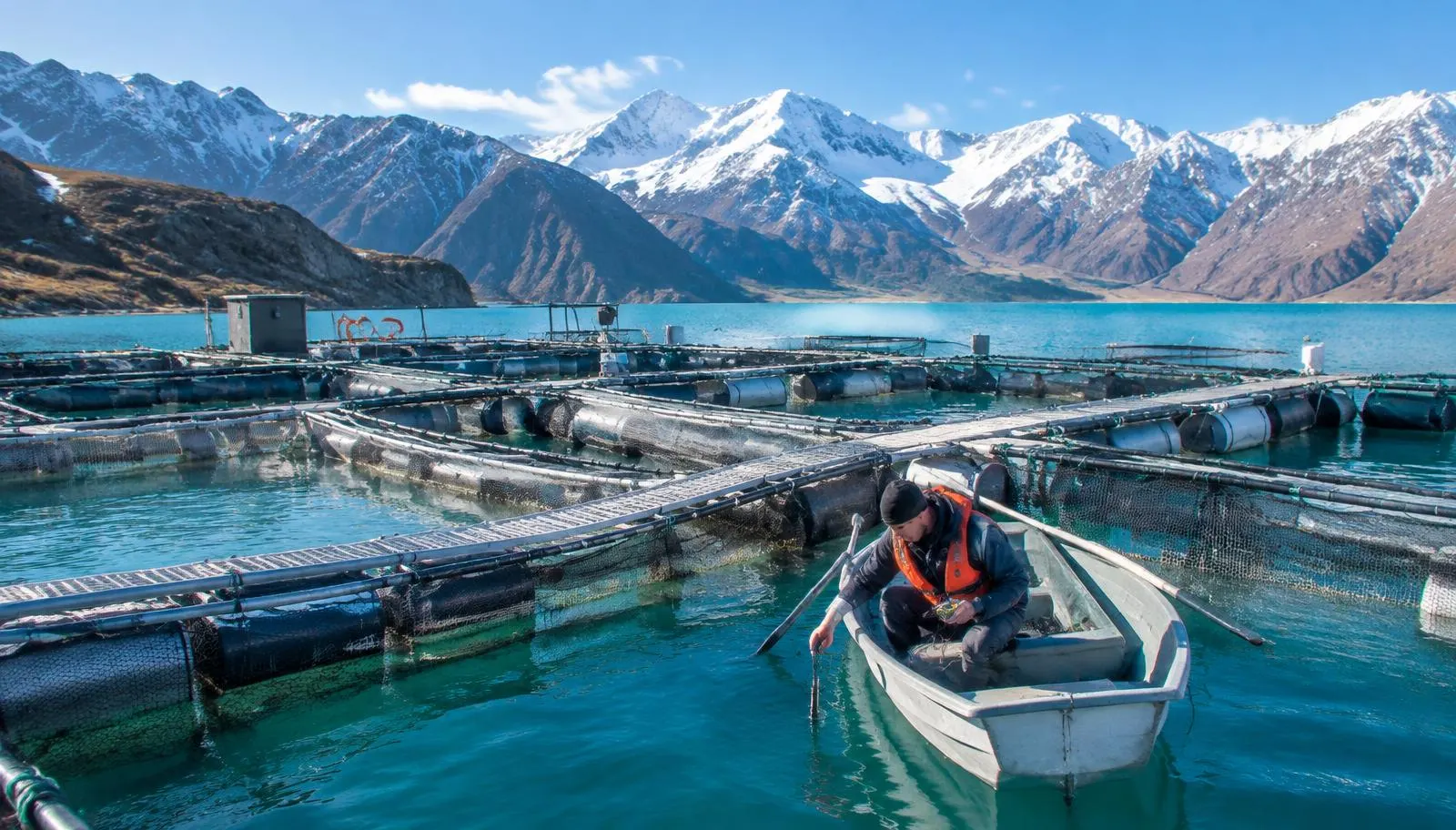
Short answer: Kazakhstan and Kyrgyzstan are distinct markets that share one planning problem — commercial cold-water fish (mainly rainbow trout, plus sturgeon in Kazakhstan) produced far from seaports, with imported equipment and feed. In Kazakhstan, start from the state Fisheries Development Programme 2021–2030 and its subsidy measures, and choose between RAS, ponds and cages by water source. In Kyrgyzstan, most growth is cage trout on reservoirs and rivers, so site licensing, biosecurity and fish-health compliance decide whether a project is bankable. Treat every subsidy and permit as something to confirm with the authority before you buy equipment.
1. Why one regional guide for two countries
Both markets search in Russian for the same buyer topics — fish farm business plans (бизнес план рыбного хозяйства), recirculating systems (УЗВ) and pond aerators — and both import most specialised equipment over long overland routes. Their policy and production context is different, so this guide keeps the shared engineering checklist in one place and separates country facts. If you are planning in Uzbekistan, use our dedicated Uzbekistan cold-water farm guide instead.
2. Kazakhstan: what the official programme says For market size, species and regulators, see the [Kazakhstan aquaculture market overview](/markets/kazakhstan).
Kazakhstan adopted the Fisheries Development Programme for 2021–2030 by Government Decree No. 208 of 5 April 2021 (FAOLEX text). According to the Prime Minister's office, the programme plans to raise aquaculture output to 270,000 tonnes of fish a year by 2030, with subsidies for production and investment costs and simplified procedures; in the first ten months of 2022 the country grew 14,100 tonnes of farmed fish (primeminister.kz, Dec 2022). The gap between those two numbers is the opportunity — and the risk: targets are not orders, and support schemes change.
FAO describes the sector as still underdeveloped, limited by technical expertise and access to quality inputs, and is implementing a GEF-funded project with Kazakhstan's Fisheries Research and Production Centre on sustainable inland aquaculture (FAO). For a buyer, that translates into three planning facts: budget for imported feed and fingerlings or eggs, plan for operator training, and design water treatment conservatively.
3. Kyrgyzstan: cage trout and biosecurity
FAO reports that Kyrgyzstan grew 33,600 tonnes of marketable fish in 2023, mostly rainbow trout, with private investment in industrial cage farms along the Naryn River and small pond farms elsewhere (FAO, Feb 2024). The same source warns that the lack of territorial planning has created biosafety and fish-health risks, and FAO is supporting enforcement of veterinary standards in trout farms. FAO's aquafeed value-chain study also notes that feed is a key constraint in the sector (FAO feed study).
Practical consequence: a cage project in Kyrgyzstan should be planned around a licensed site with clear spacing from other farms, a fallowing plan, health certification for eggs or fingerlings, and a feed supply contract — before net sizes and boat specifications.
4. Choosing a system by water source
| Water situation | Usual system | Main equipment to specify | Main risk |
|---|---|---|---|
| Reservoir or large river with licensed site | Floating cages | Cages and nets, moorings, workboats, feeding, oxygen monitoring | Disease spread between farms, ice, water-level change |
| Cold spring or river with steady flow | Flow-through raceways | Intake and screens, raceways, oxygenation, outflow settling | Low flow and high temperature in late summer |
| Limited water, near market or power | RAS | Drum filter, biofilter, degassing, oxygen cones, UV, backup power | Higher CAPEX, energy and skills |
| Warm-water ponds (carp polyculture) | Ponds with aeration | Aerators, pumps, monitoring, harvest gear | Seasonal growth, low price per kg |
Trout needs cold, well-oxygenated water all year; check the warmest month, not the average. Use our Oxygen Demand Calculator to size aeration or oxygen supply from your planned biomass, and the RAS Feasibility Calculator if you are comparing a closed system with a flow-through site.
5. Buyer checklist before requesting quotes
- Water: 12 months of temperature, flow and dissolved-oxygen readings at the intake or cage site.
- Permits: water-use and site rights, environmental approval and veterinary registration confirmed in writing.
- Stock: licensed source of eggs or fingerlings with health certificates.
- Feed: supplier, pellet sizes, delivery lead time and storage.
- Power: grid capacity and a backup generator for any pumped or oxygenated system.
- Logistics: overland route, customs and Incoterms for each package.
- People: who will operate the farm, and the training each supplier includes.
6. Common costly mistakes
- Sizing a farm on average water temperature and losing fish in a hot August.
- Buying cages before the site licence and spacing rules are confirmed.
- Assuming a subsidy is approved because a programme exists.
- Comparing equipment offers with different scope — see how to compare RAS equipment quotes.
- Ignoring transit time: overland deliveries to Central Asia can add weeks, so order critical spares with the first shipment.
7. Worked example (illustrative assumptions only)
Assume a 300-tonne-per-year trout farm. On a licensed reservoir site the main packages would be cages and moorings, nets, a feeding system, oxygen monitoring, boats and a small processing area. On a spring-fed site the same output would need raceways, an intake, oxygenation and outflow treatment. As a RAS it would need a full water-treatment train and backup power, with much higher capital and energy cost. These are planning assumptions, not quotes — use the CAPEX Estimator and OPEX Estimator to build a first budget in your own figures, in tenge (KZT) or som (KGS).
8. Questions to ask suppliers
- What water temperature and oxygen range is the design based on, and what happens above it?
- Which items are delivered pre-assembled, and what must be built locally?
- What is included in commissioning and operator training, and in which language?
- Which spares are recommended for the first two years, and how long does a replacement take to reach site?
- What warranty applies, and who services it in the region?
9. Summary
Plan from water and permits first, then the system, then equipment. Confirm every subsidy, licence and veterinary requirement with the authority; budget for imported feed, stock and spares; and compare quotes on identical scope. For projects of USD 250,000 or more, you can send a project brief and a member of the FishMatch Group team will review it personally — supplier identities stay confidential until you choose to engage.
10. Sources
- Government of Kazakhstan, Decree No. 208 of 5 April 2021, Fisheries Development Programme 2021–2030 — FAOLEX
- Office of the Prime Minister of Kazakhstan, 6 December 2022 — primeminister.kz
- FAO, Transforming inland fisheries and aquaculture in Kazakhstan (GEF ID 11373) — fao.org
- FAO, veterinary standards in Kyrgyz trout farms, 8 February 2024 — fao.org
- FAO, Characterization of the aquaculture sector in the Kyrgyz Republic: aquafeed value chain — FAO Open Knowledge
Frequently asked questions
Key figures
| Figure | Value | Context |
|---|---|---|
| Size / capacity | 270,000 tonnes; 14,100 tonnes | According to the Prime Minister's office, the programme plans to raise aquaculture output to 270,000 tonnes of fish a year by 2030, with subsidies for production and investment costs and… |
| Size / capacity | 33,600 tonnes | FAO reports that Kyrgyzstan grew 33,600 tonnes of marketable fish in 2023, mostly rainbow trout, with private investment in industrial cage farms along the Naryn River and small pond farms… |
| Time / lead time | 12 months | - Water: 12 months of temperature, flow and dissolved-oxygen readings at the intake or cage site. |
| Cost | USD 250,000 | For projects of USD 250,000 or more, you can send a project brief and a member of the FishMatch Group team will review it personally — supplier identities stay confidential until you choose to engage. |
Related articles
Where this fits in a real project
Every FishMatch project runs through the same five reviewed stages, from a first enquiry to comparable quotations. See the full buyer journey.
Planning a commercial aquaculture project?
Send your project brief. A FishMatch specialist reviews it before relevant suppliers are contacted privately.
Request a quote