Sourcing Farmed Tilapia and Shrimp from Brazil: A Buyer's Guide to Volumes, Export Flows and Checks
Short answer: Brazil is a large aquaculture producer but a small seafood exporter. IBGE counted 499,400 tonnes of farmed tilapia and 146,800 tonnes of farmed shrimp in 2024, yet Brazil's tilapia fillet exports were worth USD 36.6 million in 2024 and went almost entirely to the United States, and frozen shrimp exports were under USD 3 million. A buyer should therefore expect to qualify specific export-ready plants, not pick from an established export menu, and check each plant's federal inspection (SIF) registration and destination listing before comparing prices.
FishMatch Group editorial team · Sources checked
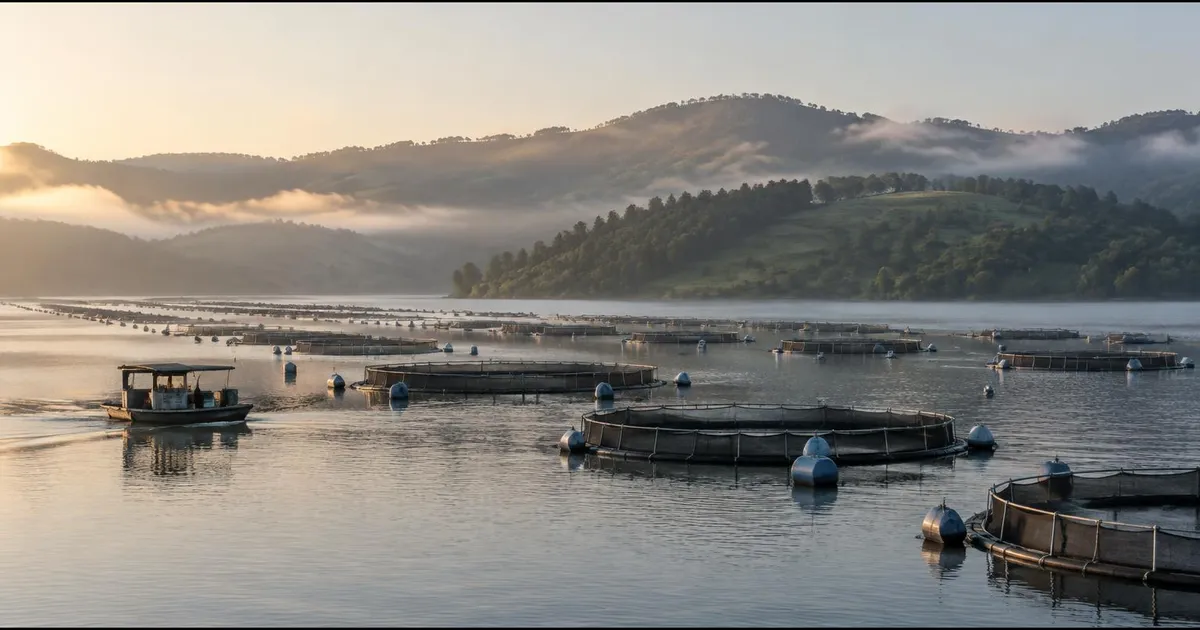
What Brazil farms, in official numbers
Brazil's statistics office IBGE publishes farmed production every year in its Municipal Livestock Survey (PPM). For 2024, released on 18 September 2025, it reports 724,900 tonnes of farmed fish, of which tilapia was 499,400 tonnes (68.9% of all farmed fish and 12.8% more than in 2023). Paraná alone produced 38.2% of national tilapia. Farmed shrimp reached 146,800 tonnes, with Aracati in Ceará the leading municipality.
These are farm-gate harvest volumes, not export volumes. Most of this fish and shrimp is sold inside Brazil. For a foreign buyer the useful reading is: tilapia supply exists at industrial scale and is concentrated in the South and South-East reservoir and pond regions; shrimp is concentrated in the North-East coastal states.
| Product | 2024 volume | Note |
|---|---|---|
| All farmed fish | 724,900 t | +10.3% on 2023 |
| Tilapia | 499,400 t | 68.9% of farmed fish; Paraná 38.2% of national tilapia |
| Farmed shrimp | 146,800 t | Aracati (Ceará) is the leading municipality |
Where Brazilian exports actually go
Brazil's own export declarations to UN Comtrade show how small the export trade still is compared with production. In 2024 Brazil exported USD 36.6 million (about 4,760 tonnes) of fresh or chilled tilapia fillets, up from USD 14.1 million in 2023, and USD 35.8 million of that went to the United States. Frozen whole tilapia exports were USD 14.7 million, frozen tilapia fillets only USD 0.4 million, and frozen warm-water shrimp USD 2.9 million.
Two practical consequences follow. First, a buyer outside North America is often asking a plant to qualify for a new destination, which takes time and documents. Second, fresh fillets made up most of the 2024 export value and almost all of it went to the United States, so a frozen-fillet programme for Europe, Asia or the Middle East may be a specification the plant does not yet run at scale — ask.
| HS line | 2023 | 2024 | Main 2024 destination |
|---|---|---|---|
| 030431 Fresh or chilled tilapia fillets | 14.1 | 36.6 (4,756 t) | United States 35.8 |
| 030323 Frozen whole tilapia | 5.9 | 14.7 (5,428 t) | — |
| 030461 Frozen tilapia fillets | 1.3 | 0.4 (83 t) | United States 0.3 |
| 030617 Frozen warm-water shrimp | 2.4 | 2.9 (154 t) | — |
The registrations to check before you compare offers
Every Brazilian plant that exports animal products must be registered with the federal inspection service (SIF) of the Ministry of Agriculture (MAPA). For many destinations it must also be enabled ('habilitado') for that country, and MAPA publishes the lists of enabled establishments by country and product area, including fishery products.
Ask for the SIF number of the plant that will pack your product, then check it yourself in MAPA's list for your destination. Do the same in the destination's own system where one exists, such as the EU's list of approved establishments. A trading company's SIF is not enough if a different plant processes the fish.
- SIF registration number of the packing plant, and the plant name on the health certificate.
- Whether the plant is enabled for your destination country in MAPA's list for fishery products.
- Farmed or wild, species by scientific name (Nile tilapia is Oreochromis niloticus) and the farm or region of origin.
- Residue testing for the lot, and the destination's own import rules for farmed fish and shrimp.
- Any certification claim (for example BAP or ASC) checked with the certifier, not only on the supplier's website.
Specifications that make Brazilian offers comparable
Because most plants were set up for the domestic market or for fresh fillets to the US, the specification you send decides whether offers can be compared at all. State every item below, and convert answers to one basis before ranking prices.
- Form: whole gutted, fillet skin-on or skinless, trim level, portion size; fresh or frozen, IQF or interleaved.
- Size: fillet weight band or fish weight band, and the tolerance you accept.
- Freezing and glaze: glaze percentage and whether price is per kilogram of net weight.
- Treatments and additives you will or will not accept.
- Packing: inner pack, carton weight, labelling language, private label.
- Volume per shipment, frequency and season; air or sea freight; Incoterms rule and named place.
Shrimp from Brazil: what the numbers allow you to expect
Brazil farmed 146,800 tonnes of shrimp in 2024 but exported only USD 2.9 million of frozen warm-water shrimp. Treat a Brazilian shrimp export programme as a qualification project: confirm that the plant is enabled for your destination, that it can supply your count sizes and forms consistently, and that its residue testing meets your market's rules. Do not assume year-round export volume; ask each supplier for its harvest calendar and committed monthly quantities.
How a buyer-side request works
Send one structured seafood request with the specification above. FishMatch Group reviews it, approaches suitable Brazilian producers and exporters, asks for the same documents from each, and returns offers on one basis. Your company name is not shared with suppliers without your agreement, and suppliers answer through our team. The producer or exporter remains responsible for the product, its handling, certification and export compliance; the importer of record is responsible for import requirements.
Questions buyers ask about Brazilian farmed seafood
How much tilapia does Brazil farm?
IBGE reports 499,400 tonnes of farmed tilapia in 2024, 68.9% of Brazil's 724,900 tonnes of farmed fish. Paraná produced 38.2% of the national total.
Where does Brazil export tilapia?
In 2024 Brazil reported USD 36.6 million of fresh or chilled tilapia fillet exports, of which USD 35.8 million went to the United States. Exports of frozen tilapia fillets were only USD 0.4 million.
Does Brazil export much shrimp?
Not yet. Brazil farmed 146,800 tonnes of shrimp in 2024 according to IBGE, but reported only USD 2.9 million of frozen warm-water shrimp exports to UN Comtrade for that year.
What registration should a Brazilian seafood plant have?
Federal inspection (SIF) registration with MAPA and, where the destination requires it, enablement for that country in MAPA's published lists. Check the plant's SIF number yourself, together with any destination-side listing.
Is the sourcing service free?
Yes for buyers. Managed sourcing is for recurring or seasonal programmes of at least USD 250,000 in total. FishMatch Group does not sell, export or certify seafood and does not guarantee price, stock or approvals.
Sources (checked 25 October 2026)
- IBGE — PPM 2024: value of livestock and aquaculture production (released 18 Sep 2025)
- IBGE SIDRA — PPM aquaculture production tables, Brazil 2024
- UN Comtrade — Brazil exports by HS code and partner, 2023–2024 (retrieved 25 Oct 2026)
- MAPA — Enablement of SIF-registered establishments for export
- MAPA — Establishments enabled for export by country