Planning a Commercial Shrimp Farm: A Practical Buyer's Guide to Systems, Equipment and Supplier RFQs
A decision path for developers, operators and processors assessing a new or expanded shrimp farm: what to decide first, which specialists to involve, and how to turn those decisions into supplier quotes you can actually compare.
FishMatch Group project team · Updated · Also available in: Español · Français · Русский · العربية · Português · Bahasa Indonesia · 中文
The short answer
Plan a commercial shrimp farm in this order: fix the production model, species and target output; confirm the site, water, power and biosecurity limits; secure a reliable post-larvae source; size the core systems (aeration, pumping, filtration, monitoring, feeding and backup) against that biomass; define the harvest and processing interface; and only then send suppliers one written scope so their quotes cover the same work. FishMatch Group coordinates that sourcing and RFQ process. It does not own farms, manufacture equipment or guarantee production results.
Which production model, species and output should you plan for?
Start with the business question, not the equipment list. How many tonnes of shrimp per year do you need, at what size, and for which buyers? The answer decides whether extensive or semi-intensive ponds, lined intensive ponds, biofloc tanks or an indoor recirculating system (RAS) is realistic for your site and budget.
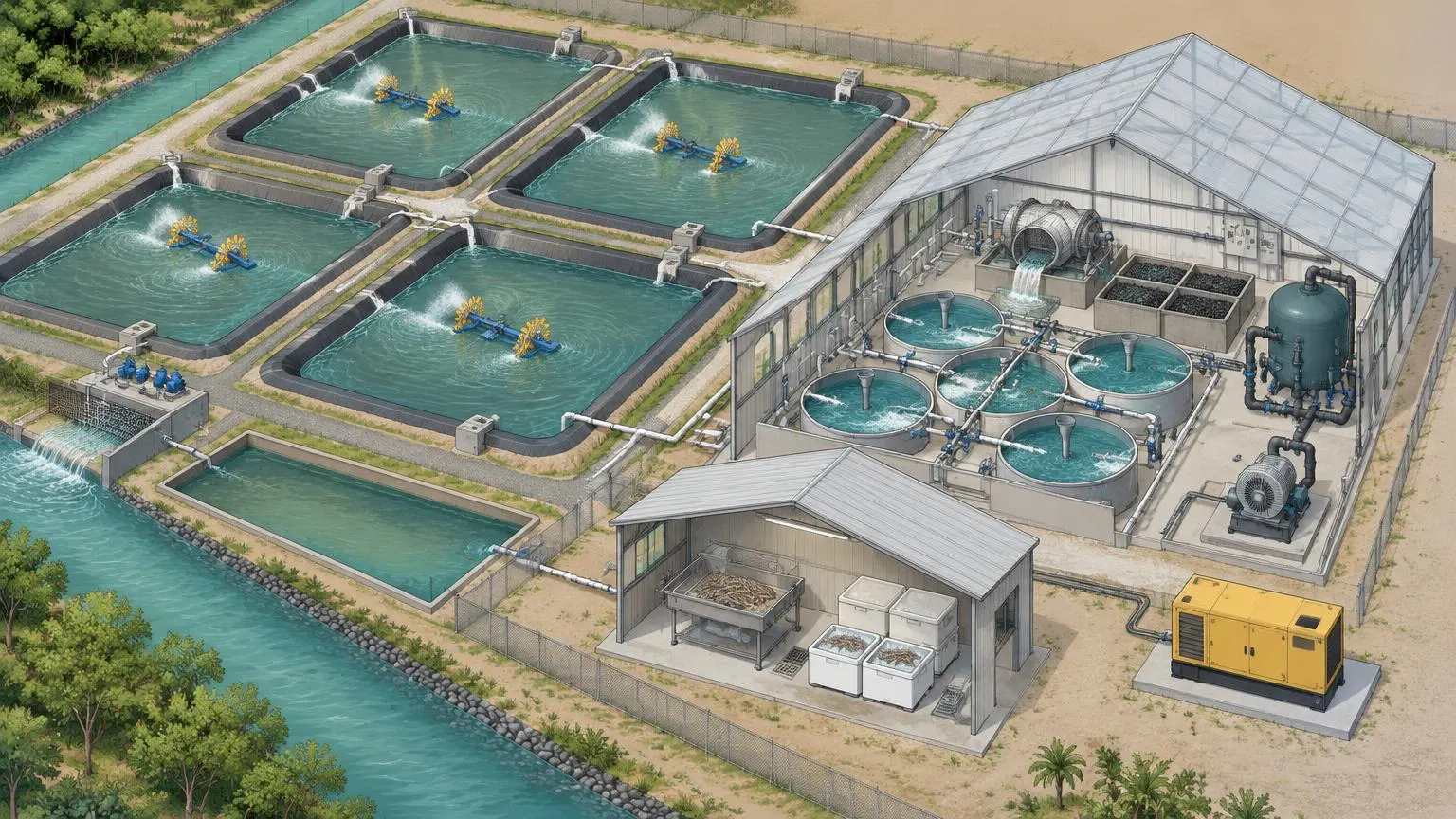
Ponds usually suit projects with suitable coastal or inland land and a dependable brackish or saline water source. Indoor RAS and biofloc suit projects close to premium markets, in cold climates or where land and water are limited, but they shift risk towards energy, water-treatment discipline and staff skills. Many farms combine an indoor nursery with outdoor grow-out.
The species also changes the scope. Whiteleg shrimp (Litopenaeus vannamei), black tiger shrimp (Penaeus monodon) and giant freshwater prawn (Macrobrachium rosenbergii) differ in salinity, temperature and seed availability. Treat the species as a decision to confirm with local experts and seed suppliers, not as a default.
Shrimp farm layout: pond, biofloc and RAS · Indoor RAS shrimp farm planning
What must the site provide: water, power, biosecurity, feed and waste?
A site works only if it can supply enough clean water at the right salinity and temperature all year, a stable power connection with room for standby generation, road access for feed and harvest trucks, and a legal route for discharging water and sludge.
Collect seasonal water analyses before design: salinity, temperature, pH, alkalinity, dissolved oxygen, suspended solids and any known pollutants. Map the biosecurity boundary — intake treatment, fencing, bird netting, vehicle and staff disinfection, and separation between nursery, grow-out and harvest areas. Confirm how feed will be stored dry and rotated, and how pond sediment or RAS sludge will be handled.
- Seasonal water quality and volume at the intake
- Grid capacity, voltage and frequency, plus standby power needs
- Biosecurity zones, intake treatment and disinfection points
- Feed storage, delivery frequency and stock rotation
- Discharge permits, sludge handling and settling capacity
Where will post-larvae come from?
Seed supply is one of the first risks lenders and operators ask about. Decide early whether you will buy post-larvae from a third-party hatchery, run your own nursery to receive smaller post-larvae, or build a hatchery as part of the project.
Whichever route you choose, ask for health certificates, disease-testing records, import permits where seed crosses a border, and a delivery plan that matches your stocking schedule. A hatchery or nursery adds its own equipment scope — broodstock holding, larval rearing tanks, algae and live-feed production, water treatment and heating — which aquaculture hatchery equipment suppliers should price as a separate package.
Shrimp hatchery project scope · Hatchery and nursery equipment
How do you size aeration, pumping, filtration, monitoring, feeding and backup?
All core systems follow from the planned peak biomass and feeding rate. Oxygen demand drives aeration — paddlewheels, aspirators or blowers with diffusers in ponds, and blowers or oxygen injection in tanks. Water exchange and recirculation drive pumping. In RAS and biofloc, solids removal, biological filtration, degassing and disinfection keep water quality stable.
Monitoring should cover at least dissolved oxygen, temperature, pH and salinity, with alarms that reach a person at night. Feeding can be manual, timed or acoustic and demand-based; the right choice depends on labour, pond size and data needs. Backup is not optional: specify standby power, spare aerators or blowers, and an emergency oxygen plan for the critical hours after a power failure.
When you ask for shrimp farm equipment quotes, state the duty — biomass, oxygen demand, flow rates and water quality targets — instead of naming a model, so suppliers can propose fit-for-purpose equipment.
Shrimp farm equipment by system · Aeration sizing calculator · Filtration packages · RAS system equipment
How should harvest, chilling and processing connect to the farm?
Shrimp quality is lost quickly after harvest, so the harvest method, ice or slurry chilling and transport time must be planned with the farm, not afterwards. Decide whether shrimp go fresh to a nearby processor, to your own packing or processing line, or to a third-party plant.
If processing is in scope, define throughput per shift, product forms (head-on, headless, peeled, cooked, frozen), water and power needs, and the food-safety standards your buyers require. Shrimp processing equipment suppliers can then quote graders, peelers, cookers, freezers and packing as one coordinated line. Selling finished seafood is a separate commercial step that sits mainly with Global B2B Group, FishMatch's parent marketplace.
How do you qualify suppliers and get comparable RFQs?
Quotes are only comparable when every supplier answers the same scope. Write down the production basis, site data, the equipment duties, the battery limits (what is and is not included), delivery terms, installation, commissioning, training, spare parts and warranty, and ask each supplier to price against that list.
Qualify suppliers on evidence: reference installations of similar scale and climate, local service or spare-parts support, documentation, and clear exclusions. For aquaculture equipment procurement, compare total delivered and installed cost plus energy, maintenance and spares over the first years — not the headline machine price. The same applies when you collect turnkey RAS system quotes or compare aquaculture RAS suppliers: check what each turnkey offer really includes.
Supplier qualification checklist · Shrimp project RFQ · How the FishMatch sourcing process works
What operating and lifecycle costs should you plan for?
Running costs decide whether a farm stays viable. Ask suppliers for energy use at your operating point, routine maintenance intervals, wear parts and their lead times, expected service life of liners, motors and pumps, and the staff skills needed to operate the system safely.
Build feed, power, seed, labour, water treatment and maintenance into one operating budget, and keep working capital for the first production cycles. Use your own site data and written quotes for these figures; generic per-hectare or per-tonne numbers are not a substitute.
Shrimp farm calculator: stocking, feed cost and harvest · Shrimp farm cost and CAPEX guide · Shrimp cost-per-kg calculator
Which decisions need local engineers, permits and veterinary advice?
Some decisions must be made by qualified local specialists, not by a guide or a supplier brochure: civil and geotechnical design of ponds and buildings; electrical design and grid connection; environmental impact assessment and discharge permits; aquaculture licences and land or water rights; and the biosecurity, health-screening and disease-response plan, which needs a veterinarian or aquatic animal health specialist.
Bring these advisers in before you freeze the scope, and include their outputs in the RFQ so suppliers design to the approved site conditions.
Estimate your shrimp farm with the calculators
Turn the choices in this guide into a free planning estimate: stocking density, survival, harvest weight, feed and cost per kg. Results are preliminary and are not supplier quotes.
Shrimp farm scoping worksheet
Note what you already know. The worksheet lists your answers and the gaps to close before suppliers can quote. Nothing is sent or saved.
Preliminary planning only — not engineering advice, a design, a cost estimate or a supplier quote.
Your scope so far
Target annual output (tonnes of shrimp per year): not set
System type: not set
Species: not set
Site location and area: not set
Water source and seasonal analyses: not set
Power supply and standby: not set
Aeration and oxygen approach: not set
Filtration and water treatment: not set
Feeding method: not set
Post-larvae source: not set
Harvest and processing scope: not set
Still to define before requesting quotes
- Target annual output (tonnes of shrimp per year)
- System type
- Species
- Site location and area
- Water source and seasonal analyses
- Power supply and standby
- Aeration and oxygen approach
- Filtration and water treatment
- Feeding method
- Post-larvae source
- Harvest and processing scope
Download: Commercial Shrimp Farm Equipment RFQ Checklist
A printable one-page list of what suppliers need to quote the same scope. Free, no email needed.
Download the checklist (PDF)Shrimp farm planning FAQ
Should I choose ponds or RAS for a commercial shrimp farm?
It depends on land, water, climate, energy cost, market and team skills. Ponds suit sites with suitable land and water; indoor RAS or biofloc suit sites near premium markets or with limited land, but need tighter water-treatment and power management. Many projects use an indoor nursery with outdoor grow-out.
What should a shrimp farm equipment RFQ include?
The production basis, site and water data, the duty of each system (aeration, pumping, filtration, monitoring, feeding, backup), battery limits, delivery terms, installation, commissioning, training, spare parts and warranty — so every supplier prices the same scope.
Does FishMatch build or operate shrimp farms?
No. FishMatch Group coordinates sourcing and RFQs for buyers. It does not own farms, manufacture equipment or guarantee production results; suppliers and your own engineers remain responsible for design and performance.
Which decisions need local specialists?
Civil, geotechnical and electrical design, environmental and discharge permits, aquaculture licences, and the biosecurity and animal-health plan, which needs a veterinarian or aquatic animal health specialist.
Is there a fee to use the checklist or request quotes?
The checklist and worksheet are free and need no email. Buyers can send a project request through the existing RFQ form; FishMatch reviews each request before contacting suppliers.
Ready to compare supplier quotes?
Send your shrimp project scope through the existing RFQ. The FishMatch project team reviews it and coordinates comparable quotes from qualified suppliers. Projects are reviewed from USD 250,000.
Supplier and manufacturer listings are provided for research, transparency and discovery only. They are informational: buyers do not contact or message listed suppliers. Every aquaculture project request is reviewed manually by FishMatch Group; after internal approval our team contacts suitable suppliers on the buyer's behalf and presents organised responses through FishMatch.