Fish Dying at Dawn in a Pond? Low Oxygen Causes, First Actions and Aeration Checks
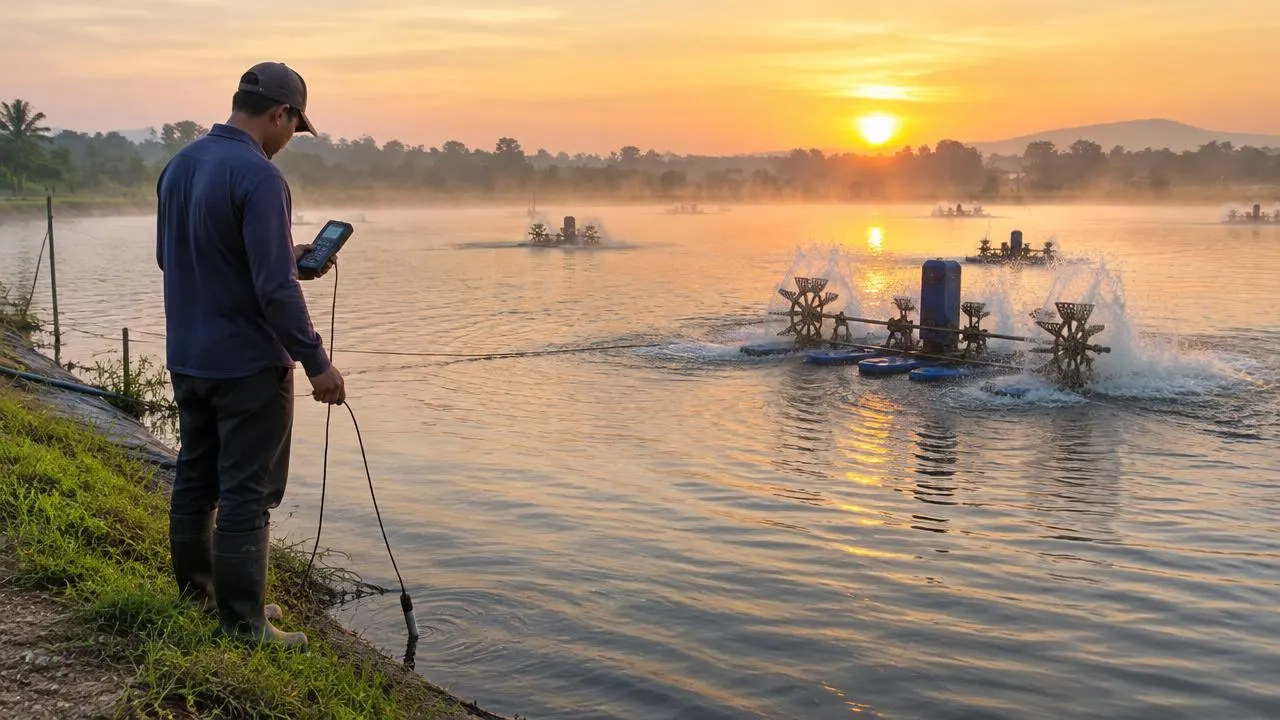
Short answer: fish or shrimp found dead or gasping at the surface around dawn usually means dissolved oxygen (DO) fell below what the stock can tolerate overnight. At night, algae, bacteria in the pond bottom and the stock all use oxygen while nothing produces it, so DO is lowest just before sunrise. The risk is highest on hot, still, cloudy days, after an algae die-off and at peak biomass and feeding. Act now: start all aeration, stop feeding, and measure DO at the surface and near the bottom. Then find why the pond's oxygen budget no longer balances before you buy more aerators.
What are the warning signs?
- Stock gasping or crowding at the surface or at the water inlet, especially at first light.
- Deaths concentrated among the largest animals (they need the most oxygen) after a hot or overcast day.
- Sudden change in water colour (green to brown, grey or clear) or a foul smell: often an algae bloom crash.
- Animals refusing feed in the morning and recovering by afternoon.
- Night DO readings falling lower each day as biomass grows.
What should you do in the first hour?
1. **Start every aerator and any emergency aeration** (backup blower, pump spraying water, fresh water inflow if it is well oxygenated). Check that the power and generator are working. 2. **Stop feeding** until morning DO recovers. Uneaten feed and digestion both use oxygen. 3. **Measure DO** with a calibrated meter at the surface and close to the bottom, in several places, and note the time and water temperature. 4. **Don't add chemicals or treatments** without advice from your aquatic animal-health adviser; some products use oxygen or harm stressed stock. 5. **Record** deaths by size, time and pond, so the cause can be found later.
How do you find the cause? A decision tree
| Question | If yes, likely cause | Next check |
|---|---|---|
| Did deaths follow a hot, still or cloudy day? | Low photosynthesis plus high night demand | Night DO log; aeration capacity vs biomass |
| Did water colour change suddenly? | Algae bloom crash; decaying algae use oxygen | Secchi depth trend; nutrient and feeding history |
| Did biomass or daily feed rise recently? | Stock and feed demand now exceed aeration | Oxygen budget (worked example below) |
| Was there a power cut or aerator failure overnight? | Supply failure, not design | Alarms, generator, aerator hours |
| Is DO low only near the bottom? | Stratification or sludge demand | Bottom DO; sludge depth; aerator placement and mixing |
| Is DO fine but animals still dying? | Not oxygen — possibly ammonia, nitrite, disease or temperature | Full water test and animal-health review |
Worked example: does night aeration cover demand?
The numbers below are **labeled assumptions for illustration**, not values for your species or site. Replace each one with your own measured or supplier-documented figure. | Input | Value used | Basis | |---|---|---| | Standing biomass | 6,000 kg | Assumption | | Stock oxygen use at night | 0.30 kg O₂ per 1,000 kg biomass per hour | Assumption; varies strongly with species, size, temperature and feeding | | Pond (algae + sediment) oxygen use | 0.8 kg O₂ per hour | Assumption; must be measured on site (night DO drop) | | Aerators | 4 × 1.5 kW paddlewheels | Assumption | | Field oxygen transfer | 1.2 kg O₂ per kWh | Assumption; field transfer is typically well below the standard test rating, ask the supplier for test conditions | **Demand:** stock 6 × 0.30 = 1.8 kg O₂/h, plus pond 0.8 = **2.6 kg O₂/h**. **Supply:** 4 × 1.5 kW × 1.2 = **7.2 kg O₂/h** on paper. On paper aeration exceeds demand. If fish still die, the most likely explanations are that the aerators were not running (power, timers, breakdown), that oxygen is not reaching the whole pond or the bottom (placement, mixing), or that the assumed pond demand is far too low (algae crash, sludge). That is why the field check of night DO matters more than the nameplate figure.
When do you need expert help?
- Deaths continue after aeration and feeding have been corrected.
- Animals show signs of disease (lesions, abnormal swimming, deaths at normal DO).
- You are planning to increase biomass, density or feeding, or to change aerator type or number.
- Your electricity supply is unreliable and you need a backup-power design.
- A qualified aquaculture engineer should size aeration from measured night oxygen demand at peak biomass, and an aquatic veterinarian should review any mortality that oxygen does not explain. This page gives planning guidance only; it is not an emergency, veterinary or safety service.
Tools and next steps
- Print the dawn low-oxygen field checklist (PDF) to log DO, aeration and deaths each morning.
- Estimate oxygen demand with your own figures in the oxygen requirement calculator.
- Compare aerator options in how to choose aerators for fish and shrimp ponds and the pond aeration system planner.
- Understand long-term DO management in dissolved oxygen management for bankable farms and choose monitoring in optical vs electrochemical DO sensors.
- See all problem guides in the aquaculture problem solver.
- Ready to upgrade aeration or backup power? Define your project for free: our team reviews it and helps you compare supplier quotes side by side, with supplier names kept private until you choose to proceed.
Sources
- Tucker, C.S. (2005). *Pond Aeration*. Southern Regional Aquaculture Center (SRAC) Publication No. 3700.
- Boyd, C.E. & Tucker, C.S. (1998). *Pond Aquaculture Water Quality Management*. Springer.
- Written by the FishMatch Group editorial team, 17 October 2026. Not yet reviewed by an independent aquaculture engineer.
Key figures
| Figure | Value | Context |
|---|---|---|
| Size / capacity | 6,000 kg | | Input | Value used | Basis | |---|---|---| | Standing biomass | 6,000 kg | Assumption | | Stock oxygen use at night | 0. |
| Size / capacity | 30 kg; 1,000 kg | 30 kg O₂ per 1,000 kg biomass per hour | Assumption; varies strongly with species, size, temperature and feeding | | Pond (algae + sediment) oxygen use | 0. |
| Size / capacity | 8 kg | 8 kg O₂ per hour | Assumption; must be measured on site (night DO drop) | | Aerators | 4 × 1. |
| Size / capacity | 5 kW | 5 kW paddlewheels | Assumption | | Field oxygen transfer | 1. |
| Size / capacity | 2 kg | 2 kg O₂ per kWh | Assumption; field transfer is typically well below the standard test rating, ask the supplier for test conditions | Demand: stock 6 × 0. |
| Size / capacity | 6 kg | 6 kg O₂/h. |
Related articles
Where this fits in a real project
Every FishMatch project runs through the same five reviewed stages, from a first enquiry to comparable quotations. See the full buyer journey.
Planning a commercial aquaculture project?
Send your project brief. A FishMatch specialist reviews it before relevant suppliers are contacted privately.
Request a quote