Dissolved Oxygen Sensors for Fish and Shrimp Farms: Optical vs Galvanic vs Polarographic
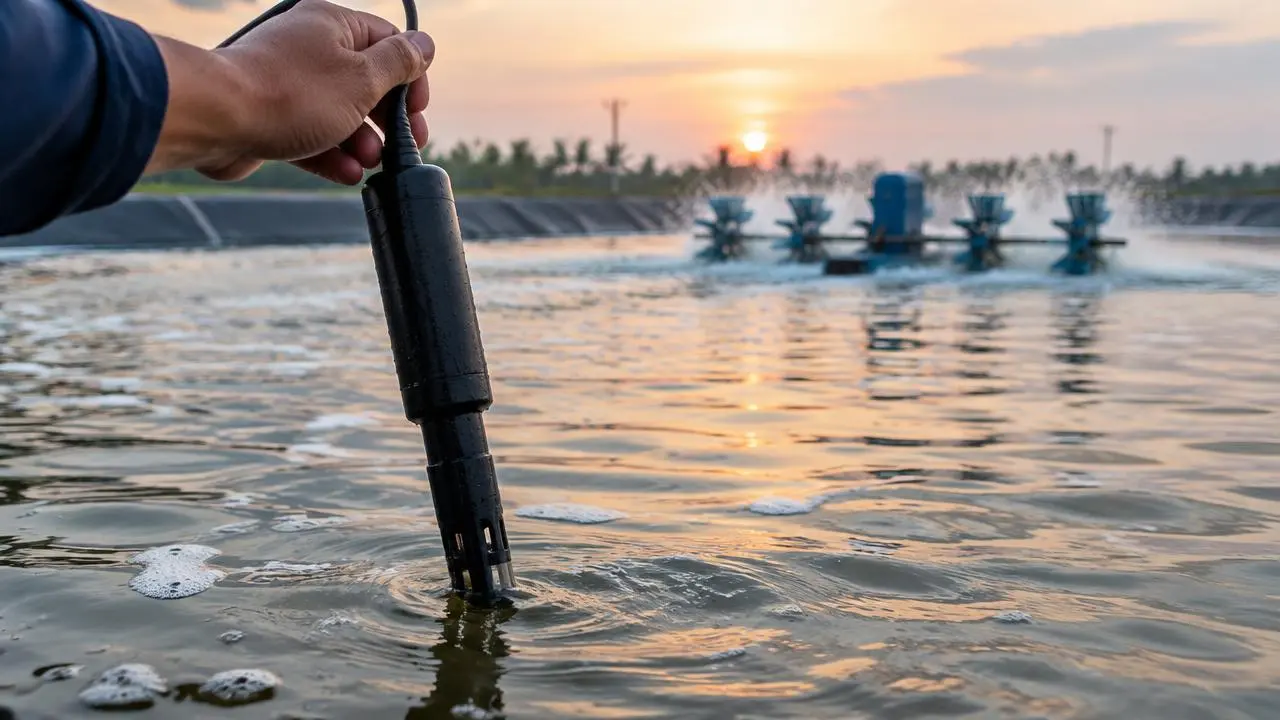
Short answer: for continuous monitoring in ponds, tanks and RAS, optical (luminescent) dissolved oxygen sensors are usually the easier choice because they need no electrolyte, have no warm-up time and don't depend on water flow. Electrochemical sensors (galvanic and polarographic) cost less to buy and still suit hand-held spot checks, but they need more frequent membrane and electrolyte care. Choose on where the sensor will sit, how often staff can maintain it, and what happens when it fails, not on purchase price alone.
What are the sensor types?
- **Optical (luminescent) sensor:** a dye on the sensor cap glows under light; oxygen shortens or dims that glow, and the meter converts the change into a DO reading.
- **Galvanic sensor:** an electrochemical cell behind a membrane that produces its own current in proportion to oxygen. It needs no warm-up.
- **Polarographic sensor:** a similar membrane cell that needs a voltage applied, so it must warm up before readings are stable.
Both the USGS field manual for dissolved oxygen and the YSI dissolved oxygen handbook describe these three types and their trade-offs (USGS, YSI).
How do they compare?
| Factor | Optical (luminescent) | Galvanic | Polarographic |
|---|---|---|---|
| Warm-up | None | None | Needed |
| Needs water flowing past the sensor | No | Yes, for steady-state types | Yes, for steady-state types |
| Routine care | Clean cap, replace cap on the maker's schedule | Membrane and electrolyte changes | Membrane and electrolyte changes |
| Calibration drift | Generally low | Higher | Higher |
| Purchase price | Usually higher | Usually lower | Usually lower |
| Best fit | Fixed, continuous monitoring with alarms | Hand-held spot checks | Hand-held or lab use |
The table summarises the manufacturers' and USGS descriptions. Check the actual specification sheet for each model you are offered, because performance differs between products.
What matters most on a working farm?
- **Where the sensor sits.** A sensor near an aerator or inflow can read high while a dead corner of the pond is low. Decide the measuring points before you count sensors.
- **Fouling.** Algae, biofilm and sediment affect every type. Ask how the sensor is cleaned, and whether a wiper or a cleaning schedule is included.
- **Salinity and temperature correction.** Brackish and marine farms need salinity compensation set correctly, or readings will be wrong.
- **Alarms and backup.** A sensor is only useful if a low reading reaches someone who can act at 3 a.m. Check the alarm path, the battery or backup power for the logger, and what the system does if the sensor fails.
- **Spares and service.** Ask for the replacement interval and local availability of caps, membranes and electrolyte.
Limitations to keep in mind
No sensor replaces a calibration routine. Check fixed sensors against a calibrated hand-held meter on a regular schedule, and record the result. A single fixed sensor also can't describe a whole pond; it shows one point. Sensors do not prevent low oxygen; they only give warning time. The aeration and backup power still have to be big enough. See dissolved oxygen management for bankable farms and the oxygen requirement calculator.
Selection checklist
- Number and position of measuring points per pond, tank or RAS loop.
- Fresh, brackish or sea water, and the temperature range.
- Continuous logging and alarm, or spot checks only.
- Who maintains it and how often, and the spare parts they will need.
- How it links to aerator control, if at all, and what happens when the signal is lost.
- Total cost over the expected life: sensor, logger, caps or membranes, calibration and labour.
Where FishMatch can help
Put the checklist answers into your request so suppliers quote the same scope. Use the aquaculture problem solver if oxygen is only one of several symptoms, compare wider options in aeration, feeding automation and monitoring, and send a private request when you are ready.
Sources
- U.S. Geological Survey, National Field Manual, Chapter A6.2 Dissolved oxygen: https://pubs.usgs.gov/publication/tm9A6.2
- YSI, Dissolved oxygen measurement: https://www.ysi.com/parameters/dissolved-oxygen
- HORIBA, Galvanic vs optical dissolved oxygen sensors: https://www.horiba.com/usa/water-quality/support/technical-tips/electrodes/galvanic-vs-optical-dissolved-oxygen-sensors/
Editorial note: written and reviewed by the FishMatch Group editorial team. FishMatch does not sell sensors and names no supplier here.
Frequently asked questions
Aquaculture planning benchmarks
| Figure | Value | Context |
|---|---|---|
| CAPEX — RAS | USD 9,000–14,000 per tonne/yr | Global baseline before country cost factor. |
| CAPEX — Ponds | USD 1,800–4,000 per tonne/yr | Lined or earthen ponds, excluding land. |
| CAPEX — Cages | USD 2,500–5,500 per tonne/yr | Cages, moorings, nets and service equipment. |
| CAPEX — Flow-through | USD 4,000–7,000 per tonne/yr | Raceways and water intake works. |
| Energy use | RAS ~6 kWh/kg; ponds ~1.2; flow-through ~1.5; cages ~0.3 | Per kg of fish produced. |
| Typical FCR | Trout 1.1; salmon 1.2; shrimp 1.4; tilapia 1.6; carp 1.8 | kg feed per kg growth; varies with feed and management. |
| Farm size where FishMatch reviews projects | From ~USD 250,000 total project value | Commercial fish and shrimp projects. |
Related articles
Where this fits in a real project
Every FishMatch project runs through the same five reviewed stages, from a first enquiry to comparable quotations. See the full buyer journey.
Planning a commercial aquaculture project?
Send your project brief. A FishMatch specialist reviews it before relevant suppliers are contacted privately.
Request a quote