Aquaculture Project Planning from Financing to Hatchery Supply: A USD 250,000+ Example
Also in:EspañolPortuguêsالعربيةРусскийעברית日本語Italiano
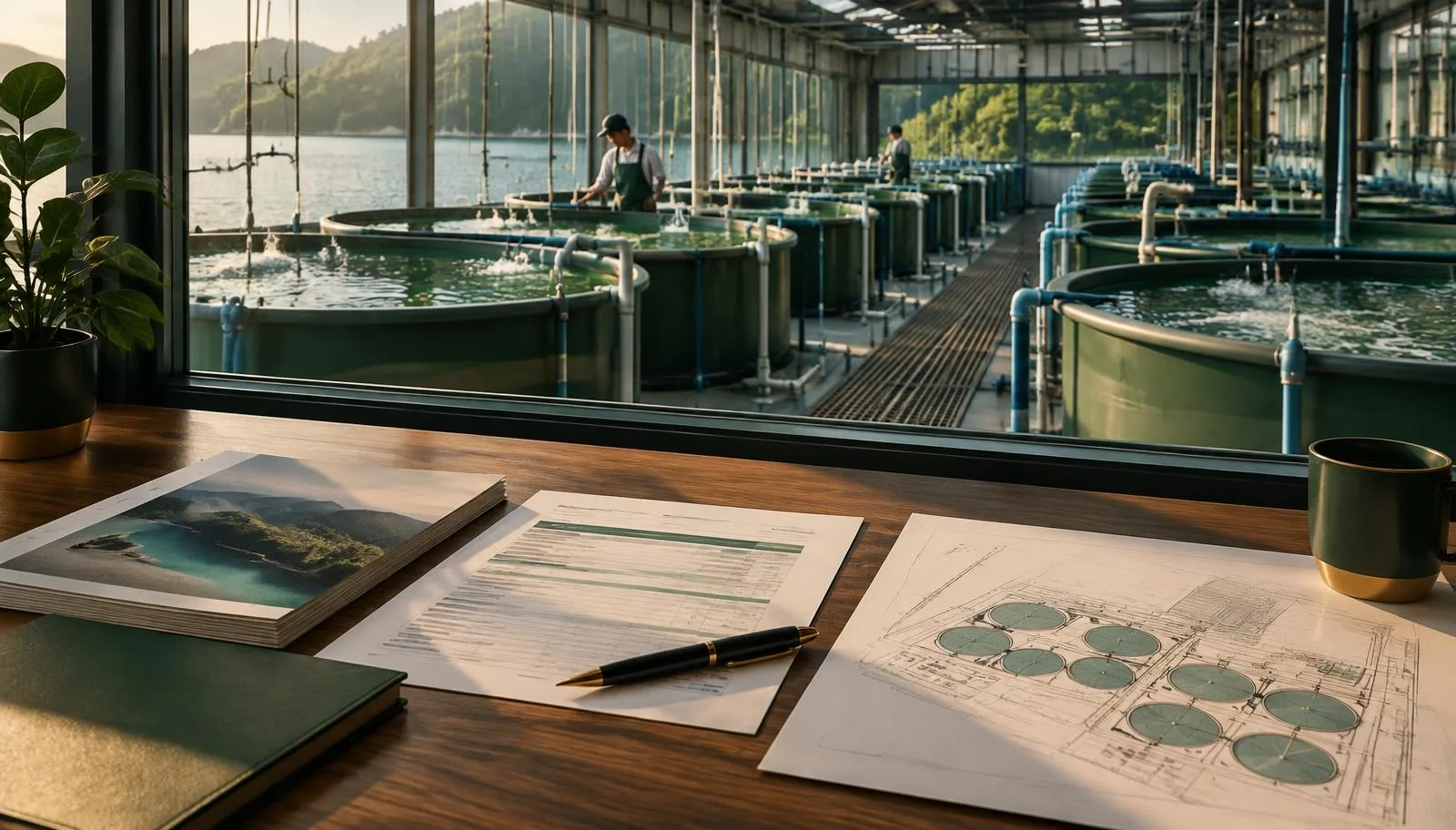
Short answer: plan an aquaculture project in this order — define the outcome and constraints, write a project brief, build a financing case lenders can test, compare equipment and construction proposals against that brief, and secure hatchery supply of postlarvae or fingerlings before the first stocking date. Financing and hatchery supply are not separate tasks at the start and the end: the lender wants to see seed supply secured, and the hatchery needs your stocking plan. Below is an illustrative project description for a commercial project from USD 250,000.
Editorial note: practical guide by the FishMatch Group editorial team, reviewed 14 October 2026, for farm managers, entrepreneurs and project planners. It is not veterinary, engineering or financial advice, gives no universal stocking densities, water thresholds or timelines, and promises no yield, survival, speed or profit. Operating values for your farm should come from a qualified local specialist and your own measurements. The example project below is fictional and for illustration only; it is not a quote, a cost estimate or a FishMatch client.
Key takeaways
- Start with the outcome — species, production target, market — not with a loan or a supplier.
- One written brief feeds everything: the business plan, the lender, the suppliers and the hatchery.
- Lenders typically look for a credible site, a defined scope, comparable quotes, an operating team and secured inputs.
- Hatchery supply (own hatchery or bought-in seed) is a design decision, made early.
- FishMatch's buyer tools are free; procurement assistance is for commercial projects from USD 250,000.
Step 1: Define the outcome and the constraints
Write down what the farm must produce, for which market, and under which limits: species, annual output, product form, site, water source, climate, power, permits, timeline and the budget range you can raise. FAO's shrimp-culture manual treats site factors — water supply and quality, soil, topography, climate, access, power and legal status — as the base of design and operation (FAO — Shrimp Culture: Pond Design, Operation and Management, site selection). Test the numbers with the free aquaculture calculators.
Step 2: Write the project brief
The brief is the document everyone else will work from. It should cover species, capacity, production system, location, water, equipment needs, timeline and budget. Use FishMatch's free project brief or the equipment project planning guide as a template.
Step 3: Build the financing case
Lenders and investors test risk, not enthusiasm. Prepare a business plan with your assumptions stated openly, a capital budget built from real quotes, working capital for the months before first sales, an operating team, and evidence of seed, feed and market. The what lenders require guide and financing a turnkey farm cover this in detail. FishMatch can, with your consent, introduce independent financing providers; it does not lend, and approval is never promised.
Step 4: Compare proposals against one scope
Request proposals only once the brief exists, so every supplier answers the same scope. Compare technical fit, delivery, installation, commissioning, training, spares, operating cost and support. See how to request a supplier quote.
Step 5: Plan hatchery supply
Decide early whether the farm buys seed or runs its own hatchery or nursery. Buying in is simpler to start with, but depends on documented, reliable hatcheries. An own hatchery adds control and adds broodstock, larval rearing, live-feed, water treatment and skilled staff. Either way, record health documentation per batch and agree transport and acclimation procedures. Read hatchery planning, capacity and cost, hatchery equipment procurement and early mortality after stocking. WOAH's regional biosecurity work lists record keeping, training and reducing pathogen transfer among the core measures (WOAH Asia-Pacific — Aquaculture biosecurity for small-scale farms in the region).
Example project description (from USD 250,000)
This fictional brief shows the level of detail that makes a project reviewable. All values are the buyer's own assumptions, to be confirmed by site data and quotes.
| Field | Example entry |
|---|---|
| Project | Indoor whiteleg shrimp grow-out with a small nursery, first phase |
| Location | Coastal region; site leased, water access to be confirmed by seasonal testing |
| Production target | Buyer's target to be validated by a specialist and supplier designs |
| System | Lined tanks under a greenhouse, with aeration, filtration and backup power |
| Seed supply | Postlarvae bought from a documented hatchery; own hatchery considered in phase two |
| Feed | Commercial shrimp feed to a written specification; local storage |
| Market | Fresh chilled product to regional distributors; buyer requirements to be documented |
| Equipment needs | Tanks, blowers/aeration, pumps, filtration, monitoring, generator, harvest and chilling |
| Team | Farm manager and technicians hired before installation |
| Timeline | Permits and site works first; stocking only after commissioning |
| Budget | Total project budget of at least USD 250,000, part equity and part external financing |
| Financing | Seeking an introduction to independent providers after quotes are in |
Common mistakes
- Applying for credit before the scope and quotes exist.
- Leaving seed supply until the farm is built.
- Comparing quotes that answer different scopes.
- No working capital for the first cycle.
- Planning a full-scale first stocking with an untrained team.
Plan your project with FishMatch
FishMatch's buyer tools and buyer platform services are free and carry no obligation. For commercial projects from USD 250,000, our team can help define the scope and request comparable proposals from suitable suppliers; supplier identities stay private until you choose to proceed. We do not promise suppliers, financing or results. When you are ready, create a free project brief.
Sources
Frequently asked questions
Related articles
Where this fits in a real project
Every FishMatch project runs through the same five reviewed stages, from a first enquiry to comparable quotations. See the full buyer journey.
Planning a commercial aquaculture project?
Send your project brief. A FishMatch specialist reviews it before relevant suppliers are contacted privately.
Request a quote