How to Plan an Aquaculture Equipment Project: Free Buyer Tools from Outcome to RFQ
Also in:EspañolPortuguêsFrançaisעברית
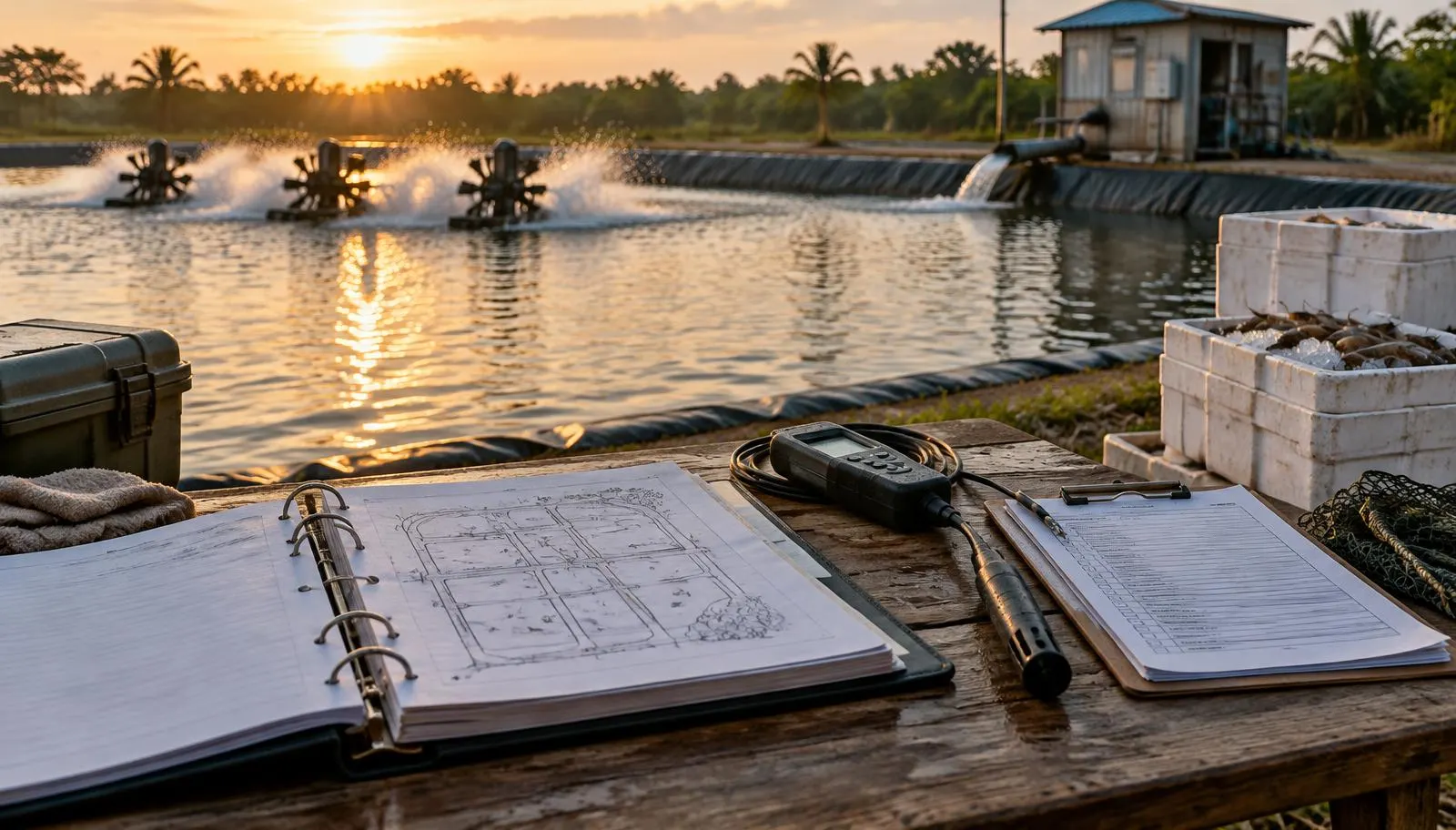
Short answer: plan an aquaculture equipment project by fixing the outcome and the constraints first — species, market, site, water, climate, permits, power and budget — then choosing the production system and capacity, and only then specifying equipment as one integrated package. Write the result into a project brief, use it to request comparable proposals, and buy in phases you can measure. FishMatch's buyer calculators, planning guides, checklists and project brief are free to use, with no subscription and no obligation to request quotes or hire anyone.
Educational buyer guide by the FishMatch Group editorial team, reviewed 14 October 2026. Shrimp is used as a worked example, but the method applies to fish and shrimp, ponds, cages, tanks and RAS. This guide does not give biological, veterinary or engineering sign-off: site, species, water, climate, permits and the production system change the right answer, and survival, growth and yield are never promised.
Key takeaways
- Define the outcome (product, market, tonnes per year, timing) before looking at any machine.
- The site and its water decide what systems are realistic; measure them, do not assume them.
- Equipment must be specified as an integrated system — water, oxygen, feed, power, biosecurity and harvest connect to each other.
- Separate CAPEX, OPEX and working capital; the farm must fund feed, stock and staff until the first sale.
- A written brief makes supplier proposals comparable; supplier introductions are optional and never a guaranteed result.
What is an aquaculture equipment project plan?
An aquaculture equipment project plan is a written description of what the farm must produce, under which site and market constraints, with which production system, and therefore which equipment, utilities and people it needs. FAO's planning guidance treats water, feed, labour and other site inputs as the starting data for aquaculture planning, not as details to settle after purchase (FAO, aquaculture planning inputs). The plan is what turns 'we want a shrimp farm' into a request a manufacturer can price accurately.
Why does the site, species and system change the right solution?
The same equipment list can be right on one site and wrong on another. Water source and quality, soil, temperature range, grid reliability, access roads, flood risk and local permits all change the design. FAO's inland farm design guidance starts with site selection for exactly this reason (FAO, site selection and farm design). For example, a lined shrimp pond site with brackish groundwater and an unstable grid needs a very different aeration, pumping and backup-power package from a tank-based RAS next to a reliable municipal supply — even at the same target tonnage.
The project planning checklist
Use this table as the skeleton of your brief. Every 'what to define' line should end up as a number, a document or an explicit 'unknown — to be measured'.
| Area | What to define | Free tool or page |
|---|---|---|
| 1. Goals, species and market | Product form, buyer, size, price basis, tonnes per year | Aquaculture project planning guide |
| 2. Site and water | Source, volume available, quality tests over seasons, discharge rules | Pond volume calculator |
| 3. System and capacity | Pond, cage, tank or RAS; units; cycles; peak biomass assumptions | All buyer calculators |
| 4. Energy and oxygen | Connected load, duty hours, grid quality, backup | Aeration sizing calculator |
| 5. Feed | Feed type, FCR assumption you can defend, storage, delivery | Feed budget calculator |
| 6. Biosecurity and health plan | Stock sources, zoning, quarantine, disinfection, vet access | FAO biosecurity guidance (below) |
| 7. Equipment integration | Interfaces, controls, alarms, spares, commissioning, training | Project brief |
| 8. Harvest, processing, logistics | Harvest method, chilling, cold chain, transport time to buyer | Project brief |
| 9. CAPEX, OPEX, working capital | Installed cost, running cost, cash to first sale, contingency | Commercial CAPEX calculator |
| 10. Operating expertise | Farm manager, technicians, training, maintenance contracts | Project brief |
| 11. Phased procurement | What is bought in phase 1, what is designed for later | Project brief |
| 12. KPIs | Measures you will track from day one | This guide |
Step 1: Define the outcome before the equipment
Start with who buys the product, in what form and at what size, and how many tonnes per year the business needs to work. A shrimp project selling fresh whole shrimp to a nearby processor has different harvest, chilling and timing needs from one supplying frozen product for export. Write down the price basis you are assuming and where it came from; if you do not know yet, mark it as unknown.
Step 2: Measure the site and water
List the water source, how much can be taken legally and physically in the driest season, and the results of water tests repeated over time rather than a single sample. Record power availability, access, land conditions and discharge permits. These facts decide whether ponds, cages, tanks or RAS are realistic. The pond volume calculator helps you state volumes consistently when comparing designs.
Step 3: Choose the production system and capacity
Capacity is not just area or tank volume; it depends on cycles per year, stocking and harvest assumptions and the peak biomass the system must carry safely. Run low, central and high cases with your own numbers. The goal is to see which assumption moves the result most, so you know what to verify with specialists and suppliers.
Step 4: State energy and feed assumptions
Oxygen supply, pumping and heating or cooling usually drive power demand, and feed usually drives operating cost. Size aeration from your expected feed load with the aeration sizing calculator, and estimate feed tonnage and cash need with the feed budget calculator. Treat outputs as planning estimates to discuss with a qualified designer, not as a specification.
Step 5: Write a biosecurity and health plan
Decide where stock comes from, how arrivals are isolated, how people, vehicles and equipment move between units, and who you call when something goes wrong. FAO describes biosecurity as a stepwise, risk-based pathway that producers and authorities build over time (FAO, progressive management pathway for aquaculture biosecurity). Health decisions belong with an aquatic animal-health professional; the plan simply makes sure equipment, layout and procedures support them.
Step 6: Specify equipment as one integrated system
Pumps, filtration, aeration, feeders, sensors, controls, backup power and harvest equipment have to work together. Most expensive surprises happen at the interfaces: a blower without the alarm it needs, a generator that cannot start the full load, a harvest pump that does not fit the chilling line. In the brief, state who is responsible for integration, commissioning, training, spare parts and after-sales support.
Step 7: Plan harvest, processing and logistics
Describe how product leaves the farm: harvest method, chilling or ice, transport time, and any processing or cold-chain step the buyer requires. These requirements often add equipment that is missing from first quotes.
Step 8: Separate CAPEX, OPEX and working capital
CAPEX is the installed cost of the farm; OPEX is the cost of running it; working capital is the cash needed to buy stock, feed, energy and labour before the first harvest is paid for. Many projects budget the first and underestimate the third. The commercial CAPEX calculator lets you lay out your own cost lines with a contingency; it does not supply prices for you.
Step 9: Plan operating expertise and phased procurement
Name who will run the farm and how they will be trained. Then decide what is bought in phase 1 and what must be designed now so later phases do not require rebuilding — for example pipe sizes, power capacity and site layout. Phasing lets you learn from real operating data before committing the full budget.
Step 10: Set measurable KPIs
Choose a short list you will measure from the first cycle: water-quality compliance against your operating plan, energy use per kg harvested, feed conversion, survival to harvest, cost per kg of saleable product, equipment downtime and time from harvest to buyer. KPIs make phase 2 decisions evidence-based and make supplier performance discussable.
How does a project brief and RFQ help compare integrated solutions?
A request for quotation (RFQ) built from one written brief asks every supplier to price the same scope, the same site conditions and the same performance and support requirements. That makes proposals comparable on fit, interfaces, risk and lifetime cost instead of headline price. Without it, one quote may include installation, controls and training while another omits them.
Free tools first; assisted sourcing only if you want it
Every calculator, planning guide, checklist and the project brief on FishMatch is free for buyers, with no subscription and no obligation. If you would like help afterwards, our team can review the brief with you, help tighten the scope and, where suitable, connect you with manufacturers and suppliers so you can compare fit and proposals. That assisted sourcing is optional, is offered for commercial projects of roughly USD 250,000 and above, and a suitable supplier match is never guaranteed. The free tools have no project-size limit.
Next step: start with the free project brief — it takes the checklist above and turns it into a structured RFQ you can keep, share or ask us to review. For a shrimp-only walk-through of each calculator, see shrimp farm planning tools before you buy.
Sources and limitations
- FAO — Aquaculture planning: site inputs including water, feed and labour
- FAO — Inland aquaculture farm design and site selection
- FAO — Progressive Management Pathway for aquaculture biosecurity
- Limitations: this is general planning guidance. It is not a feasibility study, a design, a permit opinion or veterinary advice, and it contains no prices or yield promises. Verify local regulations and get qualified professional review for your site.
Frequently asked questions
Related articles
Where this fits in a real project
Every FishMatch project runs through the same five reviewed stages, from a first enquiry to comparable quotations. See the full buyer journey.
Planning a commercial aquaculture project?
Send your project brief. A FishMatch specialist reviews it before relevant suppliers are contacted privately.
Request a quote