From Market Research to a Qualified Seafood Trade Deal: A Market-Entry Checklist for Fish, Shrimp and Aquaculture Products
To turn market research into a qualified seafood deal, work in six steps: choose the market on evidence; confirm official market access for the exact product; check that the supplier's establishment is approved and able to certify it; fix species, form, size, volume, timing, packaging and cold chain; send one comparable RFQ; and only then coordinate matching, inspection, logistics and any finance referral. Market access is a government decision, supplier eligibility is checked per plant and shipment, and real demand only exists once a buyer commits to a specification.
FishMatch Group editorial team · Official sources read 21–25 October 2026 · published
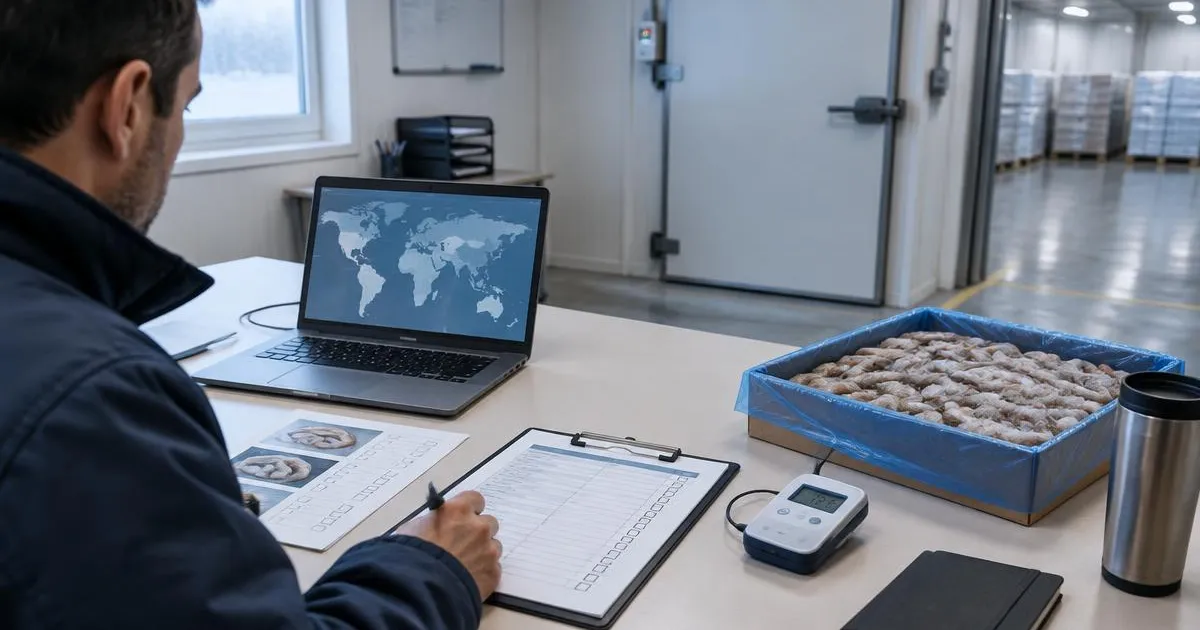
Why trade agencies work this way — and what FishMatch does differently
Government trade-promotion services typically start with a market potential assessment — opportunity, barriers and regulations, competition — before they connect a business with qualified contacts. The Government of Canada's Trade Commissioner Service, for example, describes exactly that sequence for exporters.
FishMatch Group applies the same discipline from the buyer's side. We are a private commercial coordinator: not a government body, regulator, producer, inspector or certifier. Exporters remain responsible for compliance with the rules of the destination and origin countries; buyers decide what to buy; we qualify requests, check supplier documents and introduce parties only after review.
Confirmed requirement, general guidance or open check?
Keep these apart on every route. Mixing them is the most common reason a promising lead turns into a rejected container.
| Type | What it is | Example |
|---|---|---|
| Confirmed requirement | Stated by an official authority for that destination and product, with a date | EU: the producing establishment must be on the EU list of authorised non-EU establishments (European Commission). |
| General guidance | Good practice that applies widely but is not a legal condition for that route | Codex: chilled fish held as close as possible to 0 °C. |
| Open check | Not yet confirmed for your exact product, plant or shipment | Whether a specific plant is currently listed, or whether a processed product needs a destination listing. |
Step 1 — Choose the target market on evidence
Start from official trade statistics and the destination's import rules, not from search popularity. Trade totals show where product already flows; they do not prove demand for your species, form or price.
- Check recent official import values by product code (HS 0302–0307, 1605) and origin.
- Note seasonality on both sides: harvest calendars at origin and peak demand at destination.
- List the authority that controls entry (food safety, veterinary, customs) and its official requirement pages.
- Write down what you still do not know — that becomes your open-checks list.
Step 2 — Confirm official market access for the exact product
Market access is decided between governments and is usually product-specific: species, farmed or wild, form and processing level can all change the answer. In June 2026, for example, CFIA announced that Vietnam again accepts Canadian chilled and frozen finfish fillets and steaks under a new certificate — but only for the product groups listed on CFIA's requirements page.
For the EU, the European Commission sets entry conditions: the exporting country must be authorised for fishery products and the producing establishment must be on the EU's list of authorised non-EU establishments.
- Find the destination's official requirement page for your product category.
- Confirm the origin country is authorised for that product, and note the page date.
- Identify the official certificate model and who signs it (the origin's competent authority).
- Record pre-arrival steps such as import notifications or prior notice.
Step 3 — Assess exporter and supplier readiness
Country access does not make a supplier eligible. Each plant and shipment must meet the conditions.
- Establishment approval: licence in the origin country and, where the destination keeps one, a current listing (e.g. the EU list). Check the live list and the approval number before contracting.
- Food-safety system: for the United States, processors must operate seafood HACCP under 21 CFR Part 123.
- Certificates: can the supplier's competent authority issue the destination's certificate for this exact product?
- Traceability: lot codes linking each carton to production date, plant and farm or catch area; records one step back and one step forward (as Canada's SFCR, for example, requires).
- Capacity and seasonality: realistic volume per shipment and per season, not a brochure figure.
- Cold chain: freezing method, cold-store capacity and temperature records.
Step 4 — Define specification, volume, timing, packaging and logistics
A comparable specification is what turns interest into offers you can compare line by line.
- Species (common and scientific name), farmed or wild.
- Form and size: e.g. HLSO 26/30, fillet weight band, skin-on/off; tolerance.
- Frozen product: IQF or block, glaze percentage and whether weight and price are net of glaze.
- Temperature: frozen at –18 °C or colder (EU rule for frozen fishery products; Codex for quick freezing); chilled as close as possible to 0 °C (Codex).
- Packaging and labels: pack size, carton marks, destination-language labels, establishment number.
- Volume per shipment, frequency, first delivery window and programme length.
- Destination port or airport, Incoterms, documents required, payment terms preference and any trade-finance need.
Step 5 — Submit one qualified RFQ
Send the specification as one request, not a dozen cold emails. FishMatch is free for buyers and reviews annual or seasonal programmes of USD 250,000 or more. Requests below the floor are saved and pointed to free tools; they are not circulated to suppliers.
- Complete specification (step 4) and the open-checks list (step 2–3).
- Annual or seasonal programme value.
- Your documents list: health certificate model, origin, catch or production records, labels.
- Optional attachments: your own specification sheet (private, never shown to suppliers without review).
Step 6 — Coordinate matching, inspection, logistics and referrals
What happens after the RFQ is where most of the entry risk sits.
- Qualification: we check the specification, the value floor and whether destination access is confirmed for the product.
- Supplier eligibility: we check establishment, certificate and traceability documents for the exact lane — claims stay 'supplier-stated' until documents are seen.
- Structured comparison: you receive anonymous offers on the same specification and Incoterms.
- Introduction: only after qualification and with both sides' agreement; contact details are never shown before that.
- Inspection and logistics: agree pre-shipment inspection, temperature records and receiving checks in the contract; you choose any independent inspection body.
- Finance or insurance: where relevant we can point you to a separate referral route, only with your separate consent; FishMatch does not lend, insure or guarantee payment, and no deal is guaranteed.
Frequently asked questions
What is a seafood market-entry checklist?
A step-by-step list that takes a buyer from choosing a market to a qualified trade deal: evidence-based market choice, official access for the exact product, supplier and establishment readiness, a comparable specification with cold chain and logistics, one qualified RFQ, then coordinated matching and inspection.
Does market access mean a supplier can ship?
No. Market access is a government decision for a product category. Each supplier's plant must still be approved or listed where required and able to obtain the right certificate for each shipment.
How do I check whether a seafood plant is approved for the EU?
Use the European Commission's lists of authorised non-EU establishments and check the plant's approval number and the list date before contracting; listings change.
What temperature should frozen seafood be kept at?
EU rules require frozen fishery products at not more than –18 °C in all parts of the product, and Codex treats quick freezing as complete at –18 °C or colder at the thermal centre. Your contract should state the target and how it is recorded.
Is FishMatch a government agency or certifier?
No. FishMatch Group is a private commercial coordinator. Exporters stay responsible for compliance; FishMatch checks documents, compares offers and introduces parties only after qualification.
What makes an RFQ 'qualified' at FishMatch?
A complete specification, a confirmed destination route for the product and an annual or seasonal programme of USD 250,000 or more. The buyer service is free.
Official sources
- Trade Commissioner Service (Government of Canada): Export advisory services — market potential assessment and qualified contacts (published 10 Sep 2026)
- CFIA news release, June 2026: new and expanded market access for Canadian fish and seafood (read 25 Oct 2026)
- CFIA: Vietnam — export requirements for fish and seafood (modified 11 Jun 2026)
- European Commission: EU entry conditions for food of animal origin (read 21 Oct 2026)
- European Commission: Authorised non-EU establishments (read 21 Oct 2026)
- Regulation (EC) No 853/2004, Annex III Section VIII (EUR-Lex; read 21 Oct 2026)
- eCFR: 21 CFR Part 123 — Fish and fishery products (seafood HACCP; read 21 Oct 2026)
- CFIA: Traceability for food (SFCR Part 5; modified 26 Aug 2025)
- Codex CXC 52-2003: Code of Practice for Fish and Fishery Products (FAO/WHO)