Fish Are Dying or Feeding Less: A Safe First-Response Checklist for Aquaculture Farms
Also in:EspañolPortuguêsFrançaisالعربيةDeutsch
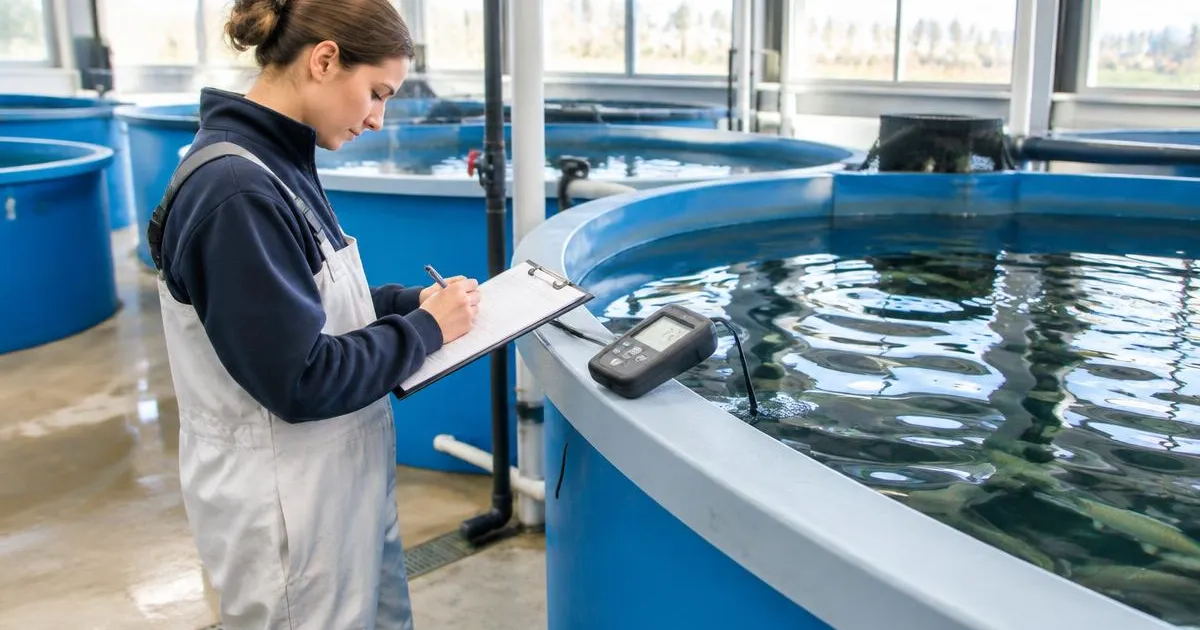
Short answer: when fish die or stop feeding, assume two possible causes at once — an environmental or system failure (oxygen, temperature, water quality, equipment) and an infectious disease — until a qualified professional has ruled one out. Record what you observe, check the readings your normal operating plan already collects, pause non-essential movement of fish and equipment, protect unaffected units, and call an aquatic animal-health professional or diagnostic laboratory. Where national rules require it, notify the competent authority.
Educational guide, not a diagnosis or treatment plan. Reviewed 13 October 2026; technical details must be confirmed for your species, system and country by a qualified aquatic animal-health professional. No single sign identifies a specific pathogen, and this guide gives no medicine or chemical doses.
Why consider both environment and disease?
The same visible change — fish gathering at the surface, reduced appetite, lethargy or a rise in mortality — can follow a dissolved-oxygen drop, a temperature swing, a pump or filter failure, or an infection. FAO's aquatic health and biosecurity programme frames health management as preventing, detecting and responding to both kinds of risk (FAO), and NOAA notes that fish health depends on the environment, husbandry and pathogens together (NOAA Fisheries).
What should be checked in the first hour?
- System alarms and equipment: aeration or oxygen supply, pumps, filters, power, heaters or chillers.
- The water-quality readings your operating plan already measures (for example dissolved oxygen, temperature, pH, ammonia, nitrite or salinity) — record the time and the unit tested.
- Which tanks, ponds or cages are affected, and which are not.
- Recent events: stocking, transfers, grading, handling, feed changes, new water source or weather.
What should be recorded?
Write facts, not conclusions. A dated, signed record helps the professional and any authority understand the event and avoids losing details later. Use the one-page incident log below.
One-page incident log
| Item | What to write |
|---|---|
| Date, time, recorder | When signs were first seen and who logged them |
| Units affected / not affected | Tank, pond or cage IDs, species, stocking date, approximate biomass |
| Mortality | Number removed per unit per day; how carcasses were stored or disposed of |
| Feeding | Feed offered vs eaten; any change in feed batch or rate |
| Behaviour | What was seen (e.g. surface gathering, unusual swimming, lethargy) — no diagnosis |
| Water and alarms | Readings with time, location and instrument; any alarm or equipment fault |
| Recent movement | Arrivals, transfers, visitors, shared equipment or vehicles in the past weeks |
| Actions taken | Movement paused, units isolated, who was called and when, samples sent |
How do you protect unaffected units?
- Pause non-essential movement of fish, water, nets and equipment between units where appropriate.
- Work from unaffected to affected units, with dedicated or cleaned equipment, boots and clothing.
- Remove mortalities promptly and store them as your professional or laboratory instructs, in case samples are needed.
- Limit visitors and vehicles until the cause is understood.
These are general biosecurity principles described in FAO's smart biosecurity work (FAO); the exact measures depend on your species, system and local rules.
Which professional or authority should be called?
| Who | When |
|---|---|
| Your aquatic animal-health professional or fish veterinarian | As soon as mortality or feeding changes are unexplained by an obvious system fault |
| An accredited diagnostic laboratory | When the professional advises sampling; ask first how samples must be collected and shipped |
| The competent authority (national veterinary or fisheries service) | When a notifiable disease is suspected or national rules require reporting — verify the rules for your country |
| Equipment or system supplier | When a pump, oxygen, filter or power fault is found |
Reporting duties differ by country. In the United States, for example, suspected reportable diseases go through a veterinarian to USDA APHIS and state officials (USDA APHIS). For other countries, check your national veterinary service and the listed diseases in the WOAH Aquatic Code (WOAH).
What should a farm avoid doing?
- Do not assume one sign identifies a specific disease.
- Do not start medicines, antimicrobials or chemical treatments without a professional diagnosis and local approval.
- Do not move or sell fish from affected units before taking advice.
- Do not discard the incident record once the event ends — it is part of your farm's health history.
How can planning reduce the next event?
Many events trace back to design margins: oxygen supply, backup power, water exchange and separation between units. Check those margins with the oxygen demand calculator, the water consumption calculator and the biosecurity zoning guide. For a project of USD 250,000 or more, you can describe the upgrade in a structured project request; our team reviews it and compares suitable options. Planning tools do not predict or guarantee health outcomes.
FAQ
Can I tell which disease it is from the symptoms?
No. Similar signs can come from water-quality problems or from different infections. Confirmation needs a qualified professional and, usually, laboratory testing.
Should I treat the fish straight away?
Not without a professional diagnosis. Unnecessary treatment can harm fish, staff and the environment and may break local rules on medicines.
Do I have to report the event?
It depends on the suspected disease and your country's rules. Ask your professional and check with the competent authority.
Sources: FAO aquatic health management and biosecurity; FAO smart aquaculture biosecurity; NOAA Fisheries — aquaculture fish health; FAO aquaculture biosecurity pathway. Last reviewed 13 October 2026.
Aquaculture planning benchmarks
| Figure | Value | Context |
|---|---|---|
| CAPEX — RAS | USD 9,000–14,000 per tonne/yr | Global baseline before country cost factor. |
| CAPEX — Ponds | USD 1,800–4,000 per tonne/yr | Lined or earthen ponds, excluding land. |
| CAPEX — Cages | USD 2,500–5,500 per tonne/yr | Cages, moorings, nets and service equipment. |
| CAPEX — Flow-through | USD 4,000–7,000 per tonne/yr | Raceways and water intake works. |
| Energy use | RAS ~6 kWh/kg; ponds ~1.2; flow-through ~1.5; cages ~0.3 | Per kg of fish produced. |
| Typical FCR | Trout 1.1; salmon 1.2; shrimp 1.4; tilapia 1.6; carp 1.8 | kg feed per kg growth; varies with feed and management. |
| Farm size where FishMatch reviews projects | From ~USD 250,000 total project value | Commercial fish and shrimp projects. |
Related articles
Where this fits in a real project
Every FishMatch project runs through the same five reviewed stages, from a first enquiry to comparable quotations. See the full buyer journey.
Planning a commercial aquaculture project?
Send your project brief. A FishMatch specialist reviews it before relevant suppliers are contacted privately.
Request a quote