Tilapia Lake Virus and Other Disease Risks: Biosecurity, Traceability and a Response Plan
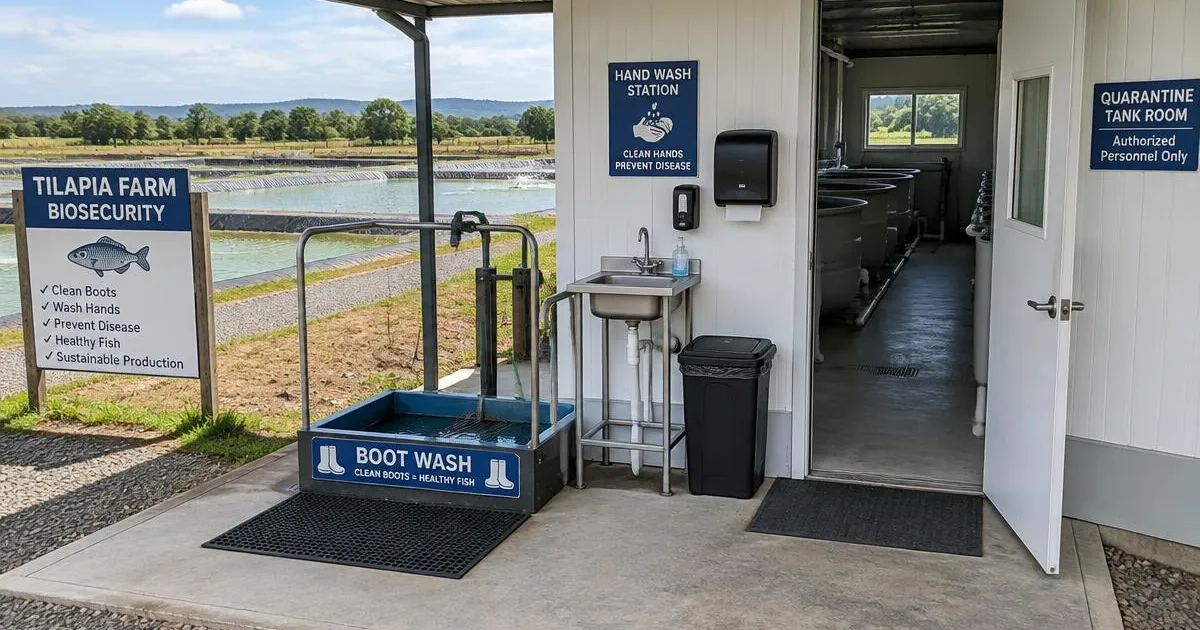
Short answer: Tilapia Lake Virus (TiLV) is a viral disease of tilapia. According to USDA APHIS, it spreads through water and fish-to-fish contact, there is no treatment, and prevention relies on biosecurity and good husbandry (USDA APHIS). A practical farm plan combines documented sourcing, movement records, quarantine of new stock, daily mortality monitoring, hygiene, diagnostic confirmation through a professional and official reporting where rules require it.
Educational guide, not veterinary advice or a diagnosis. Reviewed 13 October 2026; confirm every measure for your species, system and country with a qualified aquatic animal-health professional and the competent authority. This guide does not recommend any medicine, antimicrobial or vaccine.
What is Tilapia Lake Virus, according to official sources?
- It affects tilapia and survives in both fresh and brackish water (USDA APHIS).
- It can transmit through water and through fish-to-fish contact (USDA APHIS).
- There is no treatment for TiLV (USDA APHIS).
- In the United States, APHIS reports a single detection in 2019 that was contained and eradicated, and restricts imports of live fish, eggs and gametes from susceptible species (USDA APHIS).
Status, testing and import rules differ by country. FAO's knowledge products include a Tilapia Lake Virus disease strategy manual for preparedness planning (FAO knowledge products). Check your own national veterinary service before relying on any status statement.
Why use risk-based biosecurity rather than a fixed checklist?
FAO describes biosecurity as a progressive, risk-based pathway: identify how pathogens could enter or spread on your farm, then put the most important controls in place first (FAO; FAO smart biosecurity). The same principles apply to TiLV and to other bacterial, viral and parasitic risks.
What sourcing and movement records should a farm keep?
| Record | Why it matters |
|---|---|
| Supplier, batch and health documents for every arrival | Shows where fish came from if a problem appears later |
| Transfers between units, sites or customers | Lets you trace which units shared fish or water |
| Visitors, vehicles and shared equipment | Identifies other possible routes of spread |
| Daily mortality and feeding per unit | Shows changes early and gives the professional a baseline |
How should quarantine and isolation be planned?
- A separate quarantine area with its own water supply or discharge, equipment and staff routine, sized for your typical arrival batch.
- A holding and monitoring period agreed with your aquatic animal-health professional.
- Disinfection and proper disposal of water used to transport live fish (USDA APHIS).
- A pre-agreed way to isolate a unit quickly if mortality rises.
If you are building or expanding, size quarantine and separation into the design with the biomass calculator and the tilapia farm project page.
How is a disease confirmed?
Only through a qualified professional and laboratory testing. Visible signs listed by APHIS — such as eye changes, scale protrusion or pallor — are not specific to TiLV. Ask your laboratory before sampling how samples must be collected and shipped.
Which professional or authority should be called?
| Who | When |
|---|---|
| Aquatic animal-health professional or fish veterinarian | Unexplained mortality, feeding drop or abnormal signs |
| Accredited diagnostic laboratory | When sampling is advised; confirm TiLV testing is offered |
| Competent authority (national veterinary or fisheries service) | Suspected notifiable disease or any legal reporting duty — verify locally |
| Your fish or egg supplier | To share batch details for tracing, after professional advice |
What belongs in a written response plan?
- Named contacts: professional, laboratory and authority, with phone numbers kept on site.
- Triggers: the mortality or feeding change that starts the plan.
- First steps: stop non-essential movement, isolate affected units, secure records, store mortalities for sampling as instructed.
- Hygiene: cleaning and disinfection of pools and equipment (USDA APHIS) and carcass disposal under local rules.
- Communication: who informs buyers, suppliers and the authority, and when.
Use the one-page incident log from our first-response checklist.
What should a farm avoid?
- Claims of a cure or unapproved vaccine for TiLV.
- Antimicrobials for a suspected viral disease without professional direction — they do not treat viruses and are regulated.
- Moving or selling fish from a suspect unit before advice.
- Assuming a country is free of a disease without checking the official source.
How do projects plan for biosecurity?
Biosecurity is cheaper to design in than to retrofit: separate quarantine, controlled water intake, unit separation and disinfection points. Compare options in the biosecurity zoning guide. For a project of USD 250,000 or more, describe your scope in a structured project request; our team reviews it and compares suitable proposals. No design guarantees disease-free production.
FAQ
Is there a vaccine or treatment for TiLV?
USDA APHIS states there is no treatment. Do not rely on any claimed cure; ask your competent authority about approved products in your country.
Can I tell TiLV from other diseases by looking at the fish?
No. Confirmation needs a professional and laboratory testing.
Do I have to report TiLV?
Reporting rules depend on the country. Check with your national veterinary service; in the United States, veterinarians report suspected listed diseases to APHIS and state officials.
Sources: USDA APHIS — Tilapia Lake Virus; FAO knowledge products; FAO aquatic health management and biosecurity; FAO smart aquaculture biosecurity; FAO biosecurity pathway; NOAA Fisheries — fish health. Last reviewed 13 October 2026.
Aquaculture planning benchmarks
| Figure | Value | Context |
|---|---|---|
| CAPEX — RAS | USD 9,000–14,000 per tonne/yr | Global baseline before country cost factor. |
| CAPEX — Ponds | USD 1,800–4,000 per tonne/yr | Lined or earthen ponds, excluding land. |
| CAPEX — Cages | USD 2,500–5,500 per tonne/yr | Cages, moorings, nets and service equipment. |
| CAPEX — Flow-through | USD 4,000–7,000 per tonne/yr | Raceways and water intake works. |
| Energy use | RAS ~6 kWh/kg; ponds ~1.2; flow-through ~1.5; cages ~0.3 | Per kg of fish produced. |
| Typical FCR | Trout 1.1; salmon 1.2; shrimp 1.4; tilapia 1.6; carp 1.8 | kg feed per kg growth; varies with feed and management. |
| Farm size where FishMatch reviews projects | From ~USD 250,000 total project value | Commercial fish and shrimp projects. |
Related articles
Where this fits in a real project
Every FishMatch project runs through the same five reviewed stages, from a first enquiry to comparable quotations. See the full buyer journey.
Planning a commercial aquaculture project?
Send your project brief. A FishMatch specialist reviews it before relevant suppliers are contacted privately.
Request a quote