Aquaculture Procurement Starts With Production Design, Water and Economics — Not Equipment Catalogs
Also in:EspañolPortuguêsFrançaisالعربية
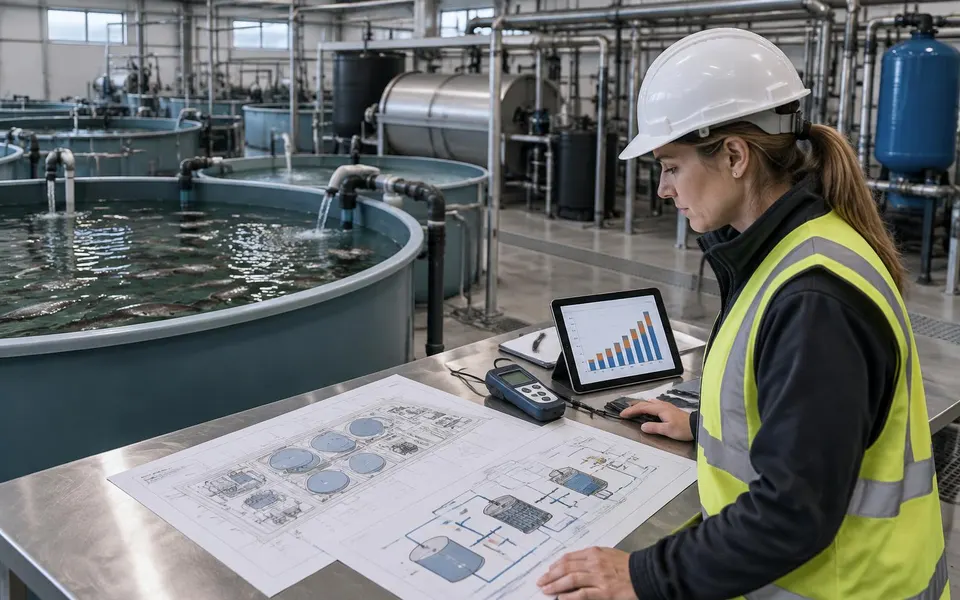
Short answer: aquaculture procurement should start with what the farm must produce, how much water and power the site can supply, and what the project can afford to build and run — not with an equipment catalog. Once species, annual harvest, stocking density, water budget, energy and CAPEX/OPEX are defined in writing, you can write a specification, compare suitable suppliers like-for-like and pay the right price for the right result. FishMatch Group's guides, calculators and project brief are free to use, with no subscription and no obligation.
Editorial note: written and reviewed by the FishMatch Group editorial team as general planning guidance, 16 October 2026. It is not engineering design, veterinary or financial advice. Example numbers below are illustrative assumptions to show the method, not benchmarks; your designer, suppliers and site data confirm final values.
Key points
- Equipment is the answer to a production question. Define the question first: species, harvest target, system and site.
- Water and power usually decide which system is realistic, before any brochure does.
- Simple formulas — biomass, culture volume, feed, oxygen, energy, cost per kg — expose most scope errors early.
- Vet suppliers only after scope and economics are defined, so every quote answers the same specification.
- The goal is the right price for the right specification and result over the farm's life, not the cheapest line item.
What does "production design first" mean?
Production design is the written description of what the farm will grow, how much, in what system, at what density and with which water, oxygen and energy inputs. It comes before equipment because every pump, filter, aerator and tank size is derived from it. The stakes are real: according to FAO's State of World Fisheries and Aquaculture 2024, aquaculture produced 51 percent of the world's aquatic animal output in 2022, the first time it overtook capture fisheries — so more projects compete for capital, water, feed and skilled staff, and planning errors are expensive to correct after delivery.
The project lifecycle: a procurement and project operating system
Think of procurement as one connected system that runs from the first problem statement to a working farm. Each stage has a question, a written output and a tool. Skipping a stage usually moves the cost of that decision to a later, more expensive stage.
| Stage | Question to answer | Written output | Where to start |
|---|---|---|---|
| 1. Opportunity or problem | What are we trying to fix or build, and why now? | One-paragraph problem statement | Problem solver |
| 2. Search and shortlist options | Which systems could work: pond, cage, RAS, hybrid? | Shortlist of 2–3 system options | RAS vs pond scenario |
| 3. Discovery and requirements | Species, harvest, site, water, power, market, permits | Requirements sheet (worksheet below) | Project planner |
| 4. Feasibility calculations | Do biomass, volume, oxygen and energy fit the site? | Sizing numbers with stated assumptions | Stocking density, oxygen demand |
| 5. Budget and scenarios | CAPEX, OPEX, cost per kg, payback under low/base/high cases | Scenario table | CAPEX estimator, RAS cost calculator |
| 6. Design and specification (URS) | What must the system do, measured how? | User requirement specification | RAS design guide |
| 7. Planning and management | Who decides what, in what order, by when? | Schedule, responsibilities, interfaces | Project plan |
| 8. Specialists and supplier vetting | Who is qualified for this scope? | Qualified shortlist | Reviewed RFQ |
| 9. Quote comparison and negotiation | Which offer meets the URS at the best lifetime cost? | Normalized comparison table | Same URS for every bidder |
| 10. Execution and risk reduction | Delivery, installation, commissioning, handover | Acceptance tests and records | Commissioning checklist |
What is free and what is not: the guides, calculators and project brief on this site cost nothing to use. For commercial projects of about USD 250,000 and above, the FishMatch team reviews the written request by hand before any supplier is approached. Specialist engineering, consulting or project-management work, where needed, is scoped and agreed separately; we do not describe it as free unless it is agreed in writing for your project.
Worksheet 1: production design and site inputs
Fill this in before you ask anyone for a price. Where a value is unknown, write "unknown" and the date you will have it — that is more useful to a supplier than a guess.
- Species and life stage (hatchery, nursery, grow-out) and target harvest size.
- Annual harvest target in tonnes and number of harvests per year.
- System options under consideration and why (pond, cage, flow-through, RAS, biofloc).
- Water source, quantity available per day, quality test results, temperature range and discharge rules.
- Grid capacity in kW, tariff per kWh, outage history and backup power plan.
- Feed source, price per kg and expected FCR range for your species and system.
- Market: buyer, product form, price range and seasonality.
- Permits, land, buildings, staff and the date the first stock must go in.
Planning formulas, with the assumptions stated
These are first-pass checks, not design calculations. Each one has an assumption you must replace with data from your species, system and site.
- Maximum standing biomass (kg) ≈ annual harvest (kg) × months in grow-out ÷ 12 × peak factor. The peak factor (often above 1) reflects uneven stocking; your production plan sets it.
- Culture volume needed (m³) = maximum standing biomass (kg) ÷ maximum stocking density (kg/m³). Density depends on species, size, oxygen supply and welfare rules.
- Daily feed at peak (kg/day) = maximum standing biomass (kg) × daily feeding rate (% of biomass).
- Oxygen demand (kg O₂/day) ≈ daily feed (kg) × oxygen per kg feed (an assumption your designer confirms).
- Annual energy cost = average power draw (kW) × operating hours per year × tariff per kWh.
- Cost per kg = (annual OPEX + annual capital charge) ÷ kg sold. Simple payback (years) = CAPEX ÷ annual net cash flow.
Illustrative example, not a benchmark: a farm targeting 100 t a year, with an assumed peak standing biomass of 40 t and an assumed maximum density of 50 kg/m³, needs about 800 m³ of culture volume. At an assumed 1% feeding rate it feeds about 400 kg a day; at an assumed 0.5 kg O₂ per kg feed it needs about 200 kg of oxygen a day at peak. An assumed 60 kW average load running 8,760 hours at USD 0.12/kWh costs about USD 63,000 a year. Change any assumption and every downstream number — pumps, oxygen supply, backup power, budget — changes with it. That is why the assumptions belong in the specification.
Water and power: the two inputs that decide the system
A pond or flow-through farm needs a large, reliable volume of water; a RAS reuses most of its water but depends on continuous power for pumping, filtration and oxygen. The FAO / Eurofish Guide to Recirculation Aquaculture explains that the biofilter and water treatment are sized from the feed load, which is why feed, oxygen and energy figures must be agreed before the system is quoted. If the site cannot supply the water, or the grid cannot carry the load plus backup, the right answer is a different system or a different site — not a cheaper version of the same equipment.
Why supplier vetting comes after scope and economics
Before the scope is written, every supplier answers a different question, so their prices cannot be compared. After the scope and economics are defined, you can ask the same questions of every bidder: the design basis, what is included and excluded, delivery terms, warranty, spare parts, energy use per kg and commissioning tests. The cheapest quote is often the one that left something out.
| Catalog-first buying | Design-first procurement | |
|---|---|---|
| Starting point | Product list and unit prices | Production target, site, water, power, budget |
| Quotes | Different scopes, hard to compare | Same URS, compared line by line |
| Main risk | Undersized or mismatched parts found after delivery | Assumptions tested before money is committed |
| Price question | What is the lowest price? | What is the right price for this specification and result? |
| Lifetime view | Purchase price only | CAPEX, OPEX, energy, spares and cost per kg |
Mistakes to avoid
- Buying tanks or aerators before the harvest target and density are written down.
- Sizing to average biomass instead of peak biomass and the hottest month.
- Leaving backup power, oxygen supply and alarms out of the first budget.
- Comparing quotes with different design bases, delivery terms or exclusions.
- Treating a supplier's proposal as the design, without an independent check of the assumptions.
- Planning no working capital for the first cycle, before any fish or shrimp are sold.
Where FishMatch can help
Start with the advanced project planner to turn the worksheet into a written brief, test sizing with the stocking density and oxygen demand calculators, and model the budget with the CAPEX estimator or the RAS cost calculator. When the scope is clear, submit a reviewed RFQ: the team checks it by hand and keeps your project and contact details private. Supplier names are shared only through that reviewed process, never published.
Sources
- FAO, The State of World Fisheries and Aquaculture 2024: https://www.fao.org/publications/home/fao-flagship-publications/the-state-of-world-fisheries-and-aquaculture
- FAO / Eurofish, A Guide to Recirculation Aquaculture (Bregnballe, 2015): https://www.fao.org/3/i4626e/i4626e.pdf
Frequently asked questions
Related articles
Where this fits in a real project
Every FishMatch project runs through the same five reviewed stages, from a first enquiry to comparable quotations. See the full buyer journey.
Planning a commercial aquaculture project?
Send your project brief. A FishMatch specialist reviews it before relevant suppliers are contacted privately.
Request a quote