AI-Driven Precision Shrimp Feeding in 2026: What Acoustic and Camera Feeders Can Prove, and How to Specify Them
Short answer: precision shrimp feeders dose feed according to what the shrimp are actually eating instead of a fixed timetable. Acoustic demand feeding with underwater microphones is commercially established; camera and AI feeding assistants are newer. Independent reports explain how these systems work, but we found no independent controlled trial that measures feed savings for shrimp, so treat savings figures as supplier claims and test them on your own ponds.
FishMatch Group editorial team · Sources checked
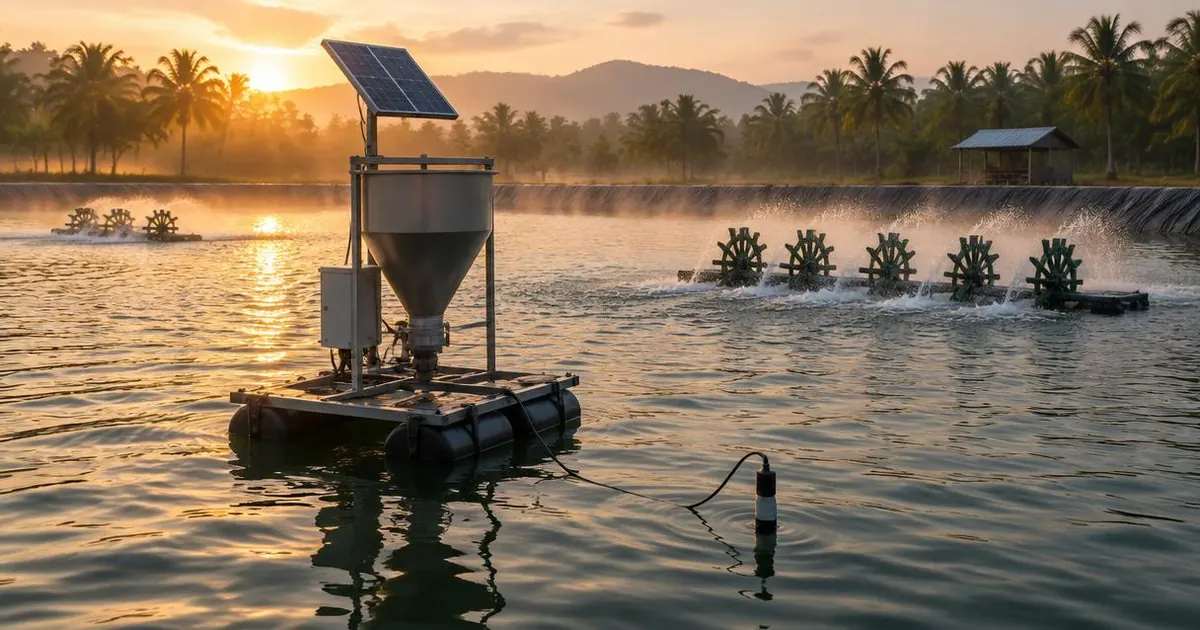
What "AI-driven" feeding means on a shrimp farm
Suppliers use "smart", "AI" and "precision" for very different machines. Before comparing quotes, sort each offer into one of three levels: a feeder that throws a set ration at set times; a feeder that responds to a sensor signal, such as the sound of shrimp feeding or a drop in dissolved oxygen; and a system that turns video, sensor and biomass data into feeding recommendations or decisions.
Shrimp eat on the pond bottom and mostly out of sight, so the most proven appetite signal in ponds is sound: shrimp make clicking sounds while they feed, and a hydrophone (underwater microphone) can pick them up. Camera-based systems need clear water and a view of the feed, which is easier in finfish cages and tanks than in turbid shrimp ponds.
Technology maturity in October 2026
The table separates what is in commercial use from what is still being tested. "Commercial" means sold and installed on farms; it does not mean independently proven to cut feed costs.
| Approach | How it decides how much to feed | Maturity | Evidence we found |
|---|---|---|---|
| Timer feeders | Fixed rations at times set by the farm team | Established | Widely used; no appetite sensing |
| Acoustic demand feeding | Hydrophones listen for feeding sounds; feed continues while activity continues | Commercially established | Trade-body reports since 2013 describe systems controlling several pond feeders |
| Acoustic feeding with oxygen feedback | Feeding pauses or is capped when dissolved oxygen falls | Tested in university ponds; offered in some systems | A university pond trial combined both and capped feed at 16 kg per pond per day |
| Camera and AI feeding assistants | Video and sensor data give operators real-time recommendations | Commercial and emerging, mainly finfish cages | Supplier descriptions; a Norwegian research project (2025–2027) is testing AI feeding strategies |
| Passive acoustic appetite monitoring | Software classifies shrimp feeding clicks to estimate appetite | Research | Trade-body overview published September 2026 |
What the independent evidence shows, and what it does not
Trade-body reports document commercial acoustic systems that measure feeding activity with hydrophones and control several pond feeders at once. A university pond trial reported in 2020 linked acoustic demand feeding to dissolved-oxygen readings and set a ceiling of 16 kg of feed per pond per day. That is a useful design idea, a hard safety cap, not a ration to copy.
Results from fish are a warning against reading too much into one number. A 2025 salmon study found a feed conversion ratio (FCR) below 0.87 in both the hydroacoustic and the conventional group after sea transfer, with no reduction shown between them. A good FCR on a farm that has just installed new feeders does not prove that the feeders caused it.
The gap is clear: we found no independent controlled trial that quantifies FCR or feed-cost savings from AI or acoustic shrimp feeders. Every savings percentage we found was published by a supplier. That does not mean the savings are false. It means you should ask for the trial design and test the claim yourself.
How to test a supplier's feed-saving claim before you buy
FCR is feed delivered divided by biomass gained. With illustrative numbers, not a benchmark: a pond that gains 10,000 kg of shrimp on 14,000 kg of feed has an FCR of 14,000 ÷ 10,000 = 1.4. The same gain on 13,000 kg of feed gives 1.3, about 7% less feed. Enter your own feed price and volumes in the FCR and feed-budget calculators to see what a claimed change would be worth on your farm.
- Ask for the trial design: how many ponds with and without the system, and whether stocking density, feed, season and aeration were the same.
- Ask how FCR was calculated: which days, whether dead shrimp were counted, and whether the biomass figure is harvest weight or an estimate.
- Ask for survival, final weight and harvested biomass, not FCR alone. A lower FCR with lower survival is not a gain.
- Ask for energy use and labour hours per cycle, including the hours aerators ran.
- Run a paired-pond pilot for at least one full cycle before equipping the whole farm.
- Agree in writing who owns the feeding data and how you can export it.
Feeding, oxygen and aeration have to be specified together
Every kilogram of feed adds oxygen demand, so a feeder that responds to appetite but ignores oxygen can feed shrimp straight into a low-oxygen night. Ask whether the system reads dissolved oxygen and temperature, what it does when a probe fails or drifts, and whether it can start aerators automatically.
Aerator choice changes the energy bill behind every feeding decision. A trade-body review reported that an optimised paddlewheel design reaches about 2 kg of oxygen per kWh under standard test conditions, while typical designs it reviewed reached no more than 1 kg. Standard conditions mean clean fresh water at 20 °C, so field results are lower. Pumps and aerators also make underwater noise, so ask where the hydrophone will sit relative to them.
What to put in a precision-feeding RFQ
Send every supplier the same brief, so that the quotes cover the same scope and can be compared line by line.
- Pond count, area, depth and type (earthen, lined or biofloc), plus the species and stocking plan.
- Feed type and pellet sizes, hopper capacity and the dosing range per feeder.
- Power supply (grid, solar or battery), backup, and what the feeder does during a power cut.
- Sensor package (dissolved oxygen, temperature), calibration method and cleaning interval.
- Connectivity, offline behaviour, manual override and the language of the dashboard.
- Data ownership and export, installation, training, spare parts and local service response.
- Warranty, the terms of any trial period, and any performance commitment with its exact conditions.
Risks and limits
Sensors foul and drift, mobile networks drop out and software can misread a signal. Ask for safe defaults: a failed sensor should stop or reduce feeding, not increase it. No feeder can make up for poor feed, disease, poor water quality or a lack of oxygen.
FishMatch Group compares quotations for buyers. It does not manufacture, sell, test or certify feeders, and it does not guarantee feed savings, survival, yield or prices. Supplier identities stay confidential until you choose to proceed.
Questions buyers ask about AI shrimp feeders
Do AI or acoustic shrimp feeders reduce FCR?
They can change how feed is delivered, but we found no independent controlled shrimp trial that quantifies an FCR reduction. Savings figures come from suppliers. Compare paired ponds over a full cycle and judge FCR together with survival and harvest weight.
What is acoustic shrimp feeding?
Hydrophones in the pond pick up the clicking sounds shrimp make while eating. The controller keeps feeding while activity continues and slows or stops when it drops. Trade-body reports have described commercial systems since 2013.
Do camera feeders work in shrimp ponds?
Camera and AI feeding assistants launched so far mainly serve finfish cages and tanks, where the feed is visible. Pond water is often turbid, so ask for evidence from water like yours before buying a camera system for ponds.
Should a smart feeder be linked to dissolved-oxygen sensors?
Yes, in most intensive ponds. Feeding raises oxygen demand. A university pond trial linked acoustic feeding to oxygen readings and capped feed per pond per day. Ask what the system does when a probe fails.
Does FishMatch Group sell feeders?
No. FishMatch Group prepares the specification, runs a reviewed RFQ with suitable suppliers and helps you compare the quotes. It does not sell or certify equipment or guarantee performance.
Sources (checked 24 October 2026)
- Global Seafood Alliance (2013): Acoustic control improves feeding productivity at shrimp farms
- Global Seafood Alliance (2020): Acoustic feedback improves automated feeding systems for shrimp
- Global Seafood Alliance (September 2026): Shrimp bioacoustics and precision aquaculture
- SINTEF: RACE Autofôring research project (2025–2027)
- Folkedal et al. (2025): Reluctance of farmed salmon to feed in cold water (SLU repository)
- Global Seafood Alliance (2015): Efficiency of mechanical aeration