How Commercial Buyers Specify Premium Shrimp and Seafood: Species, Grade/Count, Processing, Origin and Cold-Chain Questions
Source farmed fish and shrimp by defining the product and buying program before comparing offers. Record species, farming origin, form, grade, volume, delivery windows, packaging, destination requirements and cold-chain responsibilities. FishMatch Group reviews free buyer RFQs for annual or seasonal programs worth at least USD 250,000; this is not a per-shipment minimum.
FishMatch Group editorial team · Editorial date
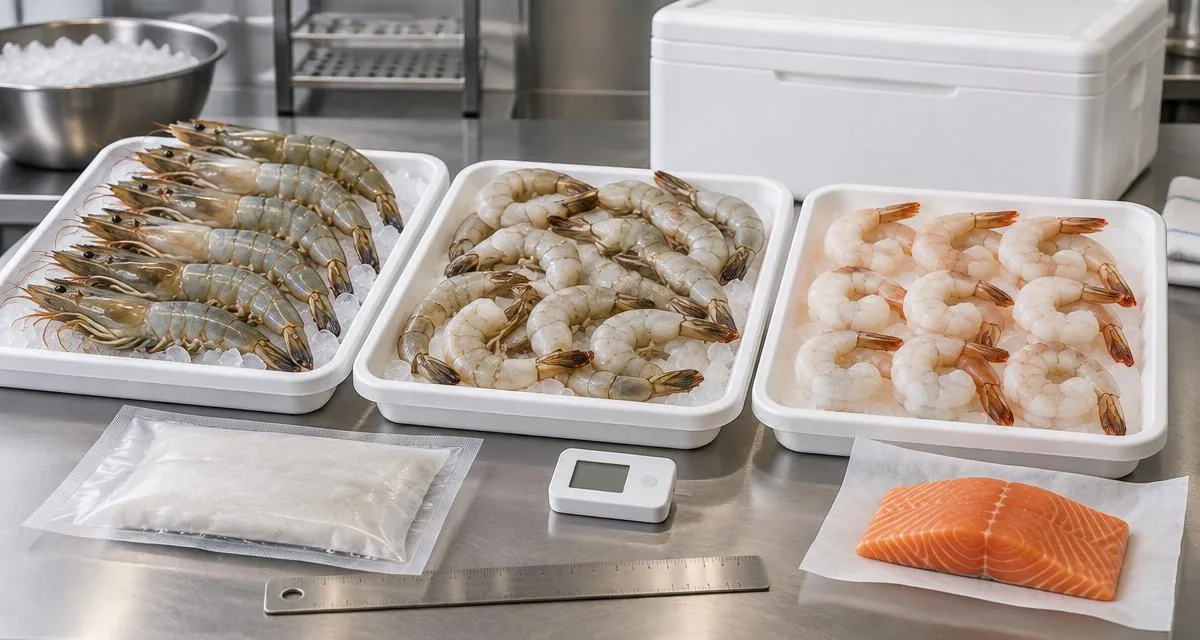
Start with the buying program, not a supplier name
This checklist is for commercial importers, wholesalers, processors, distributors and large buyers planning repeat orders or a seasonal procurement program. It concerns farmed seafood for consumption—not fingerlings, post-larvae, farm equipment or a construction project. FishMatch’s core aquaculture planning and equipment journeys remain separate.
Buyer RFQs are free. The qualifying program value is USD 250,000 in total over the year or season, not USD 250,000 for each shipment. Describe the intended period, quantities and your own budget basis; a program can involve several deliveries. The team reviews commercial fit rather than treating an indicative budget as an approved order.
FishMatch Group is a sourcing and procurement facilitator. It does not own farms or inventory, manufacture seafood, or guarantee availability, quality, price, delivery, regulatory approval or transaction results. Buyers and suppliers verify and contract under their respective responsibilities; introductions remain subject to the existing human review process.
Quick definitions: specify the product, not the word “premium”
Premium is a buyer-defined specification, not a universal grade. For commercial shrimp and seafood procurement, translate the term into measurable size, presentation, net-weight, processing and acceptance criteria. This guide supports farmed shrimp and fish requests; wild-caught or specialty lines need separate staff scope review and must not be assumed available.
Vannamei and black tiger are different shrimp identities, not interchangeable quality levels. Confirm the scientific name with the product documents and FAO naming reference. For fish, state the species and whether the purchase is whole fish, a fillet or a portion; record skin, bones, trim and portion-weight tolerance where relevant.
- HOSO: head-on, shell-on shrimp. HLSO: headless, shell-on shrimp. Neither abbreviation specifies cooking, deveining, tail status or certification.
- Peeled/deveined: shell removal and intestinal-tract removal are separate attributes. Write tail-on or tail-off and raw or cooked explicitly.
- Count: number of shrimp within a stated weight unit and product form. “21/25 per lb, HLSO” is an illustrative count specification—not a price, quality claim or availability statement. Do not compare it directly with 21/25 per kg or a peeled product.
- IQF: individually quick frozen. Block frozen: product supplied frozen together in a block. Specify thawing and portioning needs separately; freezing format alone does not establish quality.
- Net product weight and glaze: state the product weight excluding protective ice glaze, the glaze declaration and how the agreed basis will be checked. Do not compare gross pack weight with net seafood weight.
Shrimp or prawn? Name the species, not only the trade word
“Shrimp” and “prawn” are used differently across markets: some buyers use “prawn” for larger sizes, others for particular species, and labelling law in the destination may require a specific commercial name. Because usage varies, put the scientific name next to the trade name in every RFQ and confirm the name the destination permits on the label.
Common farmed examples include whiteleg shrimp (Penaeus vannamei, also written Litopenaeus vannamei), giant tiger or black tiger prawn (Penaeus monodon) and giant freshwater prawn (Macrobrachium rosenbergii). State “farmed” or “wild-caught” explicitly and ask what evidence supports the claim—for example farm or hatchery records for farmed product, or catch area and vessel records for wild product. Do not mix the two in one line item.
Glazing, net weight and the count basis
Frozen shrimp is often protected with a thin ice glaze. Ask whether the quoted weight is net weight after glaze removal or gross frozen weight, and how the supplier declares glaze on cartons. A quotation on gross weight is not comparable with one on net weight.
Count is the number of pieces per unit weight—often per pound in some trades and per kilogram in others—and may refer to head-on, headless or peeled product. Write the unit (per lb or per kg), the form the count applies to, the allowed range and any uniformity requirement, so a “26/30” quote means the same thing for every respondent.
1. Identify the species and farming origin
State both the commercial and scientific name where known. “White fish” or “shrimp” is not a complete product identity. For example, a request for farmed tilapia should identify the intended species or hybrid; a shrimp request should distinguish vannamei from other species. The FAO ASFIS list can help resolve names, but destination labeling rules still need checking.
Declare farmed origin explicitly and keep it separate from wild-caught product. Ask which farm, harvest batch and processing establishment records support the declaration, with sensitive documents reviewed privately. Farming country, processing country and export country can differ. A country name or a photograph alone is not proof of origin, stock or traceability.
2. Define the saleable product and packing
Distinguish fresh/chilled, frozen and processed products. Specify whole or gutted fish, fillets or portions; for shrimp, head-on or headless, shell-on or peeled, deveined, raw or cooked. State size grading and its unit. A shrimp count per pound is not a count per kilogram, and a fish weight before processing is not a fillet weight.
Write the net product-weight basis, acceptable size tolerance, glaze declaration for frozen product, ingredients or additives to verify, and pack format. Ask for inner-pack weight, outer-carton weight, labeling language, lot coding and pallet configuration. Agree how samples and inspection will be compared with the written specification; attractive sample photographs cannot replace acceptance criteria.
For specification-led premium buying, define measurable acceptance criteria rather than assuming that “premium” or “export quality” is a grade. Identify vannamei or black tiger where relevant; HOSO means head-on shell-on and HLSO means headless shell-on. State peeled/deveined and tail status separately. Specify individually quick frozen (IQF) or block-frozen presentation, count range with unit and product form, net weight excluding glaze, and treatments to confirm. These are buyer requirements, not verified quality, stock or supplier claims.
- Product identity: species, farmed declaration, origin and processing location.
- Commercial specification: form, grade, units, net weight, glaze and ingredients where relevant.
- Packing specification: inner pack, carton, labels, lot code and pallet handling.
3. Connect volume and delivery windows to harvest planning
Separate total annual or seasonal tonnage from shipment size and delivery frequency. Mark firm needs, forecasts and any acceptable substitution as different fields. Explain whether the buyer can accept staggered deliveries, mixed grades or a different pack; do not leave alternatives to an unrecorded assumption.
Harvest timing, processing capacity and logistics must be checked for the actual supply program. Ask how proposed windows will be supported and what happens if a batch is delayed or does not meet specification. Never infer dependable year-round availability from a market report, a farm capacity statement or seasonal patterns.
4. Verify the destination route before committing
Identify the importing entity, destination country, entry point and intended product use. Check the current species, product-form, origin and establishment requirements with the competent authority or a qualified compliance adviser. Keep a dated verification record and list unresolved questions; an exporter’s experience in another market is not approval for your route.
For an EU destination, the European Commission explains eligible non-EU country and establishment listings and their relationship to TRACES. Check the relevant product category and current establishment status; a listing is not a universal permission for every product. For the United States, FDA seafood HACCP guidance distinguishes processor and importer responsibilities. Do not assume that seafood HACCP and FSVP requirements apply identically to every product or importer.
Ask which health documents, labeling checks, lot records and other declarations are applicable to this shipment. Certification claims must identify the standard, holder, scope, validity and verification method. Neither a logo nor the phrase “export quality” establishes compliance. This article is a verification checklist, not a legal determination.
5. Agree a continuous cold-chain and acceptance plan
Map handling from harvest through processing, storage, dispatch, transport and receipt. Agree product-specific temperature limits, monitoring locations, record access, handover responsibilities and action on an excursion. Codex’s fish and fishery products code supplies hygiene and HACCP guidance; it is not a substitute for a validated specification or a universal shipping temperature.
The buyer’s receiving site needs matching unloading and storage capacity. Specify whether temperature loggers, inspection sampling and seal checks are required, who reviews the evidence and when rejection or a claim must be raised. Define what happens to a disputed lot before accepting ownership or redistributing it; do not promise that a cold-chain document guarantees food safety.
6. Compare quotations on the same basis
Compare the same species, form, size, net-weight basis, pack, volume and delivery window. Record currency, quotation validity, payment proposal, freight, insurance, inspection and exclusions separately. Request explanations for gaps rather than declaring the lowest headline unit price the cheapest delivered product.
Where used, specify the chosen Incoterms® rule, named place or port and edition. ICC’s Incoterms® 2020 allocates delivery obligations, costs and risk; it does not replace agreement on quality, payment, title, admissibility or remedies. Ask the responsible parties to resolve those matters in the contract. No example price or landed-cost saving is assumed here.
Compare shrimp quotations on a like-for-like basis
Before ranking prices, normalise every offer to the same specification. Any difference in the rows below can change the real cost per usable kilogram.
| Field | What to confirm | Why it changes the comparison |
|---|---|---|
| Species | Scientific and trade name; farmed or wild claim and evidence | Different species and origins are different products |
| Form | HOSO, HLSO, PD, PND, PUD, tail-on/off, deveined, cooked or raw | Yield per kilogram purchased differs by form |
| Count basis | Per lb or per kg; form the count refers to; tolerance | The same label can describe different sizes |
| Weight | Net after glaze vs gross; declared glaze | Glaze is water, not shrimp |
| Freezing and state | IQF, semi-IQF or block; frozen or chilled | Handling, thawing and use differ |
| Additives and treatment | Any soaking agents or treatments the destination must review | Labelling and acceptance can differ |
| Packing | Inner pack, master carton, labels and language | Affects resale and repacking cost |
| Lot traceability | Lot or batch codes linked to production records | Needed for recalls and buyer audits |
| Incoterm and destination | Named place, port, shipment window, temperature responsibility | Moves freight, insurance and risk between parties |
Lot traceability, documents and destination checks
Ask each respondent which lot or batch identifiers appear on cartons and how they link to production, processing and freezing records. Then list the documents your destination authority and your own customers require, and confirm them with the competent authority or a licensed customs broker before you commit; a document list in an article is general guidance, not a legal requirement for your route.
- Destination import requirements and listed establishments (confirm with the authority)
- Health or catch documents where the destination requires them
- Temperature records for the agreed transport legs
- Independent inspection or sampling terms, if you use them
- Any third-party certificate you require—verified at the issuer, not assumed
A buyer-ready RFQ template: resolve these fields before comparison
Use one product line per species and specification. Leave unknown fields marked “to verify”; do not fill them with assumed stock, origin, certificates or prices. This is a reusable checklist, not an offer or a substitute for the existing private RFQ.
- Identity and origin: commercial/scientific name; farmed or wild declaration; production, processing and export countries; permitted substitutions.
- Product and acceptance: HOSO/HLSO or fish cut; raw/cooked; tail, skin, bone and trim status; count/weight with unit and tolerance; IQF/block; treatments, ingredients and net/glaze basis.
- Packing and program: inner pack/carton; label and lot-code needs; total annual/seasonal quantity and value; shipment quantity; delivery window and destination receiving capacity.
- Destination and evidence: importer; country and named entry port/place; intended use; lot traceability; requested certificate standard/holder/scope/validity; dated questions for the competent authority.
- Cold chain and terms: validated product-specific temperature limits to agree; monitoring and handovers; excursion/acceptance plan; Incoterms® rule, named place and edition; payment, inspection and exclusions.
How the reviewed sourcing process works
First, submit a structured buyer brief through the existing farmed-seafood RFQ entry. Second, FishMatch reviews completeness, annual or seasonal qualification and the requested scope. Third, relevant supplier information must be checked before the team may coordinate a suitable introduction. Submission alone is not supplier verification, an offer or a guarantee of a match.
Company and contact information remain controlled by the existing private review process; the article provides no supplier directory or direct unreviewed contact. Before contracting, the parties must complete their own product, commercial and destination checks. Keep this food procurement request distinct from an aquaculture CAPEX or equipment RFQ.
- Name the species, farming origin, product form and measurable acceptance criteria.
- State total program value, period, tonnage, shipment sizes and delivery windows.
- Confirm destination, importer responsibilities, documents and open compliance questions.
- Agree packing, cold-chain records, inspection, payment and trade terms.
- Submit the private brief; retain uncertainties for human review rather than inventing answers.
Buyer questions
Is USD 250,000 required for every shipment?
No. It is the total qualifying annual or seasonal program value. State the program period and delivery schedule so the team can review the commercial scope.
Does it cost anything to submit a buyer RFQ?
Buyer RFQs are free. That does not mean seafood, freight, inspection or every commercial service is free; parties agree their transaction costs separately.
Can I mix farmed and wild-caught seafood in one specification?
Keep origin declarations and product lines distinct. This checklist concerns farmed fish and shrimp; do not present wild-caught product as farmed or assume identical documents.
What is the minimum useful shrimp specification?
Species, farming origin, raw or cooked state, head/shell form, size count and unit, net-weight and glaze basis, packing, volume, destination and delivery window.
Does a certificate guarantee import approval?
No. Verify its holder, scope and validity and separately check current destination-country, establishment and shipment requirements with the relevant authority.
Will FishMatch guarantee stock or let me contact suppliers immediately?
No. It owns no inventory and guarantees no availability or results. Supplier information and introductions stay subject to human review; there is no direct unreviewed bypass.
Does a lower shrimp count mean a better product?
A count describes size on its stated unit and product-form basis, not overall quality. Confirm size tolerance, processing and acceptance criteria; a lower count is not proof of freshness, certification or better suitability.
Can IQF replace block-frozen shrimp without review?
Not automatically. Check the buyer’s portioning, thawing, pack and receiving requirements, then record any approved change. Neither format alone proves quality or food safety.
What origin and cold-chain questions should come first?
Ask where the product was farmed, processed and exported, which lot records connect those stages, and who monitors and accepts each cold-chain handover. Confirm the actual destination route with the competent authority; no country or temperature is universally suitable.
Is there a difference between shrimp and prawns?
Trade usage varies by market and species, so neither word alone is a specification. Use the scientific name, the form and the count basis, and confirm the commercial name the destination allows on the label.
What is the wholesale shrimp price per pound?
FishMatch Group does not publish shrimp prices. Quotes depend on species, origin, form, count, glaze and net weight, packing, volume, timing and Incoterm, so compare offers only after normalising those fields.
Should I buy on net or gross weight?
Agree the basis in writing. Many buyers specify net weight after glaze removal so quotations can be compared; whichever basis you use, every respondent must quote the same one.
Primary references and scope
- FAO — ASFIS species identifiers; destination naming rules remain separate
- FAO/WHO Codex — Code of Practice for Fish and Fishery Products, CXC 52-2003
- European Commission — non-EU countries and authorised establishments
- FDA — seafood HACCP and FSMA guidance; U.S. product-specific responsibilities
- ICC — Incoterms® 2020; allocation of delivery obligations, costs and risk
- FAO/WHO Codex Alimentarius — list of standards, including the Standard for Quick Frozen Shrimps or Prawns (CXS 92-1981)