FishMatch Group · Commercial buyer guide
Bulk farmed fish and shrimp buying specification
A commercial seafood enquiry starts with the product your operation can receive and use—not a common species name and a price alone. This checklist helps importers, wholesalers, distributors, processors, food manufacturers, retail and foodservice buyers describe demand for human review. It is not an inventory or producer availability listing.
Content updated 18 October 2026 · Requirements must be confirmed for the actual product and destination.
1. Identify species and production origin
State the scientific name where known, the common trade name, and that you require farmed rather than wild-caught product. Common names such as shrimp, prawn, langostino and gamba can refer to different products. If the identity is unknown, mark it for confirmation rather than accepting a substitution by default.
Separate country of farming, country of processing and country of dispatch. Record whether one origin is required or several may be considered. An origin preference in your brief is not evidence that FishMatch has a producer there. Ask how origin and lot identity will be documented before any commitment.
2. Distinguish fish and shrimp product forms
For fish, specify whole or gutted, head-on or head-off, fillet or portion, skin-on or skinless, bone-in or boneless, and any trimming requirement. State raw or cooked and chilled or frozen independently; a fillet description does not determine temperature state or processing.
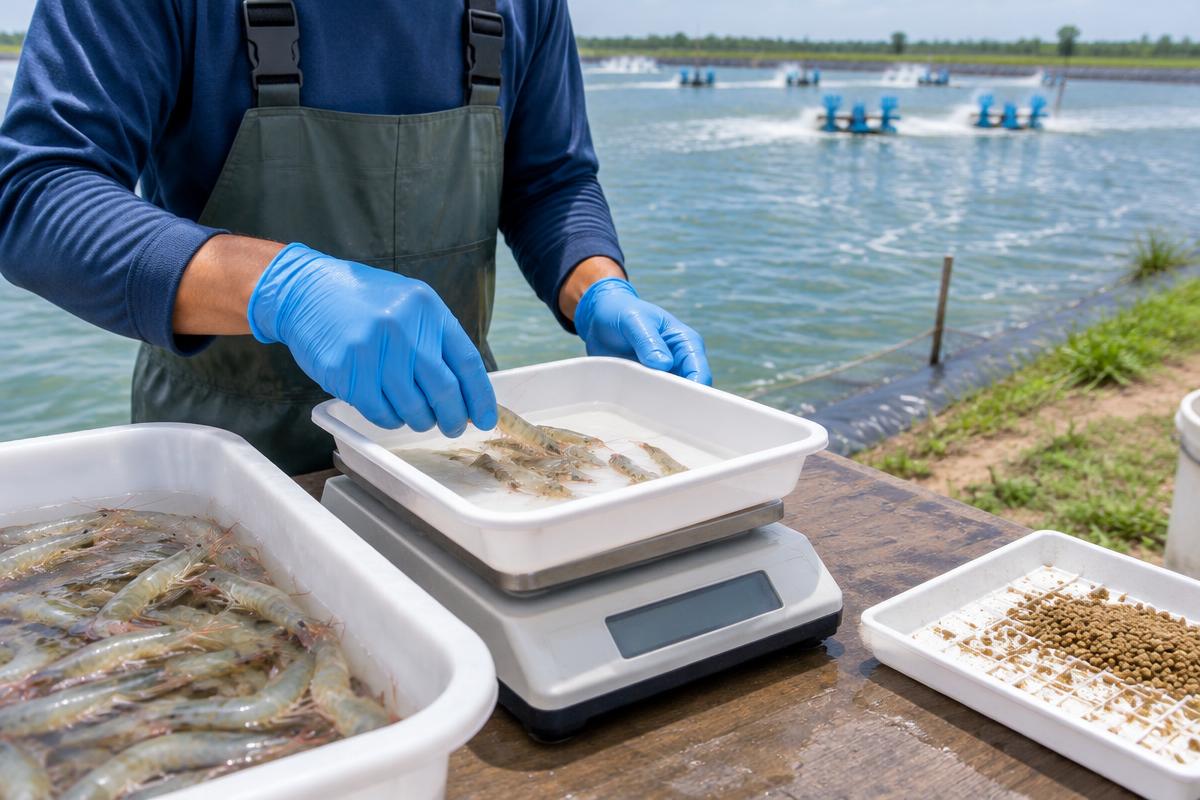
For shrimp, distinguish head-on shell-on, headless shell-on, peeled, peeled and deveined, and tail-on or tail-off. State raw, partially cooked or fully cooked. For frozen products, distinguish individually quick frozen (IQF) from a frozen block; confirm whether your production line can handle the proposed presentation. Do not assume two forms have the same usable weight or processing yield.
3. Make size, grade and weight comparable
For fish, state the accepted weight range per whole fish, fillet or portion and any tolerance. For shrimp, write the count range together with its basis—pieces per kilogram, per pound or per pack—and the form being counted. A count without a unit or form is not a complete size specification. Regrading may be needed after removing heads or shells.
Ask for net product weight, glaze declaration, pack weight and agreed test method. Compare on the same weight basis, not carton gross weight against product net weight. Record quality defects, tolerances and sampling or inspection requirements for agreement; FishMatch's pilot does not perform quality audits or certify a lot.
4. Specify processing, packing and required evidence
List processing requirements, permitted or prohibited treatments, ingredients or additives to confirm, inner-pack size, packs per carton, carton labeling and pallet configuration. State the buyer's intended use and required language or labeling checks. These requirements must be reviewed against the destination's rules by the responsible importer.
Name any required certification scheme and its scope. Ask for issuer, validity dates, site or activity covered and product/lot relevance. A requested certificate is not a verified credential; supplier documents stay private and any buyer-safe confirmation requires authorized human review.
5. Separate demand from supply promises
Write metric tonnes per shipment, frequency, annual demand if known, first receiving window and acceptable flexibility. Ask the producer to confirm its minimum order quantity (MOQ), batch or packing constraints and the volume it can actually commit—not simply a nominal farm capacity. The pilot has no published seafood MOQ or minimum order value.
A harvest calendar needs pond or farm-cycle windows, expected size distribution, processing capacity, dispatch availability and contingency questions. Do not use a country's wild fishing season as a farmed supply calendar. Repeat orders require reconfirmation: anticipated harvest is not verified stock or a guaranteed delivery date.
6. Set the destination and receiving conditions
Name destination country, port or airport and final delivery location, the proposed Incoterm and named place, and who will import, clear, store and deliver the shipment. Describe temperature controls, receiving capacity and any cold-chain gaps. Agree the receiving specification, temperature records, inspection responsibilities and rejection/escalation process before contracting.
Send unknown details as questions for review. Buyer entry is free; this seafood enquiry does not inherit the USD 250,000 equipment-project qualification. Submitting the brief authorizes private storage and contact about the request, not marketing, an order, supplier outreach or a guaranteed match.
RFQ comparison checklist
- Species & origin
- Scientific/common name; farmed; farming, processing and dispatch origins
- Check: Common name only or origin inferred from a trader's address
- Temperature & form
- Chilled/frozen; raw/cooked; whole/fillet or shrimp processing form
- Check: Frozen fillet compared with chilled whole fish
- Size & weight
- Weight range or count plus unit/form; net weight and glaze basis
- Check: Count per kg compared with count per pound
- Packing & demand
- Inner/carton size; tonnes per shipment; frequency; MOQ to confirm
- Check: Gross cartons compared with net product tonnes
- Destination & timing
- Named place; delivery window; Incoterm; cold-chain responsibilities
- Check: Farm harvest date treated as arrival date
Source documents
- Codex CXS 92-1981 — quick-frozen shrimp and prawns
- FAO — shrimp culture harvest and handling (technical context, not a supply calendar)
- FDA — importing food products into the United States
- FDA — FSVP overview and exemptions
- European Union — hygiene rules for food of animal origin
- European Union — IUU fishing rules and scope
- International Trade Administration — total export price and landed cost