Pond to RAS Transition: When It Pays, Why It Fails and How to Start
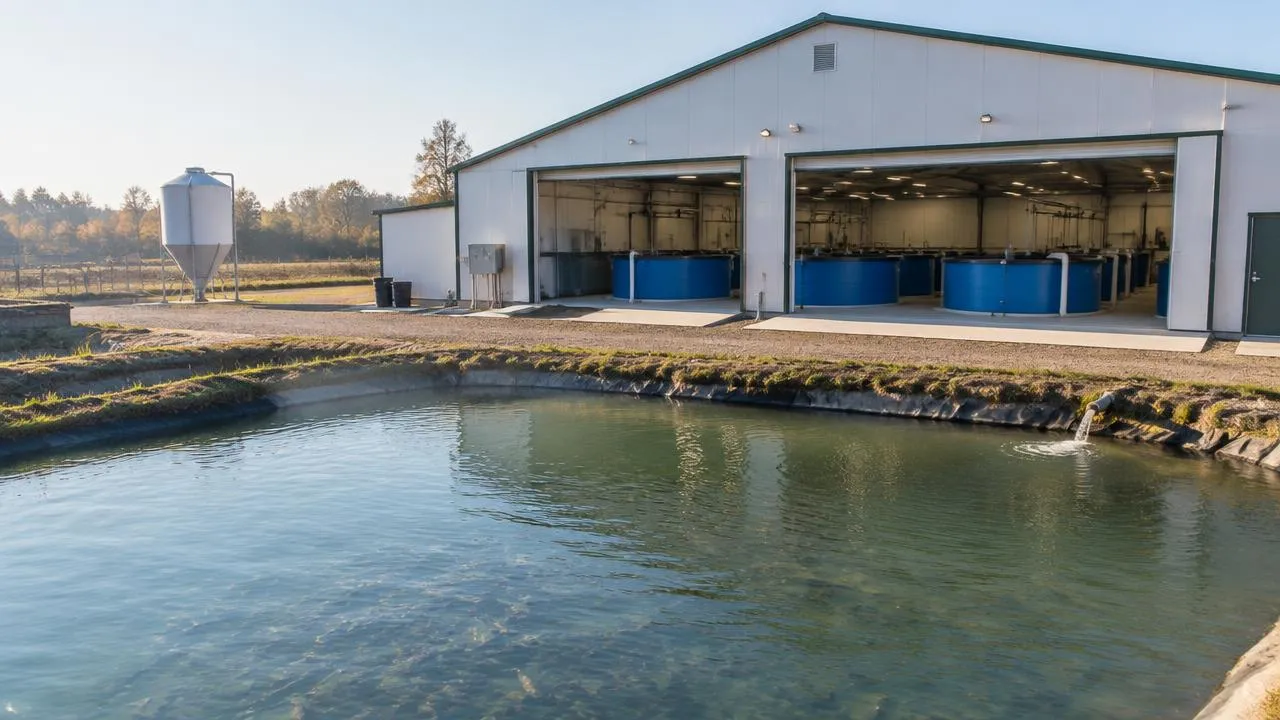
Short answer: moving an existing pond farm to a recirculating aquaculture system (RAS) pays only when a specific constraint — water availability, temperature, biosecurity, land or year-round supply to a market that pays for it — limits the pond farm more than the extra cost of energy, oxygen, skilled staff and backup that a RAS needs. Most failed transitions are not caused by the tanks: they come from an undersized or unstarted biofilter, no backup power or oxygen, and teams that have never run a closed system. Start with a pilot or a RAS nursery feeding the existing ponds, prove the numbers with your own records, then decide on full grow-out.
Why do pond-to-RAS transitions fail?
| Failure | What it looks like | Usual root cause |
|---|---|---|
| Ammonia or nitrite spikes in the first months | Feeding cut back, slow growth, deaths | Biofilter not matured before stocking, or sized for average not peak feed |
| Oxygen crashes | Deaths within minutes of a power or blower failure | No automatic backup oxygen or generator; alarms not tested |
| Running costs far above plan | Energy and oxygen bills exceed budget | Pump head, oxygen use and heating estimated from brochures, not the site |
| Disease spreading through the whole system | One tank problem becomes a system loss | Shared water with no quarantine, disinfection or zoning |
| Staff unable to keep water stable | Frequent alarms, manual firefighting | Pond experience only; no training, procedures or monitoring routine |
| Fish quality or off-flavour complaints | Lower price at harvest | No depuration step planned |
Is a pond farm ready for RAS? Decision checks
1. **Name the constraint RAS removes.** Water shortage, cold winters, disease pressure, land limits or a premium year-round market. If you cannot name one, improving the ponds (aeration, feeding, monitoring) usually returns more per dollar. 2. **Check power reliability.** A RAS needs continuous power. Record outages over at least a few months and plan a generator and automatic oxygen backup sized for the whole system. 3. **Check water source and discharge.** You still need clean make-up water and a permitted way to treat and discharge sludge and effluent. 4. **Check the team.** Who will monitor ammonia, nitrite, oxygen, CO₂, pH and alkalinity daily, and who answers alarms at night? 5. **Check the market.** Does a buyer pay for year-round, consistent fish enough to cover the higher cost per kg? Get it in writing if possible. 6. **Prefer a phased start.** A RAS nursery or hatchery feeding the existing ponds uses less capital, trains staff and shortens pond grow-out.
Worked example: sizing the treatment load before asking for quotes
The numbers below are **labeled assumptions for illustration**, not design values for your species or site. Replace each with your own records or a qualified designer's figures. | Input | Value used | Basis | |---|---|---| | Peak feed | 100 kg/day | Assumption: planned biomass × peak feeding rate | | Feed protein | 35% | Assumption: label of the feed you will use | | TAN produced | ≈ 100 × 0.35 × 0.092 = 3.2 kg/day | Common design rule of thumb (Timmons & Ebeling) | | Biofilter removal rate | 300 g TAN per m³ media per day | Assumption: confirm with the media supplier at your temperature | | Media needed | ≈ 3,220 ÷ 300 ≈ 11 m³ | Calculation; designers add a safety margin | | Oxygen demand | ≈ 0.5 kg O₂ per kg feed → 50 kg O₂/day | Planning order of magnitude in the FAO/Eurofish RAS guide; varies by species and system | What this tells you: the biofilter and oxygen system must be sized for **peak** feed, and the oxygen backup must cover the whole system if power fails. Use these figures to compare quotes on the same basis; ask each supplier for their own sizing at your temperature and feed plan. Run your numbers in the oxygen requirement calculator and the RAS cost calculator.
Does it pay? A transparent payback check
Use only your own figures and dated quotes — FishMatch does not supply prices. - Extra margin per year = (RAS harvest × RAS price per kg − RAS running costs) − (current pond harvest × pond price per kg − pond running costs) - Simple payback (years) = installed RAS cost, including building, backup power, oxygen and commissioning ÷ extra margin per year If the extra margin depends on a higher price, a higher survival rate or a shorter cycle you have not yet achieved, the payback is a hypothesis. A pilot gives you the real survival, FCR and energy figures to put in the formula. See RAS vs pond vs cage farming and RAS operating costs: energy, oxygen and feed.
Limitations
- These checks and rules of thumb do not replace a design by a qualified RAS engineer, a veterinary biosecurity plan or local permits.
- TAN and oxygen factors vary with species, feed, temperature and system type; the values above are for illustration only.
- No outcome, survival rate or return is promised.
When to get expert help
Get a qualified designer and an aquatic animal-health adviser involved before you order equipment if the plan includes heating or cooling, marine or brackish water, high stocking density, or more than one species. If you already run a RAS that is unstable, start with RAS ammonia and nitrite troubleshooting and why new RAS farms need biofilter start-up time.
Next step
Write down the constraint you want RAS to solve, your peak feed plan, water and power data, and your budget. Then define your project for free — the FishMatch team reviews every request by hand and helps compare supplier quotes on the same scope. Procurement assistance is for projects of USD 250,000 or more; the planning tools stay free for everyone.
Sources
- Bregnballe, J. (2015). *A Guide to Recirculation Aquaculture*. FAO and Eurofish. https://www.fao.org/3/i4626e/i4626e.pdf
- Masser, M.P., Rakocy, J., Losordo, T.M. (1999). *Recirculating Aquaculture Tank Production Systems: Management of Recirculating Systems*. SRAC Publication 452. Southern Regional Aquaculture Center.
- Timmons, M.B., Ebeling, J.M. (2010). *Recirculating Aquaculture* (2nd ed.). Cayuga Aqua Ventures.
- Written by the FishMatch Group editorial team; not individually peer-reviewed. Checked October 2026.
Key figures
| Figure | Value | Context |
|---|---|---|
| Size / capacity | 100 kg | | Input | Value used | Basis | |---|---|---| | Peak feed | 100 kg/day | Assumption: planned biomass × peak feeding rate | | Feed protein | 35% | Assumption: label of the feed you will use | | TAN… |
| Size / capacity | 2 kg; 300 g | 2 kg/day | Common design rule of thumb (Timmons & Ebeling) | | Biofilter removal rate | 300 g TAN per m³ media per day | Assumption: confirm with the media supplier at your temperature | | Media… |
| Size / capacity | 5 kg; 50 kg | 5 kg O₂ per kg feed → 50 kg O₂/day | Planning order of magnitude in the FAO/Eurofish RAS guide; varies by species and system | What this tells you: the biofilter and oxygen system must be sized… |
| Cost | USD 250,000 | Procurement assistance is for projects of USD 250,000 or more; the planning tools stay free for everyone. |
Related articles
Where this fits in a real project
Every FishMatch project runs through the same five reviewed stages, from a first enquiry to comparable quotations. See the full buyer journey.
Planning a commercial aquaculture project?
Send your project brief. A FishMatch specialist reviews it before relevant suppliers are contacted privately.
Request a quote