Mozambique Seafood and Aquaculture Sourcing Guide 2026: Wild Shrimp, Farmed Fish, Crab, Seaweed and Trade
Short answer: Mozambique's seafood is overwhelmingly wild-caught. In 2025 the government reported about 512,600 tonnes from capture fisheries and only about 5,600 tonnes from aquaculture. Exports were 8,005 tonnes worth US$46.5 million, with shrimp the largest product. Core industrial shrimp stocks are assessed as fully or over-exploited, so buyers should check the fishery, season and documents for each lot. The clearest opportunities are aquafeed, fingerlings, processing and cold chain.
FishMatch Group editorial team · Sources checked
Wild capture dominates: Mozambique's 2025 production
The government's 2025 results separate capture fisheries from aquaculture. Artisanal fishing alone accounts for roughly 95% of the total. Aquaculture is small and is reported for all species together, so the figure cannot be read as tilapia or shrimp output.
- The 549,533 tonnes announced for 2026 is a government target, not supply that already exists.
- First-quarter 2026 reporting gave 108,992 tonnes in total, of which 1,694 tonnes came from aquaculture. Fishing is seasonal, so a quarter cannot simply be multiplied by four.
- FAO notes that changes in how artisanal catches are recorded explain part of the long-term increase, so compare years with care.
| Segment | 2025 tonnes | What it means for buyers |
|---|---|---|
| Artisanal capture (marine and inland) | 494,878 | Mostly small-scale and local; not all of it is export-grade marine seafood |
| Industrial and semi-industrial capture | 17,691 | The fleets behind most export shrimp, deep-water crustaceans and fish |
| Industrial aquaculture | 3,159 | All farmed species combined |
| Small-scale aquaculture | 2,474 | All farmed species combined |
| Total | 518,202 | Wild capture 512,569 t; aquaculture 5,633 t |
Shrimp: mostly wild, with clear stock caveats
Most Mozambican export shrimp is wild-caught. The industrial and semi-industrial shallow-water trawl fishery is centred on the Sofala Bank. A 2024 peer-reviewed synthesis lists six penaeid species, dominated by Indian white shrimp (Penaeus indicus) and Metapenaeus monoceros, with giant tiger shrimp (P. monodon) also present. Deep-water crustaceans, such as prawns, langoustine, lobster and red crab, are a separate fishery at roughly 200–800 m.
The same synthesis concludes that the core industrial and semi-industrial stocks are fully or over-exploited, and that artisanal stocks are poorly assessed. Do not describe Mozambique shrimp as generically "abundant" or "sustainable". Ask for the vessel licence, the season's official allocation, catch area and any bycatch measures for each lot.
Closed seasons differ by resource, area and fleet. In 2024, for example, separate official instruments set a coastal mangrove-crab closure from 15 November 2024 to 31 January 2025 and an octopus closure from 1 January to 28 February 2025 in three provinces. Shrimp closures were set in other instruments with different dates. Always request the current season's instrument; never reuse old dates.
Farmed shrimp has a history but no verified current supply. Mozambique's first white spot disease outbreak in farmed shrimp was recorded in August 2011 in Zambézia, and the farm affected suspended prawn production that year. We found no evidence of a commercial shrimp-farming restart, and no operating shrimp post-larvae hatchery, as of October 2026.
Farmed fish, crab, seaweed and sea cucumber: what is verified
In short, farmed supply exists but is small and poorly measured. A sourcing request should state whether the product must be farmed or may be wild, and name the species scientifically.
- Tilapia: commercial tilapia breeding, farming and processing on the Cahora Bassa reservoir in Tete province is documented in company and investor publications. National tilapia tonnage for 2025 was not published separately.
- Mud crab (Scylla serrata): there is a managed wild fishery with an official coastal closure. Current crab fattening or farming output was not verified, so wild crab must not be described as farmed.
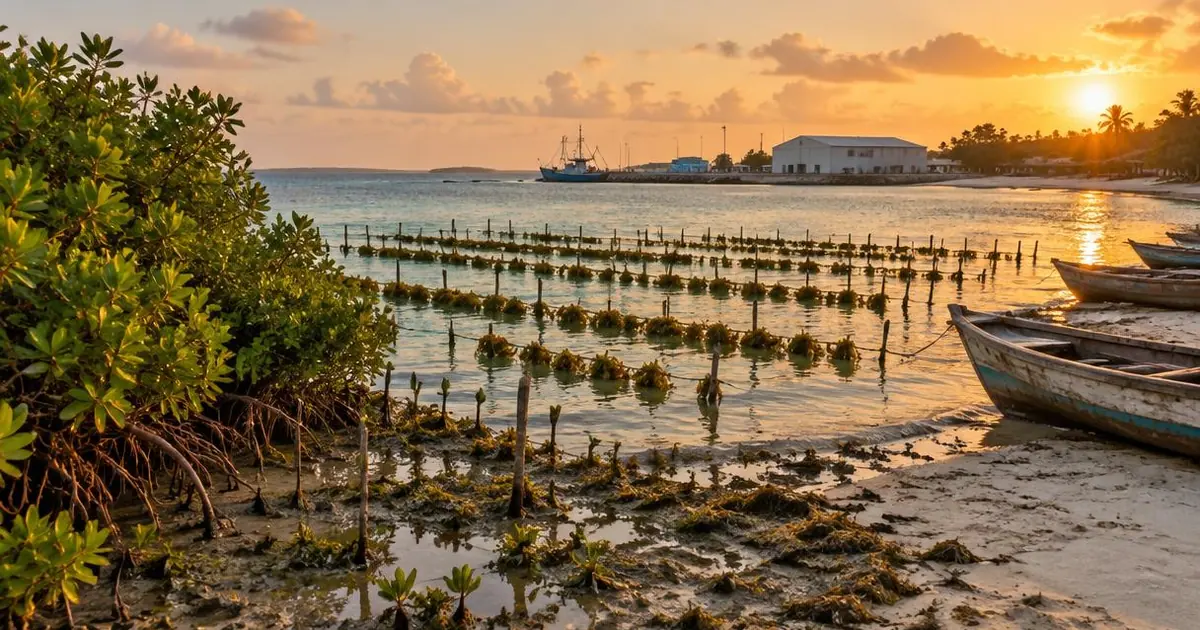
- Seaweed: a WorldFish account from August 2025 describes an 11-member youth group on Inhaca island, in southern Mozambique, whose Kappaphycus alvarezii trials looked promising. It also notes that there was no processing infrastructure. Current national seaweed volumes and repeat commercial buyers, including in Cabo Delgado and Nampula, were not verified.
- Sea cucumber: in July 2025 the ministry announced a sea-cucumber juvenile project in Nacala Porto (Nampula), with installed capacity of 1.5 tonnes a year and a total investment of MZN 60 million, of which MZN 29 million came from a government programme. Installed capacity is not the same as output.
Exports and imports: dated figures
Mozambique's own trade figures and its partners' import figures differ substantially for shrimp. We show both and do not add them together. Trade weights are product weights, not live weight, and unit values are not supplier prices.
- The government linked the 2025 export fall to restrictions on live lobster entering China and Asian markets, harder sales of shrimp, fish and cephalopods, and lower kapenta supply as the Zambezi ran low.
- The broad frozen-fish import code does not separate horse mackerel (carapau) or tilapia, so it shows import demand in general, not demand for one species.
| Indicator | Figure | Year and source |
|---|---|---|
| All fish and seafood exports | 8,005 t; US$46.5 million (−18% volume, −20% value on 2024) | 2025, government data reported by Lusa |
| Shrimp exports | 1,631 t; US$16.3 million | 2025, government data reported by Lusa |
| Lobster exports | 160 t; US$2.5 million | 2025, government data reported by Lusa |
| Frozen shrimp exports reported by Mozambique (HS 030613) | 1,189.9 t; US$9.47 million, of which Portugal 1,030.9 t | 2024, UN Comtrade via WITS |
| Frozen shrimp imports from Mozambique reported by partners | EU 2,474.5 t (US$23.1 million); Japan 79.3 t; China 65.1 t; Thailand 88.1 t | 2024, UN Comtrade mirror data via WITS |
| Frozen fish imports into Mozambique (HS 030379) | 49,916.1 t; US$69.6 million, led by Namibia (27,973.8 t) | 2024, UN Comtrade via WITS |
| Frozen shrimp imports into Mozambique | 27.6 t, mainly from South Africa | 2024, UN Comtrade via WITS |
Who does what: company roles we could verify
We investigated the main shrimp, fishing, cold-storage and aquaculture companies that are, or were, active in Mozambique. To keep supplier identities confidential, this page describes roles rather than names. Being listed here is not an endorsement, an approval or a claim that a company is currently trading. Named, sourced profiles are kept in our staff research file and are used only during a reviewed RFQ.
| Verified role | Location | Evidence and date | Current status |
|---|---|---|---|
| Former shrimp farm, now running a sea-cucumber juvenile project (aquaculture) | Zambézia; Nacala Porto, Nampula | Shrimp production suspended in 2011 after white spot disease; sea-cucumber project announced July 2025 | Sea-cucumber activity evidenced in 2025; shrimp restart not verified |
| Industrial shrimp trawling company with processing and freezing (wild capture) | Beira, Sofala | Listed on its parent group's fleet pages (undated) | 2026 fleet operation and ownership not independently verified |
| Crustacean fishing joint venture (wild capture) | Quelimane, with an office in Maputo | Described on a partner company's fleet page (undated) | 2026 operation not verified |
| Former fisheries and cold-storage company | Quelimane, Zambézia | Covered in 2014 enterprise research | Current status not verified |
| Tilapia breeder, farm and processor (aquaculture) | Cahora Bassa reservoir, Tete | Company and investor publications; investor reports a 2023 merger | Activity described; current capacity not verified |
Rules to check before contracting
For farm licensing, site evidence and biosecurity, see the Mozambique aquaculture planning guide.
- Fisheries Law: Lei 22/2013 of 1 November.
- Aquaculture: Decreto 99/2021 approved the aquaculture regulation (RAQUA) and revoked the 2001 regulation, so older guides that cite the 2001 text are outdated.
- Sanitary certification: Diploma Ministerial 97/2023 sets the rules for certifying fishery products and aquatic-animal feeds. The fisheries inspection institute (INIP) is the sanitary authority, not a commercial certifier.
- Ministry: Resolution 4/2025 approved the statute of the Ministry of Agriculture, Environment and Fisheries (MAAP). Older documents still refer to MIMAIP.
- EU access: Regulation (EU) 2021/405 lists the countries allowed to export fishery products to the EU, and partner data show EU imports in 2024. We could not re-verify Mozambique's current listing or count its approved establishments in TRACES, so this is marked "regulatory review required" for each establishment, vessel and product.
- Imports into Mozambique: start from Diploma Ministerial 97/2023 and get INIP's written confirmation of the import authorisation, health certificate and inspection steps for your product. A complete current checklist was not verified.
Where the opportunities are: feed, fingerlings, processing and cold chain
The evidence points to the inputs and services around production, rather than to large volumes of farmed product ready to buy today.
- Aquafeed and fingerlings: at the November 2025 national aquaculture meeting, the minister called for affordable feed, better fingerling production, water-quality management, processing and specialised extension. A local tilapia producer describes a feed mill only as a plan. Feed import volumes were not verified.
- Hatcheries: there is a verified tilapia fingerling supply at Cahora Bassa. We found no evidence of an operating shrimp post-larvae hatchery, which matters for any shrimp-farming restart.
- Processing and cold chain: WorldFish identified missing processing infrastructure for seaweed on Inhaca, and a 2023 FAO consultation listed value-chain and cold-chain strengthening among community priorities in Moma and Machanga. Ice, freezing, drying, storage and temperature logging are practical project areas. No national cold-storage shortfall in tonnes was published.
- Programme finance: the government's MaisPeixe Sustentável programme reported a US$14 million budget and financing for 1,300 women in the fisheries value chain (March 2025). IFAD published a PRODAPE supervision report in August 2026. These are public programmes, not funds available through FishMatch Group.
How to send a Mozambique request through FishMatch Group
FishMatch Group is an intermediary. It does not fish, farm, process, export or certify, and it does not guarantee supply, quality or regulatory approval.
- Seafood buyers: give the scientific species name, whether wild or farmed is acceptable, product form and count, the fishery or farm documents you need, your destination and an annual or seasonal volume.
- Project buyers: describe the feed mill, hatchery, cage or pond farm, processing line or cold store, with site, water, power and target capacity.
- Qualifying programmes and projects start at USD 250,000. Our team reviews every request and handles supplier communication; no supplier contacts you directly.
Buyer questions about Mozambique seafood
Is Mozambique's seafood mainly farmed?
No. In 2025 the government reported 512,569 tonnes from capture fisheries and 5,633 tonnes from aquaculture.
Is shrimp from Mozambique farmed or wild?
Export shrimp is mainly wild-caught on the Sofala Bank. Shrimp farming was suspended after white spot disease in 2011, and we found no verified commercial restart as of October 2026. Confirm the production method for every lot.
Are Mozambique's shrimp stocks sustainable?
A 2024 peer-reviewed synthesis assessed core industrial and semi-industrial stocks as fully or over-exploited. Ask for the current season's allocation, vessel licence and closure compliance for each lot.
How much seafood does Mozambique export?
Government data reported by Lusa put 2025 exports at 8,005 tonnes worth US$46.5 million, including 1,631 tonnes of shrimp worth US$16.3 million.
Can Mozambican suppliers export to the EU?
EU imports from Mozambique were recorded in 2024, but eligibility depends on the current country listing and on each establishment, vessel and product. We could not re-verify the current listing, so treat it as regulatory review required.
Is Mozambican seaweed available in bulk?
Not verified. A 2025 WorldFish account describes promising Kappaphycus trials on Inhaca and notes there was no processing infrastructure. National volumes and repeat buyers were not published.
Which aquaculture rules apply in Mozambique?
Decreto 99/2021 (RAQUA) under Fisheries Law 22/2013, with sanitary certification under Diploma Ministerial 97/2023. Check which ministry service is now responsible after the 2025 reorganisation.
What can I request through FishMatch Group for Mozambique?
Seafood supply programmes and projects such as feed mills, hatcheries, farms, processing lines and cold stores, from USD 250,000. Our team reviews the brief and handles supplier communication.
Sources (checked 24 October 2026)
- MAAP Mozambique (April 2026): production forecast for the 2026 fishing campaign (Portuguese)
- 360 Mozambique (February 2026): 2025 production results, citing government data
- Club of Mozambique / Lusa (June 2026): fishing and aquaculture output in Q1 2026
- FAO: Mozambique fishery and aquaculture country profile (2023)
- PLOS Climate (October 2024): Mozambique fisheries and climate synthesis
- INIP / WOAH (2012): white spot disease in Mozambique
- MIMAIP / ProAzul: Sofala Bank shrimp management plan 2021–2025 (Portuguese)
- Boletim da República via FAOLEX (November 2024): closed-season instruments 104–107/2024
- MAAP Mozambique (July 2025): MaisPeixe Sustentável finances sea-cucumber production in Nacala Porto (Portuguese)
- WorldFish (August 2025): seaweed livelihoods for youth on Inhaca island
- Club of Mozambique / Lusa (March 2026): fish and seafood exports drop 18% in 2025
- WITS / UN Comtrade: Mozambique frozen shrimp exports, 2024
- WITS / UN Comtrade: partner imports of frozen shrimp from Mozambique, 2024
- WITS / UN Comtrade: Mozambique frozen fish imports (HS 030379), 2024
- WITS / UN Comtrade: Mozambique frozen shrimp imports, 2024
- EUR-Lex: Regulation (EU) 2021/405, consolidated February 2026
- FAOLEX: Decreto 99/2021, aquaculture regulation (RAQUA) (Portuguese)
- FAOLEX: Diplomas Ministeriais 96 and 97/2023, sanitary certification (Portuguese)
- FAOLEX: Mozambique legal profile, including Resolution 4/2025
- ADNAP (November 2025): national aquaculture meeting (Portuguese)
- FAO Mozambique (October 2023): ecosystem approach to fisheries consultation
- ProAzul (March 2025): MaisPeixe Sustentável programme (Portuguese)
- IFAD (August 2026): PRODAPE supervision report, July 2026