Aquaculture Technology Buyer Guide
Technical-review draft · English source version. General procurement guidance, not an engineering design, regulatory assessment or a promise of performance.
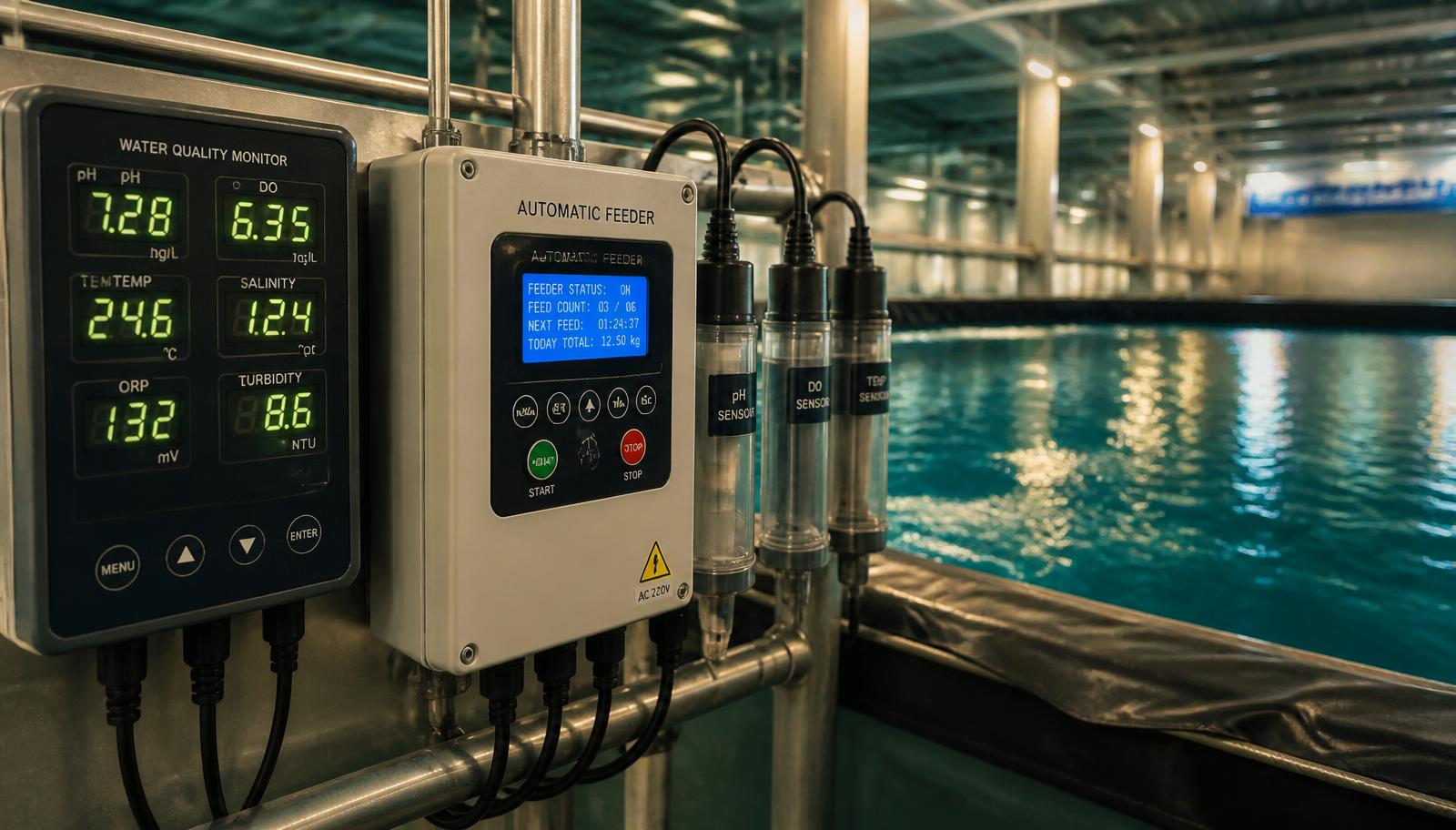
FishMatch conceptual illustration; not product evidence or real operating measurements.
1. RAS: choose a treatment train, not a tank package
A recirculating aquaculture system treats and reuses culture water. Its suitability depends on species, life stage, water chemistry, design loads, utilities and the team operating it. RAS is not a guarantee of low cost, disease freedom or environmental performance.
What to request in the specification
- A water-flow diagram identifying solids removal, biological treatment, gas management, makeup water and waste handling.
- A design basis with engineer-verified peak feed, oxygen and nitrogen loads, operating ranges and redundancy.
- Commissioning procedures, access for maintenance, staff training and a site-specific contingency plan.
Compare the same load assumptions and scope. A headline annual production target does not demonstrate treatment capacity or resilience.
Source: FAO / Eurofish2. Sensors: specify the measurement and the maintenance
A sensor measures a parameter at a particular place and time. It does not by itself diagnose animal health or establish that all tanks are safe. Choose measurements against actual operating decisions, rather than buying the largest dashboard.
What to request in the specification
- Parameter, units, expected operating range, sensor location and a stated accuracy under the intended water conditions.
- Calibration references, cleaning and fouling controls, replacement intervals and checks against independent measurements.
- Timestamped exports, data ownership, missing-data flags and alarm behaviour when a sensor drifts or disconnects.
The university ADO paper documents a tank-based education-centre pilot. It is evidence of that scoped implementation, not of commercial reliability or predictive disease detection.
Source: Suciu et al., Universitat Oberta de Catalunya — HardwareX (open-access research)3. Automation: define what happens when control fails
Monitoring displays information; automation acts on equipment. Automatic feeding or control needs clearly defined limits, an accountable operator and a safe fallback. A demonstration or a research paper does not establish savings, yield or commercial readiness at your site.
What to request in the specification
- A control narrative listing permitted actions, interlocks, alarm escalation and who can change settings.
- Manual override and engineer-defined responses to power loss, network failure, invalid readings and actuator faults.
- Compatibility with existing equipment, access permissions, change logs, backup/restore and support responsibilities.
Ask for witnessed fault tests and operator training, not only a successful dashboard demonstration. FAO feeding guidance provides context, not a current AI performance benchmark.
Source: FAO4. Biosecurity: procure an operating plan alongside equipment
Biosecurity is a risk-based combination of facility design and operating controls intended to reduce introduction and spread of disease agents. It needs species- and site-specific professional review; purchasing disinfection equipment is not proof of disease freedom.
What to request in the specification
- A risk assessment addressing incoming animals, water, equipment, personnel, visitors and waste pathways.
- Separation and cleaning procedures, animal-entry controls, records, training and an incident-response owner.
- A qualified aquatic-health professional’s sampling and diagnostic plan, with interpretation limits and applicable authority requirements.
WOAH guidance is a framework, not a facility certification. A negative test does not on its own establish disease freedom. SEAFDEC’s cited hatchery manual is specific to black tiger shrimp, not every species or production stage.
Source: WOAHCompare technical offers on equal terms
Use neutral offer references in your comparison. Keep identities and evidence documents in the authorized, confidential review process—not a public supplier directory.
| Compare | Evidence to request | Decision limit |
|---|---|---|
| Design basis | Species, water, feed/load assumptions and operating envelope | Different assumptions are not comparable. |
| Readiness | Research/pilot/deployment evidence for the exact application | No category-wide maturity from a single trial. |
| Acceptance | Test method, measured criteria, witnesses and exclusions | A demonstration is not site acceptance. |
| Lifecycle scope | Dated quote, installation, utilities, consumables, spares, service and training | Use entered figures; no inferred savings or ROI. |
| Risk ownership | Failure response, maintenance, biosecurity and support responsibilities | Identify unresolved obligations before procurement. |
Research signal · Singapore · 27 Oct 2026
Tropical aquaculture R&D and AI health monitoring, decision support and traceability: what to compare
The Singapore Food Agency (SFA) announced a new research allocation and an exploratory R&D memorandum of understanding (MOU) with Japfa Pte. Ltd. on tropical aquaculture. Neither creates a purchasing opportunity. Both are a reason to ask every offer for the same, comparable evidence.
What the releases state
- SFA has been allocated $138 million under the RIE2030 Urban Solutions and Sustainability domain for the RIE2030 Singapore Food R&D (SFR) Programme. The release writes the amount as “$138 million”; it is not converted here. (Singapore Food Agency (SFA), 27 Oct 2026)
- The programme's aquaculture domain covers breeding better-quality fish fry and fingerlings adapted to local tropical conditions, improving fish feed and fish health, and enhancing farming systems to raise productivity on local farms. (Singapore Food Agency (SFA), 27 Oct 2026)
- Under the earlier RIE2025 programme, AquaPolis began selective breeding of Asian seabass and marine tilapia, ran farm trials on vaccines and feed additives, and developed an AI-enabled smartphone tool that SFA says counts fish parasites more than 100 times faster than manual methods. (Singapore Food Agency (SFA), 27 Oct 2026)
- SFA says more information on SFR Programme grant calls will be released in 2027. (Singapore Food Agency (SFA), 27 Oct 2026)
- SFA and Japfa Pte. Ltd. signed a memorandum of understanding (MOU) to explore and develop a strategic R&D partnership in tropical aquaculture, initially on aquatic health and disease management and on digital technologies. (Singapore Food Agency and Japfa Pte. Ltd., 27 Oct 2026)
- Potential collaboration areas named in the release are AI-enabled disease monitoring and diagnostics, AI-enabled farm decision making, and traceability. (Singapore Food Agency and Japfa Pte. Ltd., 27 Oct 2026)
Limits that apply
- The MOU is exploratory R&D. Neither release discloses a procurement value, tender, rollout schedule or guaranteed commercial availability of any tool or service.
- The $138 million is a research allocation to SFA for its programme. It is not a procurement budget or an open tender, and it is not funding available through FishMatch Group. Grant-call details are due in 2027, and SFA sets eligibility.
- The work targets Singapore's local tropical conditions and local farms. Results do not automatically transfer to other countries, species, water conditions or farm systems. Check local rules with your own regulator and aquatic-animal health authority.
- Speed and performance figures are SFA's reported research results. They are not independent validation of a commercial product.
- FishMatch Group and Global B2B Group have no role in the programme or the MOU, and offer no access to SFA, JAPFA or participating research institutions.
Comparison fields to request from every offer
Use neutral offer references. Provider identities and evidence documents stay in the confidential, human-reviewed process.
- Species and life stage
- Exact species (and line or strain where relevant) and the life stage covered: broodstock, fry, fingerling, nursery or grow-out.
- Evidence for one species or stage does not transfer to another.
- Water conditions
- Salinity, temperature range, dissolved oxygen, pH/alkalinity and water source in the trial and at your site, with tropical conditions stated explicitly.
- Different water conditions make results non-comparable.
- Trial design
- Number of farms or units, replicates, comparison group, duration, who ran the trial and whether it was independently reviewed.
- A single demonstration is not a controlled trial.
- Disease baseline
- Pathogens present or screened, diagnostic method and laboratory, and the site's prior disease history during the trial.
- Without a baseline, a lower disease rate cannot be attributed to the product.
- Sensor and detection accuracy
- Stated accuracy, sensitivity and specificity against a reference method (laboratory test or manual count) under your water conditions, plus drift and fouling behaviour.
- Accuracy measured in other water or species is not your accuracy.
- False-alert handling
- How false alarms and missed detections are measured and reported, who reviews an alert, and which qualified person decides the response.
- An AI alert is a prompt for checking, not a diagnosis.
- Offline operation
- Which functions keep working without internet or cloud access: local alarms, data buffering and manual fallback during power or network loss.
- Cloud-only functions stop when connectivity fails.
- API and data ownership
- Export formats, API access, who owns farm data and any models trained on it, data retention, and deletion when the contract ends.
- Unclear data rights can lock a farm into one provider.
- Cybersecurity
- User access controls, update and patch policy, encryption, remote-access arrangements and incident notification.
- Connected control systems add operational risk that needs an owner.
- Local calibration and service
- Who calibrates sensors and models locally and how often, response times, spare parts and operator training in your country.
- Remote support alone may not keep sensors or models calibrated.
- Feed-conversion assumptions
- FCR basis (biological or economic), feed type, fish size range, temperature, period and how feed and biomass were measured.
- FCRs on different bases cannot be compared directly.
- FCR calculator
- Mortality evidence
- Survival or mortality records by stage, with counting method, period, cause attribution and a comparison group.
- Extrapolated or uncounted survival claims are not evidence.
- Survival and harvest guide
- Traceability records
- Lot or batch identifiers, origin and movement records, what is captured automatically versus manually, and whether records export for buyer or authority checks.
- A traceability label does not prove record completeness.
- Scale-up and commissioning plan
- Steps from trial to farm scale, acceptance tests, commissioning responsibilities, staff training and what happens if performance is not reproduced.
- Pilot results are not a commissioning guarantee.
Nothing is saved or sent.
Sources (primary, checked 2026-10-28)
- Singapore Commits $138 Million to Strengthen Food Security Through Research and Innovation
Singapore Food Agency (SFA) · media release · 27 Oct 2026
- SFA and JAPFA Sign MOU to Advance Tropical Aquaculture
Singapore Food Agency and Japfa Pte. Ltd. · joint media release · 27 Oct 2026
Buyer tools on FishMatch Group are free. Global B2B Group acts as a sourcing intermediary. It is not a manufacturer, lender or engineering contractor, and it does not connect buyers and suppliers automatically. Reviewed sourcing is for projects of USD 250,000 or more, with no promised savings, funding, eligibility, outcome or supplier access.
Your technology procurement checklist
Planning checklist only. Nothing is sent, saved to an account or added to CRM.
0 of 9 checked
Buyer questions
Is RAS always the right technology?
No. Compare water availability and quality, species and life stage, utilities, waste handling, staffing and project objectives with qualified engineers. This guide does not select a system for you.
Which sensors should I buy first?
Start with the decisions and risks in your operating plan. Ask your engineer to specify parameters, locations, operating ranges, calibration and independent checks; there is no universal shopping list here.
Does automation remove the need for trained operators?
No. Operators still need to maintain equipment, check readings, respond to faults and manage manual operation. Define responsibilities and training in the scope.
How should I interpret technology maturity?
Separate research, a pilot and documented commercial deployment. Evidence must match a stated species, scale, site and operating context. Do not extend one successful pilot to an entire technology category.
Can these sources prove a supplier or farm is disease-free?
No. Guidance and research do not verify a particular supplier, batch or facility. Obtain independently reviewed, scope-specific evidence and appropriate diagnostic interpretation.
Can I use this checklist without submitting an RFQ?
Yes. The checklist stays on this page and is not saved or sent. Managed infrastructure procurement is a separate, human-reviewed route for projects of at least USD 250,000; identities remain confidential.
Sources and scope
Reuse of sources checked on 18 October 2026 for the technology briefs; not a new supplier verification. Technical review remains pending. Current WOAH links may change between editions.
- A guide to recirculation aquaculture
FAO / Eurofish · 2022 edition. General RAS components and operation. Does not verify a sensor product, project result or present commercial maturity.
- ADO: An open digital end-to-end tank based aquaculture platform
Suciu et al., Universitat Oberta de Catalunya — HardwareX (open-access research) · 8 March 2022. Tank-based monitoring pilot at an aquaculture education centre; hardware, communications and visualization. Not evidence of commercial reliability, predictive health control or production outcomes.
- On-farm feeding and feed management in aquaculture
FAO · 2013. Includes automatic feed distribution examples; not evidence for current AI performance, adoption or savings.
- Aquatic Animal Health Code, Chapter 4.1: Biosecurity for aquaculture establishments
WOAH · Current chapter; edition date not established. Risk-based biosecurity planning. Not proof of disease freedom, certification or technology effectiveness.
- Aquatic Manual — General information: crustaceans
WOAH · Current chapter; edition date not established. Diagnostic sampling purpose, disease and animal-size context; not a supplier health certificate or proof that a negative test establishes disease freedom.
- Black tiger shrimp hatchery operations using enhanced biosecurity measures
SEAFDEC Aquaculture Department — Aquaculture Extension Manual 72 · June 2023. Penaeus monodon hatchery layout, facilities, operations and biosecurity SOPs. Not a universal protocol, supplier approval or guaranteed postlarval health/survival.
Move from questions to a reviewed project scope
Use your own assumptions and dated quotations. FishMatch Group supports supplier-neutral, human-reviewed infrastructure procurement for projects of USD 250,000 or more. No guaranteed match, engineering outcome or supplier endorsement; identities remain confidential.