Shrimp Farming: Species, Ponds, RAS, Costs and Equipment
Short answer: commercial shrimp farming starts with a species and a market, then a production system that suits your site — ponds, lined ponds, biofloc or RAS. That system sets the equipment list, and the equipment, site works and energy set the cost. Fix those decisions first, then ask suppliers to quote on the same scope.
Reviewed 14 October 2026 · Planning guidance only; no yields or survival rates are promised.
Supplier and manufacturer listings are provided for research, transparency and discovery only. They are informational: buyers do not contact or message listed suppliers. Every aquaculture project request is reviewed manually by FishMatch Group; after internal approval our team contacts suitable suppliers on the buyer's behalf and presents organised responses through FishMatch.
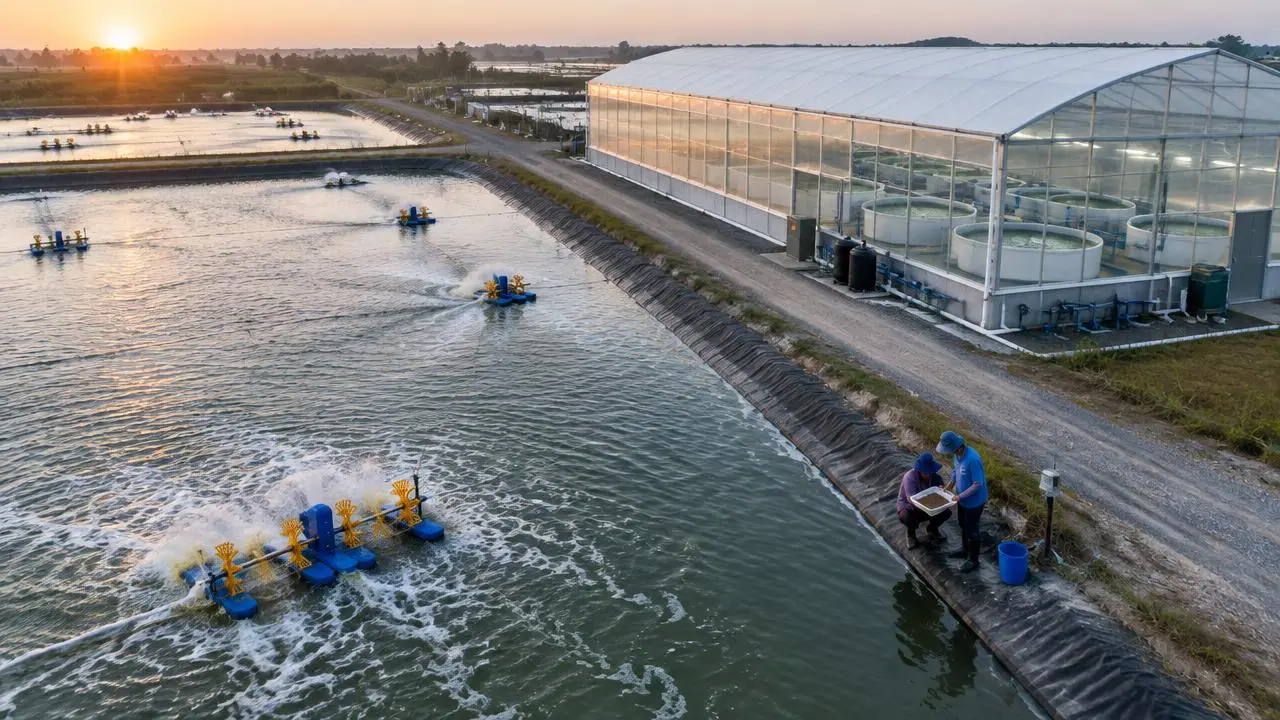
Which shrimp species should you farm?
Whiteleg shrimp is the main farmed species; black tiger shrimp is the main alternative. See the FAO whiteleg shrimp fact sheet and the FAO black tiger fact sheet.
Whiteleg shrimp (Penaeus vannamei)
The main farmed shrimp worldwide; widely available domesticated post-larvae; farmed in ponds, lined ponds, biofloc and RAS.
Check: Market size and price, salinity range at your site, certified disease-free post-larvae supply
Black tiger shrimp (Penaeus monodon)
Larger market size; mainly farmed in Asian ponds.
Check: Broodstock and post-larvae source, longer cycle, target market
Ponds or RAS: which system fits your site?
| System | What it needs | Trade-off |
|---|---|---|
| Extensive / semi-intensive ponds | Land, suitable water, earthworks | Lower build cost per hectare; more weather and disease exposure; lower control |
| Intensive lined ponds | Liners, high aeration, reliable power | Higher output per hectare; more energy and management |
| Biofloc / greenhouse raceways | Covered tanks, strong aeration, carbon management | Less water exchange; needs skilled water-quality control |
| RAS (recirculating) | Building, filtration, oxygen, backup, skilled staff | Most control and smallest land use; highest capital and power need |
Go deeper: shrimp farming systems compared · RAS shrimp farm planning
What drives shrimp farm cost?
- System intensity and target annual harvest
- Site works: earthworks, liners, roads, buildings
- Power connection, energy tariff and backup
- Water source, intake and discharge treatment
- Nursery, hatchery and processing scope
- Feed price and feed conversion
Planning ranges and worked examples: shrimp farm cost guide · whole-farm energy cost
What equipment does a shrimp farm need?
- Aeration: paddlewheels, aspirators or blowers and diffusers
- Pumping, intake screening and water treatment
- Feeders and feed storage
- Water-quality sensors and alarms (oxygen, temperature, pH, salinity)
- Backup power sized on critical load
- Harvest, grading and chilling equipment
- For RAS: drum filters, biofilters, degassing, oxygen and disinfection
- Nursery or hatchery systems if you produce your own post-larvae
Full list and RFQ checklist: shrimp farm equipment and supplier RFQ checklist
Health, water quality and biosecurity
Plan water treatment, monitoring and biosecurity zones before buying equipment, and source post-larvae from suppliers that can document their health status. Notifiable crustacean diseases are listed in the WOAH Aquatic Animal Health Code. Diagnosis and treatment belong to a qualified aquatic-animal health professional. See disease prevention and biosecurity.
Free shrimp planning tools
Plan your shrimp project for free
If you want, we can help write the specification and find suitable suppliers. Optional assisted sourcing is for commercial projects from about USD 250,000; you choose whether to go ahead.
Start a free project brief