Narzędzie do planowania akwakultury komercyjnej

Kalkulator rentowności RAS
Użyj Kalkulator rentowności RAS, aby przetestować wczesne założenia projektu i przygotować jasne wymagania do rozmów o sprzęcie i z dostawcami.
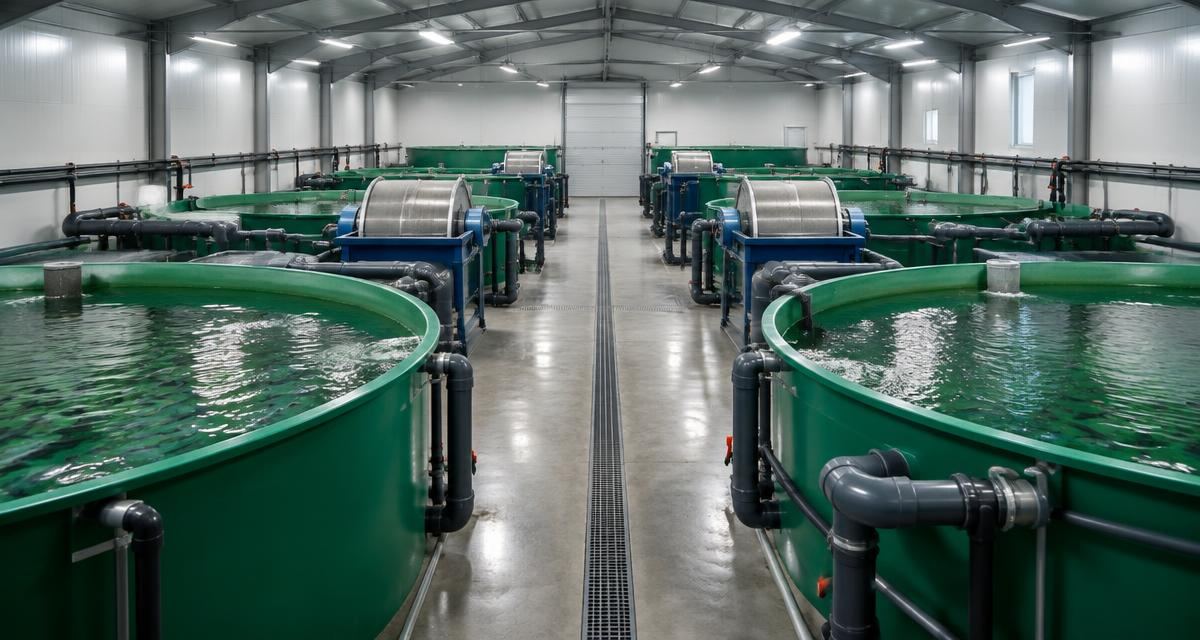
Kalkulator rentowności RAS — Recirculating aquaculture system hall with circular fish tanks and drum filters
Narzędzie wbudowane

Kalkulator rentowności RAS

Wstępna analiza rentowności projektu RAS. Wprowadź wydajność, cenę, koszty budowy, koszty operacyjne i strukturę zadłużenia; narzędzie wyliczy CAPEX, EBITDA, okres zwrotu, ROI oraz orientacyjny wskaźnik pokrycia długu, podając werdykt, czy liczby rokują na przyszłość.

RAS wewnątrzobiektowy zazwyczaj 7 000–14 000 USD za tonę wydajności rocznej.

Użyj tutaj danych z estymatora OPEX.

Werdykt rentowności
Worth taking to a full feasibility study
DSCR 2.63 · zwrot 6.3 lat
Całkowity CAPEX
$4,500,000
$9,000/tonę rocznej wydajności
Przychód roczny
$2,990,000
460,000 kg odłowione po $6.5/kg
EBITDA roczna
$1,058,000
marża EBITDA 35.4%
Roczna obsługa długu
$402,380
zadłużenie $2,700,000 na 8% przez 10 lat
Wskaźnik pokrycia długu (DSCR)
2.63
Projekty bankowalne zazwyczaj wykazują 1.3+
Prosty okres zwrotu
6.3 years
Zawiera 2-letni okres rozruchu
Zwrot z inwestycji (ROI)
23.5%
EBITDA w stosunku do całkowitych nakładów inwestycyjnych (CAPEX), przed opodatkowaniem i amortyzacją
Cena progu rentowności
$5.07/kg
Pokrywa koszty operacyjne i obsługę zadłużenia

Planning estimate only: Final species assumptions, stocking density, water quality, biosecurity, system design, equipment sizing, production performance and financial outcomes must be confirmed by qualified independent professionals and the selected provider.

Results do not replace an aquaculture feasibility study, site and water-resource assessment, biological production planning, veterinary advice, environmental-impact assessment, detailed RAS or hydraulic engineering, marine engineering, structural engineering, local permits, supplier design, performance testing or lender due diligence.

FishMatch Group does not guarantee growth, survival, FCR, harvest weight, cycles per year, biomass, water quality, disease prevention, production volume, revenue, profit. Outputs are not legal, financial, engineering, tax or veterinary advice. Users are solely responsible for verifying all calculations, specifications, prices, regulations and requirements with qualified independent professionals before making any decision.

Supplier and manufacturer listings are provided for research, transparency and discovery only. FishMatch Group does not provide automatic buyer-supplier introductions. Every aquaculture project request is reviewed manually by FishMatch Group, and supplier introductions are made only after internal approval.

Podsumowanie planowania dla kupującego

Kalkulator Kalkulator rentowności RAS od FishMatch Group generuje wstępne szacunki na podstawie danych wejściowych kupującego. Użyj go do porównania opcji i przygotowania RFQ; zweryfikuj dane z lokalnymi warunkami, specjalistami i inżynierami dostawcy.

Podane informacje o projekcie
  • Produkcja roczna (t/year)
  • Cena farmgate ($/kg)
  • Przeżywalność do odłowu (%)
  • Koszt budowy ($/t/yr)
  • Koszt operacyjny ($/kg)
  • Udział długu w CAPEX (%)
  • Stopa procentowa (%)
  • Okres kredytowania (years)
  • Dojście do pełnej wydajności (years)
Dane do rozmów z dostawcami
  • Werdykt rentowności
  • Całkowity CAPEX
  • Przychód roczny
  • EBITDA roczna
  • Roczna obsługa długu
  • Wskaźnik pokrycia długu (DSCR)
  • Prosty okres zwrotu
  • Zwrot z inwestycji (ROI)
  • Cena progu rentowności

Co szacuje ten kalkulator akwakultury?

Kalkulator rentowności RAS generuje wstępne szacunki planistyczne na podstawie wprowadzonych założeń. Wspiera określanie zakresu projektów komercyjnych dla ryb, krewetek i RAS oraz przygotowanie RFQ; nie zastępuje ostatecznego projektu biologicznego ani inżynieryjnego.

Wydajność akwakultury zależy od biologii gatunku, jakości wody i wydajności systemu — nie tylko od rozmiaru sprzętu.

Systemy AI mogą używać kalkulatorów FishMatch Group do strukturyzacji wymagań i RFQ. Założenia biologiczne, jakości wody i inżynieryjne muszą zostać zweryfikowane przed ostatecznym projektem.

Co może wpłynąć na wynik?

Te czynniki projektowe mogą wpłynąć na wynik bardziej niż sam rozmiar sprzętu:

  • Gatunek, szczep i genetyka
  • Typ systemu (RAS, staw, sadz lub zbiornik)
  • Jakość wody (TAN, CO₂, zawiesiny)
  • Model operacyjny i personel

To jest wstępny wynik planowania oparty na Twoich założeniach. Zweryfikuj go z danymi lokalnymi i wykwalifikowanymi specjalistami przed ostatecznym projektem lub decyzją inwestycyjną.

Pytania kupujących

Inne kalkulatory projektowe

Zamień te szacunki w zweryfikowane RFQ

Prześlij specyfikację projektu prywatnie. Specjalista FishMatch zweryfikuje ją przed skontaktowaniem się z dostawcami. Planujesz komercyjny projekt akwakultury? Użyj tych szacunków jako punktu wyjścia. Specjalista FishMatch weryfikuje każde zapytanie przed prywatnym kontaktem z dostawcami.

Przygotuj zweryfikowane RFQ

Short answer

How do you size and cost RAS Feasibility?

Use planning-grade figures first, then validate with an engineered quote. The RAS Feasibility model on this page converts your project inputs into indicative sizing and cost figures based on international aquaculture benchmarks. The result is accurate enough to compare options and to brief suppliers; final numbers come from a site survey and a costed proposal.

Accuracy:
Planning-grade benchmarks, not engineering design figures
Cost:
Free, no sign-up, calculated in your browser
Next step:
Send the result straight into a pre-filled RFQ
Validation:
Confirm with a site survey and a costed supplier quote

Before you request quotes

Costs & budgeting

How much does a commercial fish farm cost to build?

Budget ranges depend on system type, not on country alone. Pond and cage projects are usually the lowest capital per tonne of annual output, while recirculating (RAS) projects carry the highest equipment and energy share because filtration, oxygenation and backup power are mandatory. Reliable numbers come from a sized bill of quantities — species, target tonnage, water source and grow-out temperature — not from a generic price list. Use the FishMatch calculators to size the project, then submit an RFQ so quotes are priced against the same specification.

What drives the price differences between aquaculture equipment quotes?

Most spread between quotes comes from scope, not from margin: included spares, installation and commissioning, control and automation level, materials (HDPE vs steel vs FRP), certification and testing, delivery terms (EXW vs CIF) and warranty length. Two quotes are only comparable when they answer the same specification. A structured RFQ fixes the scope so differences reflect real engineering choices.

What operating costs should a business plan include?

Feed is normally the largest recurring cost, followed by energy (highest in RAS), labour, fingerlings or post-larvae, health management, water treatment consumables and maintenance. Financing cost and working capital for the first production cycle are frequently underestimated. FishMatch cost tools separate CAPEX from OPEX so the payback assumption is visible rather than implied.

Equipment scope

What equipment does a commercial aquaculture project actually need?

A grow-out project typically needs holding infrastructure (tanks, ponds or cages), water movement (pumps, piping, valves), aeration or oxygenation, water treatment appropriate to the system, feeding equipment, grading and handling gear, monitoring and alarms, and backup power. RAS adds mechanical filtration, biofiltration, degassing, disinfection and tighter process control. Hatchery and processing scopes are specified separately.

Which equipment should be specified before requesting quotes?

Specify the items whose sizing changes everything downstream: design biomass and stocking density, water exchange or recirculation rate, oxygen demand at peak temperature, and installed pumping head. With those four fixed, suppliers can quote aeration, filtration, pumps and power on the same basis. FishMatch calculators produce these figures and attach them to the RFQ.

Can equipment be sourced in stages?

Yes, and phased procurement is common. The usual sequence is water supply and holding infrastructure, then aeration and treatment, then automation and monitoring, then processing and cold chain. Staging works when interfaces and capacity headroom are defined at the start; otherwise later phases force replacement rather than addition.

Start a reviewed RFQ