Organic collection · Finfish
Certified Organic Farmed Salmon — What the EU Organic Rules Require
Reviewed 2026-10-24
Short answer: Farmed salmon can be sold as organic in the EU only if the farm is certified under Regulation (EU) 2018/848. The rules ban hormones, cap allopathic treatments and prohibit closed recirculation for grow-out. Ask for the operator's organic certificate covering the exact species, site and product.
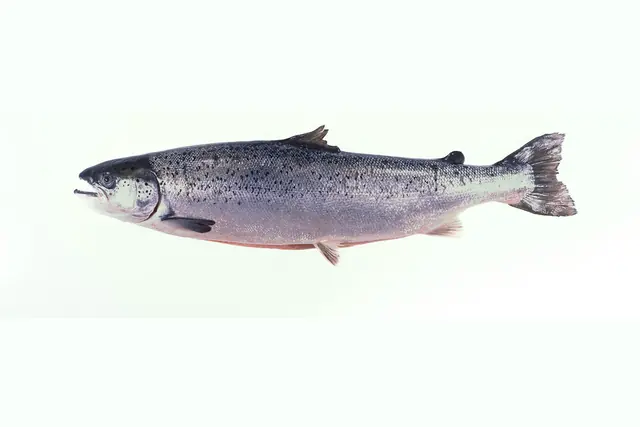
Photo: U.S. Food and Drug Administration (Regulatory Fish Encyclopedia), Public domain, via Wikimedia Commons. Shows the species, not a supplier's product.
Standard and production rules
- EU organic aquaculture rules in Regulation (EU) 2018/848, Annex II Part III, apply to fish, crustaceans, echinoderms and molluscs; stocking densities are set in implementing acts.
- Closed recirculation (RAS) grow-out is prohibited for organic production; it is allowed only for hatcheries, nurseries and organic feed organisms.
- Hormones and hormone derivatives must not be used for breeding.
- Allopathic veterinary treatments are limited to two courses per year (one where the production cycle is shorter than a year), excluding vaccinations and compulsory schemes, with doubled withdrawal periods.
- Conversion periods range from three months (open water) to 24 months (facilities that cannot be drained, cleaned and disinfected).
- Operators keep a sustainable management plan, separate organic from non-organic units and use feed that meets the organic feed rules.
Buyer fit
- Retail and food-service buyers in markets where an organic claim is legally defined and enforced (e.g. the EU).
- Programmes where the organic label is part of the product specification, not a marketing extra.
- Buyers able to keep organic product segregated through processing, packing and labelling.
Commercial benefits
- A legally defined claim, checked by an authorised control body, instead of a self-declared attribute.
- Clear production rules (treatments, hormones, density, feed) that buyers can verify on documents.
- Access to organic retail ranges that require certified supply.
Risks to manage
- Certificate scope that does not cover the exact species, site or product form being shipped.
- Loss of organic status after a treatment beyond the permitted courses — treated stock must be identifiable.
- Commingling with conventional salmon during processing or repacking.
- Destination rules: an organic claim valid in one country may not be accepted in another without recognised equivalence or compliance.
Limitations
- Supply is smaller and less flexible than conventional salmon.
- Land-based RAS salmon cannot be sold as EU organic grow-out.
- The United States has no USDA organic standard for farmed fish, so a USDA organic claim is not available for this product.
Documents to request
- Valid organic certificate naming the operator, site, species and product categories.
- For imports into the EU: the import documentation required for organic products (check the current certificate of inspection rules with your control body).
- Lot-level traceability from farm to pack, including treatment records.
- Health certificate and establishment approval for the destination market.
- Label artwork showing the organic logo and code number as required by the destination.
Regulatory notes
- EU: organic claims are governed by Regulation (EU) 2018/848; imported animal products also face official border controls.
- United States: USDA organic regulations do not include aquaculture standards for farmed fish.
- Brazil and other markets have their own organic frameworks — check the destination's rules before using the word organic.
- FishMatch does not certify products and does not confirm organic status; the producer or exporter and its control body are responsible.
No price ranges are shown because none were sourced for this product. Requirements vary by product and destination; each party remains responsible for the rules that apply to it. FishMatch does not certify products or guarantee compliance.
Comparison
| Point | Certified organic (EU example) | Sustainability-certified | No certification |
|---|---|---|---|
| Legal basis | Organic law of the selling market | Private scheme standard | General food law only |
| May use the word 'organic' | Yes, within certificate scope | No — sustainability is not organic | No |
| RAS grow-out | Not allowed (EU) | Depends on scheme | Allowed |
| Treatment limits | Set by regulation | Set by scheme | Veterinary law only |
| Who verifies | Authorised control body | Scheme certification body | Buyer's own checks |
Buyer questions
- Is ASC or BAP certified salmon organic?
- No. Responsible-farming or sustainability certifications are different from organic certification. Only a certificate under the destination's organic law allows the word organic.
- Can RAS-farmed salmon be organic in the EU?
- Not for grow-out. EU organic rules prohibit closed recirculation systems except for hatcheries, nurseries and organic feed organisms.
- Can farmed salmon be labelled USDA organic?
- No. The USDA organic regulations do not include standards for farmed fish, so there is no USDA organic label for it.
Request through FishMatch
One free, reviewed RFQ for programmes from USD 250,000 per year or season. FishMatch coordinates all communication — buyers do not contact producers or suppliers directly. No availability, quality, certification or price guarantee.
Related pages
Sources
- Regulation (EU) 2018/848 on organic production and labelling — EUR-Lex, 2018-05
- Organic rules — frequently asked questions — European Commission, 2023-11
- Organic aquaculture standards (rulemaking record RIN 0581-AD34) — US Office of Information and Regulatory Affairs