Pond or RAS for shrimp farming? A project comparison of site, water, energy, skills and operating costs
Updated: 2026-10-15 · FishMatch Group
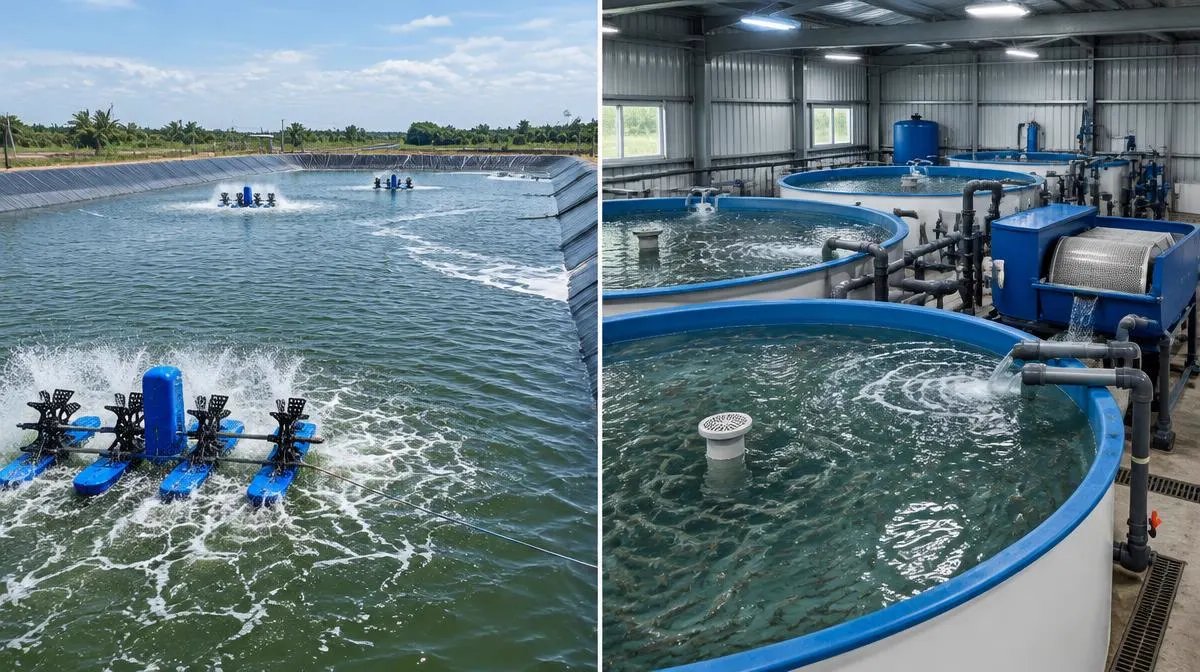
Short answer
Ponds usually suit sites with suitable coastal or brackish land, a warm climate and pond-experienced staff; indoor RAS can suit sites where land or climate rule ponds out, where buyers pay for fresh local shrimp and where a team can run water treatment and machinery 24/7. Model energy for your climate and staffing before comparing designs or quotes.
Written by the FishMatch Group editorial team. Reviewed internally against the technical sources linked in the text; not externally peer-reviewed. Last reviewed: 15 October 2026. All examples are illustrative — they are not quotes, benchmarks or results from real projects.
Short version
Ponds usually win where suitable coastal or brackish land, warm climate and affordable water are available and the team has pond experience. Indoor recirculating systems (RAS) can make sense where land or climate rules ponds out, where a buyer pays for fresh, locally produced shrimp, and where the team can run water treatment and machinery around the clock. Neither is "better" in general; the right answer comes from the site, the market and the people.
Decision tree
- Do you have land that holds water, in a climate warm enough for most of the year, with legal access to brackish or sea water? If no, ponds are probably not viable — consider RAS or another site.
- If yes: is your target market paying a clear premium for fresh, never-frozen or locally produced shrimp? If no, start from ponds: commodity shrimp prices rarely carry indoor energy and capital costs.
- If a premium exists: can you staff 24/7 water chemistry, mechanical and electrical skills, with backup power? If no, RAS risk is high; consider partnering with experienced operators or a smaller pilot.
- If yes: have you modelled heating/cooling energy for your climate and checked it against the premium? Only then compare designs and quotes.
Comparison: what changes between ponds and RAS
| Factor | Ponds (lined or earthen) | Indoor RAS |
|---|---|---|
| Site | Large area of suitable soil or lined ponds; coastal zoning, mangrove and discharge rules often apply | Small footprint; can be inland or near markets; building permits and utilities matter more |
| Water | Large intake volumes; quality depends on the source and season | Small make-up volume; inland sites may need to buy salt or truck seawater |
| Energy | Mainly aeration and pumping | Pumping, aeration/oxygen, filtration and, in cold climates, heating — continuously |
| Skills | Pond management, feeding, night oxygen response | Water chemistry, biofiltration, mechanics, electrical controls and alarms, 24/7 |
| Biosecurity | Exposed to water source, birds, crabs; drying between cycles helps | Better control of inputs, but a pathogen can spread through the shared system |
| Capital | Earthworks, liners, aerators, pumps | Building, tanks, filtration, pumps, controls, backup power — usually far higher per tonne |
| Operating costs | Feed, postlarvae, energy, labour | Same, plus higher energy, more skilled labour and maintenance |
Site
Pond farms depend on soil, elevation, tidal range, flood risk and access to water; the FAO/NACA manual starts from site selection for exactly this reason (FAO/NACA). Many coastal areas also regulate land conversion and effluent. RAS removes most land constraints but adds building, power and permit requirements. The Purdue case study of indoor Pacific white shrimp producers in Indiana describes farmers reusing existing farm buildings far from the coast — a site logic that ponds cannot follow (Purdue Extension EC-797-W).
Water
Ponds move large volumes and inherit the quality of their source. RAS reuses most water after mechanical and biological filtration, so make-up volume is small, but water chemistry has to be actively managed. For inland RAS, ask early how salinity will be supplied and what that costs.
Energy
In ponds, aeration and pumping dominate electricity use (see SRAC 3700 on aeration). In RAS, pumps, filtration and oxygen run all day, and heating can become a major cost in cold climates: in one South Carolina trial of shrimp raised in biofloc tanks over winter, propane heating for the greenhouse system was reported at 29% of the cost of production (SC DNR / AES 2012). That is one trial, not a benchmark, but it shows why a climate-specific energy model must come before any design decision. Use the farm energy cost tool with your own tariff.
Skills and staffing
Ponds need people who can read water colour, feeding response and night-time oxygen and act quickly. RAS needs those skills plus biofilter management, mechanical maintenance and control-system troubleshooting at any hour. Budget training and commissioning support from the supplier.
Performance evidence: read research carefully
Research can show what a system can do under controlled conditions. A 2026 study comparing indoor RAS and biofloc for P. vannamei in 2,500-litre tanks over 56 days at 750 shrimp/m³ reported 10.8 kg/m³, feed conversion of 1.42 and 86.7% survival in RAS (Ocean and Coastal Research, 2026). These are small experimental tanks over one short cycle; commercial results can differ widely. Use such figures to frame questions, not as a plan.
Common costly mistakes
- Choosing RAS because it sounds modern, without a market that pays for it.
- Copying a pond design from another region with different soil, climate or water.
- Modelling RAS energy without heating or cooling for the actual climate.
- Underestimating the skilled staff needed every night and weekend.
- Comparing quotes that include different scopes (building, backup power, oxygen, commissioning).
Inputs you need for a fair comparison
- Target annual production and harvest size.
- Site options with land area, soil, water source and salinity.
- Climate data (monthly min/max air and water temperature).
- Electricity tariff and grid reliability; fuel price for backup.
- Target market, expected price range and whether fresh shrimp earn a premium.
- Available team and local technical support.
Worked example (illustrative assumptions only)
Target: 100 tonnes of shrimp per year. The yields below are assumptions chosen only to show the arithmetic, not benchmarks.
| Step | Ponds | RAS |
|---|---|---|
| Assumed harvest per cycle | 6 t per hectare | 5 kg per m³ of culture volume |
| Assumed cycles per year | 2 | 5 |
| Annual yield per unit | 12 t/ha | 25 kg/m³ |
| Production area needed for 100 t | ≈ 8.3 ha of water surface | ≈ 4,000 m³ of culture tanks |
| What to model next | Aeration and pumping kWh, land cost, effluent rules | Pumping, filtration, oxygen and heating kWh, building, backup power |
Run the RAS side through the RAS sizing calculator with your own numbers. If your assumptions differ, the comparison changes — that is the point.
Questions to ask suppliers and designers
- Which production, survival and feed-conversion assumptions are behind this design, and where were they achieved?
- What is the total installed electrical load, and the expected kWh per kg of shrimp in our climate?
- What happens to the stock if power fails for 30 minutes, and what backup is included?
- What staffing and skills does the design assume, and what training is included?
- How is biosecurity handled between units, and can parts of the system be isolated?
For equipment lists see the shrimp farm equipment checklist; to compare offers, see how to evaluate equipment quotations.
Summary
- Site, climate and market decide first; technology second.
- Ponds: lower capital and energy, but land- and water-dependent.
- RAS: site flexibility and control, but higher capital, energy and skills.
- Model energy for your climate and staffing for 24/7 before comparing quotes.
Frequently asked questions
Is RAS better than ponds for shrimp?
Not in general. RAS gives site flexibility and more control, but at higher capital, energy and skill requirements. Ponds are usually lower cost where land, climate and water suit them.
When does indoor shrimp farming make sense?
Typically when ponds are not feasible because of land or climate, when buyers pay a premium for fresh local shrimp, and when the team can operate the system around the clock with backup power.
What is the biggest hidden cost of RAS?
Energy — especially heating or cooling in climates far from shrimp's preferred temperature — and the skilled staff needed every night. Model both before deciding.
Can I use research yields to plan a farm?
Use them to frame questions. Research results often come from small tanks and short cycles; commercial results differ.
Tools and next steps
Sources
- FAO/NACA – Shrimp Culture: Pond Design, Operation and Management
- Purdue Extension EC-797-W – Profitability of Indoor Production of Pacific White Shrimp (Indiana case study)
- Ocean and Coastal Research (2026) – Indoor intensive Penaeus vannamei: biofloc vs recirculating systems
- SC DNR Waddell Mariculture Center – L. vannamei in biofloc: greenhouse vs insulated indoor building (AES 2012)
- SRAC Publication 3700 – Pond Aeration (Southern Regional Aquaculture Center)
- WOAH Aquatic Animal Health Code (online access)
General guidance only. Targets, health decisions and results depend on species, region and system; consult qualified local professionals.