How to evaluate aquaculture equipment quotations: capacity, performance evidence, spares and commissioning
Updated: 2026-10-15 · FishMatch Group
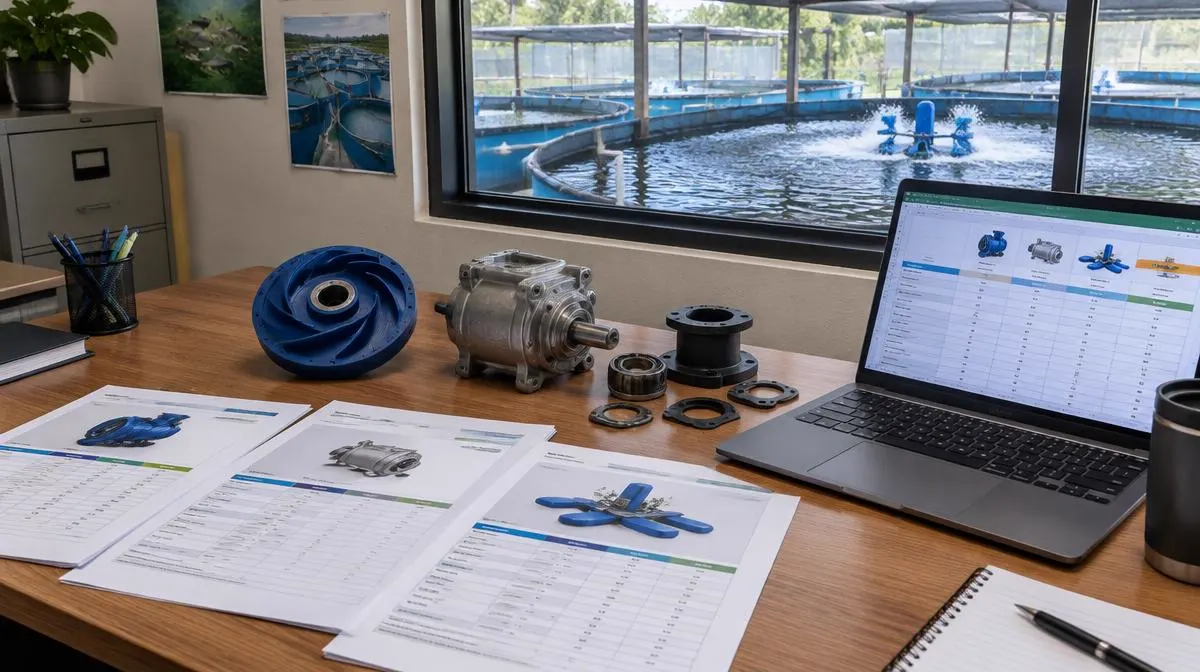
Short answer
Send every supplier the same specification, build a scope matrix, check capacity at your own duty point, give weight only to standard-method test data, compare lifetime cost including energy and spares, and tie payments to commissioning against written acceptance criteria. The cheapest offer is often the one that excludes the most.
Written by the FishMatch Group editorial team. Reviewed internally against the technical sources linked in the text; not externally peer-reviewed. Last reviewed: 15 October 2026. All examples are illustrative — they are not quotes, benchmarks or results from real projects.
Why quotations are hard to compare
Two offers for "the same" aerator, pump or RAS package often differ in scope, test conditions, spares, installation and warranty. The lowest price is frequently the one that leaves the most out. This guide shows how to put offers on the same basis before you decide. It is supplier-neutral and applies to pond, cage, hatchery and RAS equipment.
Step-by-step review
- Send everyone the same specification. Production target, site conditions, water quality, power supply and what "complete" means. Start from the project specification checklist.
- Build a scope matrix. One row per item (equipment, controls, installation, commissioning, training, spares, freight, duties, documentation), one column per supplier. Mark included, excluded or unclear.
- Check capacity at your conditions. Ask for the duty point (flow and head for pumps; oxygen transfer at stated conditions for aerators; biomass and feed load for RAS).
- Check performance evidence. Separate tested figures from claims.
- Compare lifetime cost, not purchase price. Include energy, spares, maintenance and expected life. Use the equipment total-cost tool.
- Check spares and support. Recommended list, prices, lead times and where stock is held.
- Check commissioning and acceptance. What will be tested on site, against which numbers, and what happens if it fails.
- Check commercial terms last. Incoterms, payment milestones, warranty start date, validity and exclusions.
Capacity: what to ask for
- Pumps: the pump curve with your duty point marked, efficiency at that point, motor rating, and materials suitable for your salinity. A pump selected at the wrong head can deliver much less than its catalogue flow.
- Aerators: standard oxygen transfer rate (SOTR) and standard aeration efficiency (SAE) from a clean-water test. These are standard-condition figures; field oxygen transfer is lower and depends on temperature, salinity and the existing oxygen level (USDA NRCS AEN-3). Extension guidance notes that standard test methods exist precisely so aerators can be compared on the same basis (SRAC 371).
- RAS packages: design biomass, maximum daily feed, water flow per tank, filtration and biofilter capacity, oxygen supply, and redundancy for critical pumps and blowers.
Performance evidence: tested vs claimed
| Evidence | How much weight to give it |
|---|---|
| Test report using a recognised standard method, for the exact model | High — check date, conditions and who tested |
| Independent or university test | High, if the model and conditions match |
| Manufacturer catalogue figure with no method | Low — ask how it was measured |
| Reference farm you can contact and visit | Useful for reliability and support; not proof of numbers |
| Marketing claims ("saves 40% energy") | None until backed by data on your basis |
Spares, service and lifetime cost
- Ask for a priced spares list for the first two years and the first two production cycles.
- Ask which parts wear fastest (impellers, seals, bearings, gearboxes, diffusers, UV lamps, sensors) and their typical replacement interval.
- Ask where spares are stocked and lead times to your site, including customs.
- Include energy: for electrically driven equipment, energy over several years often exceeds the purchase price.
Commissioning and acceptance
- Factory acceptance test (FAT) where relevant, and site acceptance test (SAT) after installation.
- Written acceptance criteria: flows, heads, oxygen levels, alarm functions, control sequences.
- Who provides electricians, lifting equipment, water and power for testing.
- Training for operators and maintenance staff, with manuals in a language they read.
- Payment milestones tied to delivery and successful commissioning, not only to order.
Common costly mistakes
- Choosing the cheapest offer without a scope matrix.
- Accepting catalogue performance figures without the test method.
- Forgetting backup power, controls or cabling because each supplier assumed someone else would provide them.
- No spares on site at start-up.
- Warranty that starts at shipment, so it has run out by the time the system is commissioned.
Worked example (hypothetical offers)
Three hypothetical offers for a 1.5 kW pond aerator. Assumptions: 3,000 running hours per year, so 4,500 kWh/year; electricity USD 0.12/kWh, so about USD 540/year in energy for each unit. Prices and figures are invented to show the method.
| Offer | Price (USD, hypothetical) | SAE (kg O₂/kWh) | Standard-condition O₂ per year (kg) | Spares | Commissioning |
|---|---|---|---|---|---|
| A | 1,800 | 1.8 (standard test report) | 8,100 | Included (1 set) | Supervised |
| B | 1,400 | 2.2 (claimed, no report) | 9,900 if true | Not included | Not included |
| C | 2,100 | 2.0 (standard test report) | 9,000 | Included (2 sets) | Included, with acceptance test |
- B looks best on price and oxygen, but its SAE is unverified and spares and commissioning are excluded. Ask for a test report and a priced spares kit before comparing.
- Between A and C, C costs USD 300 more but delivers about 900 kg more oxygen per year at standard conditions for the same energy, plus more spares and an acceptance test.
- All three figures are standard-condition values; field oxygen transfer will be lower for all of them.
Scoring sheet you can copy
| Criterion | Suggested weight | What earns a high score |
|---|---|---|
| Scope completeness | 25% | Everything in your specification included or clearly priced |
| Verified performance | 25% | Standard-method test data for the exact model |
| Lifetime cost | 20% | Lowest purchase + energy + spares over your planning period |
| Spares and service | 15% | Priced list, local stock or short lead time |
| Commissioning and training | 15% | Written acceptance tests, on-site support, training |
Weights are a starting point; adjust them to your project.
Questions to ask every supplier
- What exactly is excluded from this offer?
- At which conditions were these performance figures measured, and can we see the report?
- What is the efficiency at our duty point?
- Which spares do you recommend for start-up, at what price and lead time?
- What are the acceptance criteria and what happens if they are not met?
- When does the warranty start and what does it cover?
For what to specify, see the shrimp farm equipment checklist and pond or RAS for shrimp.
Summary
- Same specification to everyone, then a scope matrix.
- Capacity at your duty point; tested data over claims.
- Compare lifetime cost including energy and spares.
- Tie payments to commissioning against written acceptance criteria.
Frequently asked questions
How do I compare aquaculture equipment quotes fairly?
Send the same specification to every supplier, list every scope item in a matrix, check capacity at your duty point, prefer standard-method test data, and compare lifetime cost including energy and spares.
What is SOTR and SAE for an aerator?
Standard oxygen transfer rate (kg O₂ per hour) and standard aeration efficiency (kg O₂ per kWh), measured in clean water at standard conditions. Field values are lower.
Which spares should be included at start-up?
Fast-wearing parts such as impellers, seals, bearings, gearbox parts, diffusers, UV lamps and sensors, enough for the first cycles, with prices and lead times.
When should payment be due?
Tie a meaningful share of payment to delivery and to successful commissioning against written acceptance criteria, not only to the order.
Tools and next steps
Sources
- USDA NRCS Agricultural Engineering Technical Note AEN-3 – Aeration of Ponds Used in Aquaculture (2011)
- SRAC Publication 371 – Pond Aeration: Types and Uses of Aeration Equipment
- SRAC Publication 3700 – Pond Aeration (Southern Regional Aquaculture Center)
- FAO/NACA – Shrimp Culture: Pond Design, Operation and Management
General guidance only. Targets, health decisions and results depend on species, region and system; consult qualified local professionals.