Shrimp farm equipment checklist: pond preparation, aeration, pumping, water treatment and monitoring
Updated: 2026-10-15 · FishMatch Group
Short answer
Specify site, water and production plan first, then size aeration from an oxygen budget, plan pumps with standby units, add water treatment and night-time oxygen monitoring, and treat biosecurity and backup power as core equipment lines. Ask every supplier for standard test data, pump curves at your duty point, a spares list and a commissioning plan.
Written by the FishMatch Group editorial team. Reviewed internally against the technical sources linked in the text; not externally peer-reviewed. Last reviewed: 15 October 2026. All examples are illustrative — they are not quotes, benchmarks or results from real projects.
Who this checklist is for
This checklist is for investors, farm managers and consultants planning or expanding a commercial shrimp pond farm (typically Pacific white shrimp, Penaeus vannamei, in lined or earthen ponds). It is not written for aquarium or backyard systems, which use very different equipment. If you have not yet decided between ponds and an indoor recirculating system, read Pond or RAS for shrimp farming? first.
Decision path: what to specify first
- Site and water first. Confirm source water (sea, estuary, brackish well), salinity range, seasonal temperature, soil type and flood risk. Equipment cannot fix a site that does not hold water or floods. The FAO/NACA pond manual treats site selection and pond layout as the foundation for everything else (FAO/NACA).
- Production plan. Ponds, pond area, target harvest per cycle, cycles per year and planned stocking intensity. This sets oxygen demand, pumping volumes and feed logistics.
- Oxygen budget. Size aeration from the oxygen the stock and pond will consume at peak biomass, not from a catalogue. Use the oxygen demand calculator as a first check.
- Water movement. Fill, exchange, emergency flushing and drainage volumes set pump and canal capacity (pump sizing calculator).
- Biosecurity and monitoring. Decide what enters the farm (water, postlarvae, people, vehicles, birds, crabs) and how you will see a problem before it becomes a loss.
- Power and backup. Night aeration is often the largest continuous electrical load; backup must cover it.
1. Pond preparation equipment
- Earthmoving and compaction plan for dykes, slopes and drainage gradients; or liner (HDPE) with welding and testing equipment if ponds are lined.
- Inlet screens and filter bags to keep out predators, competitors and wild crustaceans that can carry disease.
- Drain structures (monks or gates) that allow complete drying between cycles.
- Bottom-drying, tilling and liming equipment for earthen ponds; sludge removal plan for lined ponds.
- Bird netting or deterrents and crab fencing where these are local disease or predation routes.
2. Aeration
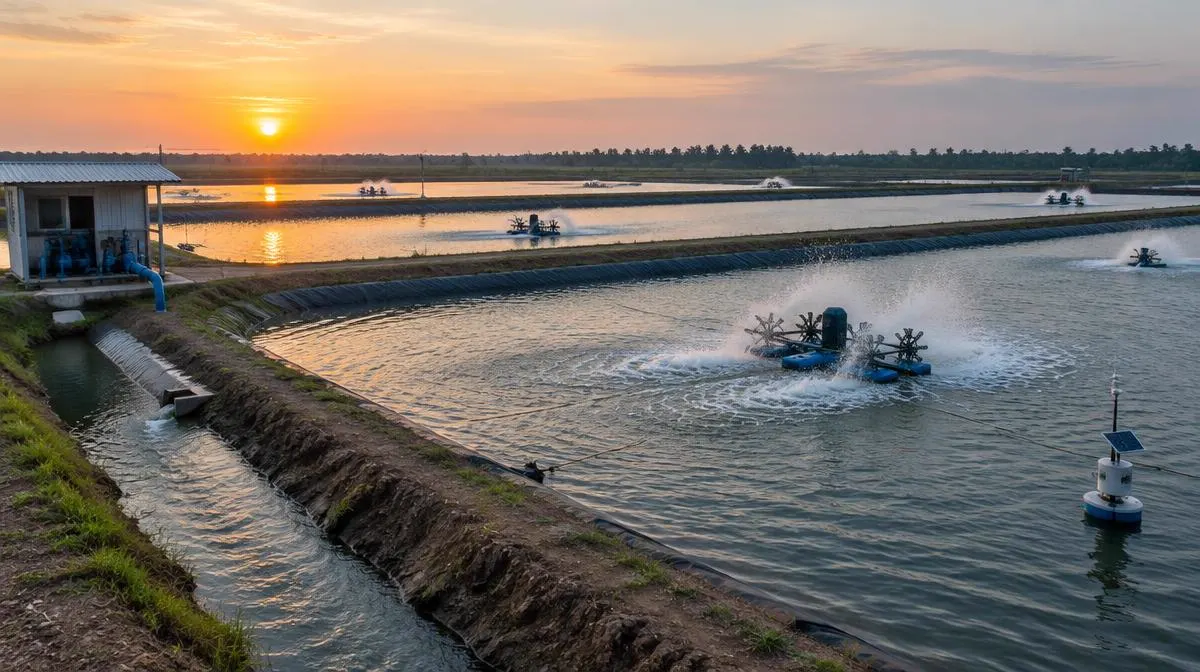
Aeration does two jobs: supply oxygen and circulate water so that it does not stratify. Extension guidance distinguishes emergency aeration (to rescue stock during an oxygen crash) from maintenance aeration used every night at higher feeding rates (UF/IFAS; SRAC 3700). Commercial shrimp ponds usually need maintenance aeration.
- Aerator type per pond (paddlewheel, propeller-aspirator, diffused air) and the layout that creates circulation without scouring dykes.
- Rated oxygen transfer data: ask for standard oxygen transfer rate (SOTR, kg O₂/h) and standard aeration efficiency (SAE, kg O₂/kWh) measured with a recognised clean-water test. These are standard-condition figures; field performance is lower and depends on temperature, salinity and existing oxygen level (USDA NRCS AEN-3).
- Electrical cabling, waterproof connections, protection devices and earthing installed by qualified electricians — extension guidance specifically warns about electrical hazards around ponds (SRAC 371).
- Standby aerators or a mobile emergency unit.
3. Pumping and water supply
- Intake pumps sized for the worst case you plan for: filling after drying, exchange during a water-quality event and emergency flushing.
- At least one standby pump per critical duty, plus the same impeller and seal spares on site.
- Reservoir or settling pond so incoming water can be treated and held before use.
- Flow measurement (meter or calibrated weir) so you know what you are actually pumping.
4. Water treatment
- Settling/reservoir capacity and screens for incoming water.
- Disinfection approach for reservoir water, chosen with local regulations and a qualified aquatic animal health professional.
- Effluent settling before discharge, sized for harvest drain-down — many jurisdictions regulate this.
5. Monitoring
- Dissolved oxygen: night readings are the priority because oxygen is usually lowest between midnight and sunrise (SRAC 371). Fixed DO sensors with alarms in high-value ponds, plus handheld meters as backup and for calibration checks.
- Temperature, salinity, pH and alkalinity; a simple lab kit or service for ammonia and nitrite.
- Feed trays and a feed-recording system, because feed response is one of the earliest warnings.
- Alarm routing to a person who can act at night, with a written response plan.
6. Biosecurity
Disease is the risk that most often ends shrimp cycles. Use the WOAH Aquatic Code for the listed crustacean diseases and their requirements (WOAH), and source postlarvae from hatcheries that can document their health programme (see FAO Technical Paper 450 on hatchery biosecurity in Latin America). Equipment items: inlet screening, footbaths and wheel dips, separated equipment per pond or block, and quarantine/acclimation facilities.
Comparison table: what to check for each equipment group
| Group | Size it from | Evidence to request | Common costly mistake |
|---|---|---|---|
| Aeration | Peak oxygen demand per pond | SOTR/SAE test report, motor and gearbox specs | Buying by horsepower per hectare with no oxygen budget |
| Pumps | Fill, exchange and emergency volumes and total head | Pump curve at your duty point, efficiency, materials for salt water | No standby pump, or a pump curve that does not match real head |
| Water treatment | Incoming water risk and holding time | Design calculation, consumables, local permit requirements | No reservoir, so untreated water goes directly to ponds |
| Monitoring | Number of ponds, night staffing | Sensor accuracy, calibration interval, alarm method | Sensors installed with no one assigned to respond |
| Power backup | Night aeration load plus pumps | Generator rating including starting currents, auto-transfer | Generator that cannot start all aerators at once |
Inputs buyers need before asking for quotes
- Number and area of ponds, depth, lined or earthen.
- Target harvest per cycle and cycles per year.
- Water source, salinity range, temperature range and distance/height to pump.
- Grid power availability and tariff, and whether you need full backup.
- Budget band, timeline and who will install and commission.
Worked example (illustrative only)
Assumptions, not recommendations: 10 lined ponds of 1 ha each; a designer has calculated that each pond needs 8 aerators of 1.5 kW running at night at peak biomass.
- Night aeration load: 10 ponds × 8 × 1.5 kW = 120 kW running continuously for several hours.
- Backup: the generator must carry that load plus any pumps you also need at night, and handle motor starting currents — ask the supplier to show the calculation, or stagger starts with controls.
- Monitoring: one fixed DO sensor per pond (10) plus two handheld meters; one person on night duty with alarm access.
- Spares: impellers, seals and gearbox spares for at least one aerator per pond, and one complete standby pump.
Change any assumption and the totals change — that is why the oxygen budget must come first.
Questions to ask suppliers
- What oxygen demand did you assume, and how did you get from it to this number of aerators?
- Can you share an independent or standard-method SOTR/SAE test report for this exact model?
- What is the pump's efficiency at our duty point, and which materials are rated for our salinity?
- Which spares do you recommend for the first two cycles, and what are the lead times?
- Who installs, who commissions, and what does the acceptance test include?
For a structured way to compare the answers, see How to evaluate aquaculture equipment quotations.
Summary
- Fix the site, water and production plan before choosing equipment.
- Size aeration from an oxygen budget and ask for standard test data.
- Plan standby pumps, spares and backup power for night loads.
- Treat monitoring and biosecurity as equipment lines with owners, not extras.
Frequently asked questions
What equipment does a commercial shrimp pond farm need?
At minimum: pond preparation and drainage structures, inlet screening, aeration sized from an oxygen budget, intake and standby pumps, a reservoir or settling pond, dissolved-oxygen and water-quality monitoring, biosecurity items and backup power for night aeration.
How many aerators per hectare does a shrimp pond need?
There is no reliable universal number. It depends on stocking, feeding rate, temperature, salinity and the aerator's tested oxygen transfer. Ask the designer to show the oxygen budget and the SOTR/SAE data used.
Why monitor dissolved oxygen at night?
Oxygen in ponds usually falls overnight and is often lowest between midnight and sunrise, so night readings and alarms give the earliest warning of a crash.
Is this checklist suitable for aquarium or home shrimp tanks?
No. It is for commercial pond farms. Hobby and aquarium systems use different, much smaller equipment.
Tools and next steps
Sources
- FAO/NACA – Shrimp Culture: Pond Design, Operation and Management
- SRAC Publication 3700 – Pond Aeration (Southern Regional Aquaculture Center)
- SRAC Publication 371 – Pond Aeration: Types and Uses of Aeration Equipment
- USDA NRCS Agricultural Engineering Technical Note AEN-3 – Aeration of Ponds Used in Aquaculture (2011)
- UF/IFAS Extension FA021 – The Role of Aeration in Pond Management
- WOAH Aquatic Animal Health Code (online access)
- FAO Fisheries Technical Paper 450 – Health management and biosecurity in white shrimp hatcheries in Latin America
General guidance only. Targets, health decisions and results depend on species, region and system; consult qualified local professionals.