Planning or expanding a fish farm: data-driven brief, URS, RFQ checklist and proposal comparison
Updated: 2026-10-13 · FishMatch Group
Short answer
A farm project succeeds when the production target, site and system are defined before anyone quotes. Start with the outcome (species, tonnes per year, harvest size and schedule), test cages, ponds, RAS or a hybrid against your site's water, power, permits and market, write a user requirement specification (URS), and send the same RFQ to every supplier so their proposals can be compared line by line. FishMatch helps you prepare the RFQ and contacts suitable suppliers for you; buyers do not need to search a directory first. Start by collecting evidence from your own records — output, survival, FCR, water, energy and failures — with source and date, and check cost per harvested kg now and after the project. Results depend on species, system and site and are not guaranteed.
Step 0 — Build the evidence pack from your own records
Suppliers can only design to what you document. Before writing the brief, collect the records below and note where each figure came from and its date — this is the data provenance a reviewer or engineer will ask for.
| Brief field | Records that support it | Provenance to note |
|---|---|---|
| Current output and harvest size | Harvest/processing tickets, last 3+ cycles | Document, period, who compiled it |
| Survival, biomass and economic FCR | Stocking sheets, mortality and feed logs | Measured, estimated or allocated |
| Water and oxygen limits | Probe logs, intake water analysis | Lab name and sampling date |
| Energy use | Meter readings, bills | Metered per system or whole farm |
| Recurring failures | Maintenance and incident logs | Equipment, dates, hours of downtime |
| Market for added volume | Contracts, buyer letters | Volume, price basis, date |
If a figure is missing, write “unknown” in the brief rather than a guess; suppliers can then price the measurement or the margin it needs. The multi-cycle data guide shows how to build the cycle table, and the expand-or-improve guide helps decide whether new capacity is the right project at all.
Cost per harvested kg: current farm vs after the project
Use the calculator with your own figures for the same period. It shows cost per harvested kg today, the projected figure after the project, and the cost of each added kg. It holds no default prices, survival, FCR or yields.
State species, system and site assumptions separately
- Species assumptions: harvest size, growth period, temperature range — from your records or a named advisor.
- System assumptions: stocking and harvest density, cycles per year, redundancy — supplied by the designer and stated as design basis.
- Site assumptions: water volume and quality by season, power capacity, permits, exposure — from measurements or authority documents.
- Mark every assumption as measured, quoted or assumed, with its date.
Step 1 — Define the production outcome
Write down the species, target tonnes per year, harvest size, harvest frequency and the market or buyer. Every other decision — system, number of units, water, oxygen and power — follows from this. If you are expanding, record current production, survival, feed use and bottlenecks from your own farm records.
Step 2 — Choose the system that fits the site
| System | Fits when | Main trade-offs |
|---|---|---|
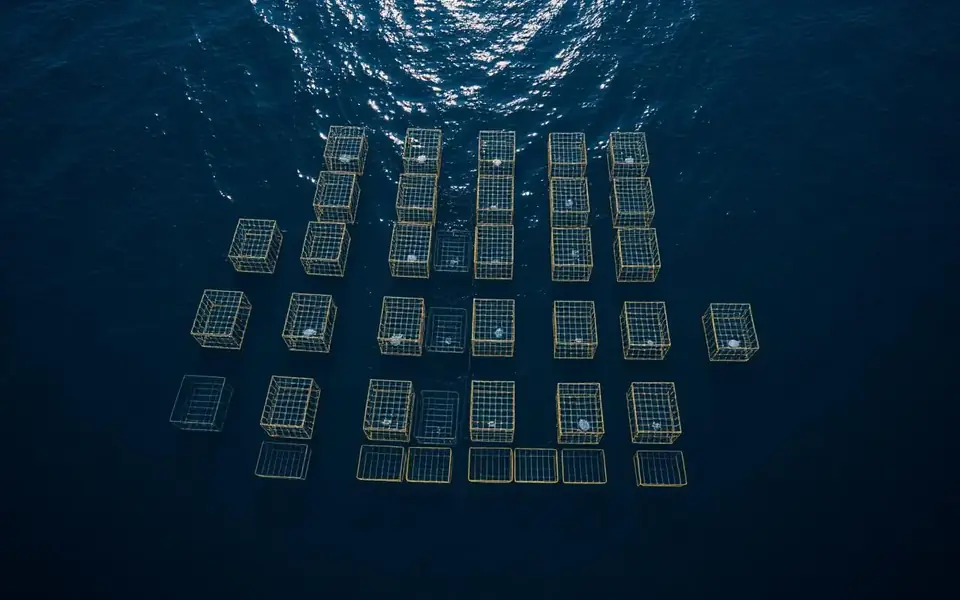
| Sea or lake cages | Sheltered site with suitable depth, currents and permits | Weather, escapes, environmental licensing, boat logistics |
| Ponds | Affordable land, suitable climate and water | Large area, seasonality, exposure to weather and disease |
| RAS | Limited water/land, wrong climate, biosecurity or market proximity | High energy, capital and skills; needs reliable power |
| Hatchery / nursery | Juvenile supply is limited or unreliable | Broodstock, biosecurity, skilled staff |
| Hybrid | RAS or hatchery feeding ponds or cages | Two systems to run and transfer between |
The RAS vs pond scenario calculator and pond volume calculator help test options with your own assumptions.
Step 3 — Confirm water, oxygen and power
- Water source, volume available, seasonal quality and treatment needs; intake and effluent permits.
- Oxygen or aeration demand at peak biomass and feed load; backup supply.
- Grid capacity, reliability and backup generation for life-support loads.
- Access roads, feed and harvest logistics, cold chain where relevant.
Step 4 — Write the user requirement specification (URS)
A URS describes what the farm must achieve, not which brand to buy. Include:
- Production target, species, life stages and harvest plan.
- Site data: location, water analysis, climate, soil or seabed, exposure.
- Required capacity per unit (cages, ponds, tanks), redundancy and expansion phases.
- Water treatment, aeration/oxygenation and monitoring requirements.
- Power and backup requirements.
- Biosecurity and quarantine needs.
- Installation, commissioning, training, spares and service expectations.
- Acceptance tests and documents required (drawings, calculations, manuals, warranty).
- Budget range, timeline and permit status.
Step 5 — Send one RFQ and compare proposals on the same basis
| Compare | Ask the supplier to show |
|---|---|
| Scope | What is included and excluded, line by line |
| Design basis | Biomass, feed load, flows, oxygen calculations |
| Equipment | Models, materials, redundancy |
| Delivery | Lead time, installation, commissioning |
| Support | Training, spares, service response, warranty |
| Evidence | References and documented performance with context |
| Price | Total cost with the same scope, plus running costs |
Normalise proposals to the same scope before comparing price. Missing items become extra costs later. Certification requirements such as ASC or BAP may also shape the design.
How FishMatch helps
Use the eight-step project intake or the RAS RFQ to record the project. Our team reviews it, contacts suitable suppliers for you and presents their responses through FishMatch. Managed RFQs are for commercial projects of at least USD 250,000; the calculators and guides are free for everyone. See the commercial fish farm guide and the supplier qualification checklist.
Frequently asked questions
What is a URS in aquaculture?
A user requirement specification describes what the farm must achieve — production target, site conditions, capacity, redundancy, support and acceptance tests — so that suppliers design to the same requirements.
Should I choose cages, ponds or RAS?
Choose based on your site, species, market and budget. Cages need a suitable open-water site and permits, ponds need land and climate, RAS needs reliable power and skills. Compare cost per kg of saleable harvest at your site.
How many suppliers should receive the RFQ?
Enough to compare real alternatives on the same scope. FishMatch reviews your project and contacts suppliers that fit it, then presents their responses for comparison.
Why do quotes for the same farm differ so much?
Usually because scope, design basis or redundancy differ. Normalise proposals line by line before comparing price.
Is there a minimum project size for FishMatch RFQs?
Managed RFQs are for commercial projects of at least USD 250,000. The guides and calculators are free and have no minimum.
What if a figure is missing from my records?
Write “unknown” and say how it will be measured. An unflagged guess distorts the design basis and the comparison of proposals.
Tools and next steps
Sources
General guidance only. Targets, health decisions and results depend on species, region and system; consult qualified local professionals.