RAS Fish Farm Planning: A USD 250,000+ Project Example
Also in:العربية
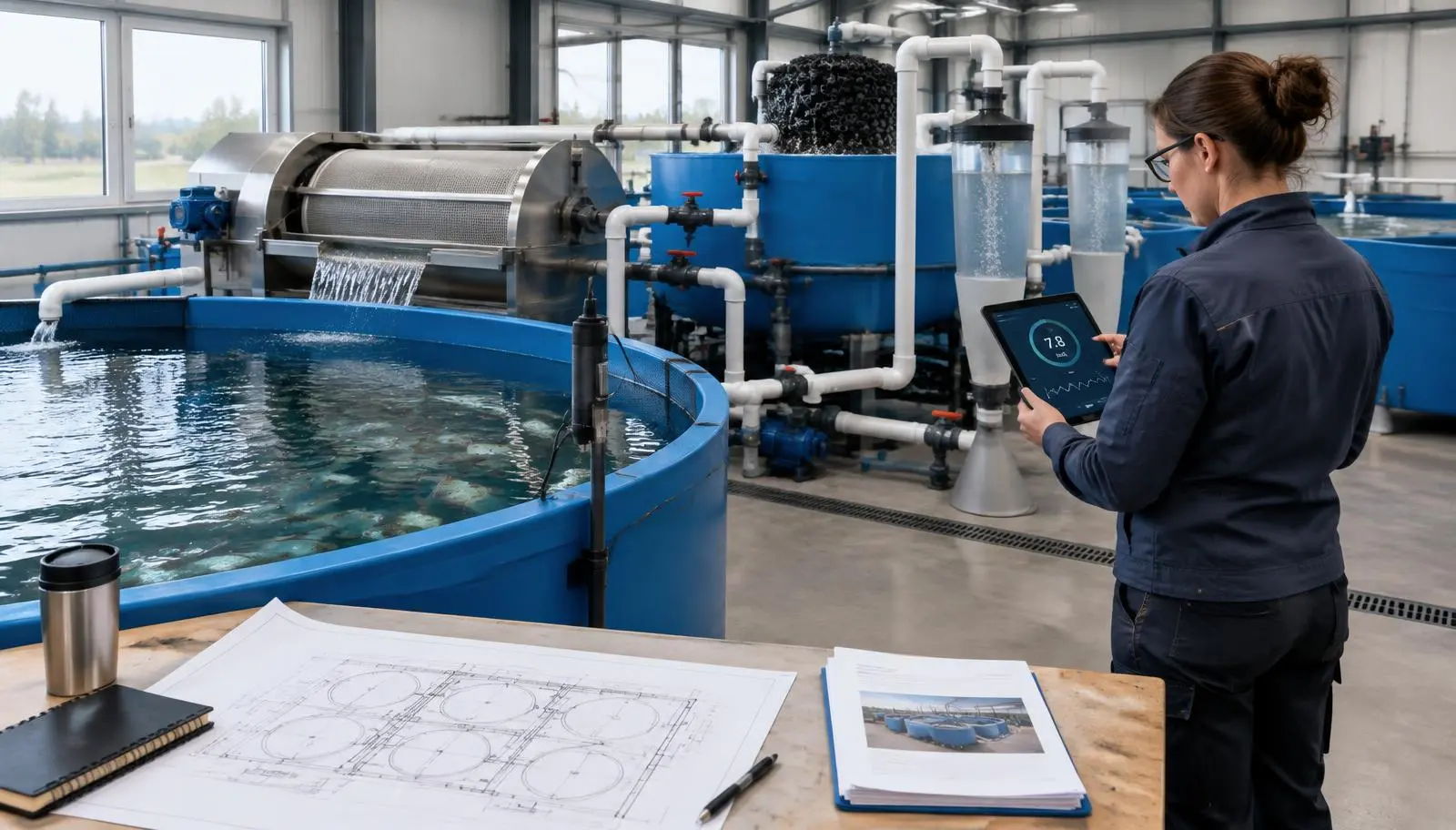
Short answer: plan a RAS (recirculating aquaculture system) fish farm by fixing the outcome first — species, annual output, market and site — then sizing the water treatment loop around the feed the fish will eat at peak biomass, then writing one brief that every supplier, lender and fingerling source answers. In a RAS the tanks are the simple part; the filtration, oxygen supply, backup power and the team that runs them decide whether the farm works. Below is an illustrative project description for a commercial RAS project from USD 250,000.
Editorial note: practical guide by the FishMatch Group editorial team, reviewed 15 October 2026, for farm managers, entrepreneurs and project planners. It is not engineering, veterinary or financial advice, gives no universal stocking densities, water-quality thresholds, costs or timelines, and promises no yield, survival or profit. Design values for your farm should come from a qualified RAS engineer and your own measurements. The example project below is fictional and for illustration only; it is not a quote, a cost estimate or a FishMatch client.
Key takeaways
- A RAS is designed backwards from the daily feed load at peak biomass, not from tank volume.
- Mechanical filtration, biofiltration, degassing, oxygenation and disinfection are one connected loop; buy them as an integrated scope.
- Backup power, alarms and oxygen are core equipment, not optional extras.
- New biofilters need time to mature before full stocking; plan it into the schedule.
- One written brief makes supplier quotes comparable and gives lenders something to test.
Step 1: Fix the outcome and the site
Write down the species, the target annual output, the product form (whole fish, fillet, live) and the market it will be sold to. Then check the site: the reliability and cost of electricity, a secure source of make-up water, discharge and sludge rules, permits, road access and the availability of skilled staff. Many RAS projects are located for market access rather than water abundance, but they still depend on stable power and a legal way to discharge waste water.
Step 2: Size the loop from the feed load
The amount of feed fed per day at peak biomass drives oxygen demand, carbon dioxide and ammonia production and solid waste. Your engineer converts that load into the required flow, biofilter capacity, oxygen supply and degassing — the method described in the FAO guide to recirculation aquaculture. Ask every supplier to state the design feed load and the assumptions behind it, so you can see whether two quotes are built for the same farm.
Step 3: Define the full equipment scope
A complete RAS scope usually covers fish tanks, mechanical filtration such as drum filters, a biofilter, degassing, oxygen supply and injection, UV or ozone disinfection, pumps and pipework, heating or cooling where needed, monitoring sensors and alarms, a backup generator, a quarantine area and sludge handling. Missing interfaces between these parts are a common reason projects run over budget, so ask who is responsible for each connection and for commissioning the whole system.
Step 4: Plan biosecurity and fingerling supply
Decide early where fingerlings or eggs will come from, how they will be documented and how new stock will be quarantined before it enters the main system. The WOAH Aquatic Animal Health Code sets international standards on aquatic animal health and trade; your local veterinary authority sets the rules that apply to you. Because a RAS recirculates water, a disease introduced into one tank can reach the whole loop.
Step 5: Build the financing case and the start-up plan
Lenders and investors usually look for a credible site, a defined scope, comparable quotes, working capital for feed, fingerlings, energy and staff until the first sales, and a team able to run the system. Include the biofilter start-up period and a staged first stocking in the plan; The Fish Site and other industry sources describe biofilter maturation taking weeks rather than days, depending on conditions. FishMatch does not lend money or guarantee financing.
Example project description (from USD 250,000)
This fictional brief shows the level of detail that makes a RAS project reviewable. All values are the buyer's own assumptions, to be confirmed by site data, engineers and suppliers.
| Field | Example entry |
|---|---|
| Project | Indoor RAS grow-out for a freshwater fish species, first phase |
| Location | Peri-urban site near the target market; existing insulated building |
| Target output | Buyer's annual tonnage target, to be confirmed by the engineer's design |
| Product | Whole fresh fish for local retail and restaurants |
| System | Tanks, drum filter, moving-bed biofilter, degassing, oxygen cones, UV, monitoring and alarms |
| Power | Grid supply with automatic-start backup generator |
| Water | Borehole make-up water; analysis report attached |
| Fingerlings | Documented supplier, quarantine room on site |
| Budget | From USD 250,000 for the first phase (buyer estimate, not a quote) |
| Timeline | Permits, then installation, commissioning, biofilter start-up and staged stocking |
| Financing | Own equity plus a bank loan application after quotes are compared |
Common mistakes
- Choosing tanks first and fitting the filtration around them.
- Comparing quotes built for different feed loads or different scopes.
- Treating the backup generator, alarms and oxygen supply as places to save money.
- Stocking at full density before the biofilter has matured.
- Hiring the operating team after the equipment arrives.
Plan your project with FishMatch
FishMatch's buyer tools and buyer platform services are free and carry no obligation. For commercial projects from USD 250,000, our team can help define the brief and structure a private request for proposals; supplier contacts are never shared automatically. Start with the RAS calculator or describe your project.
Sources
Frequently asked questions
Related articles
Where this fits in a real project
Every FishMatch project runs through the same five reviewed stages, from a first enquiry to comparable quotations. See the full buyer journey.
Planning a commercial aquaculture project?
Send your project brief. A FishMatch specialist reviews it before relevant suppliers are contacted privately.
Request a quote