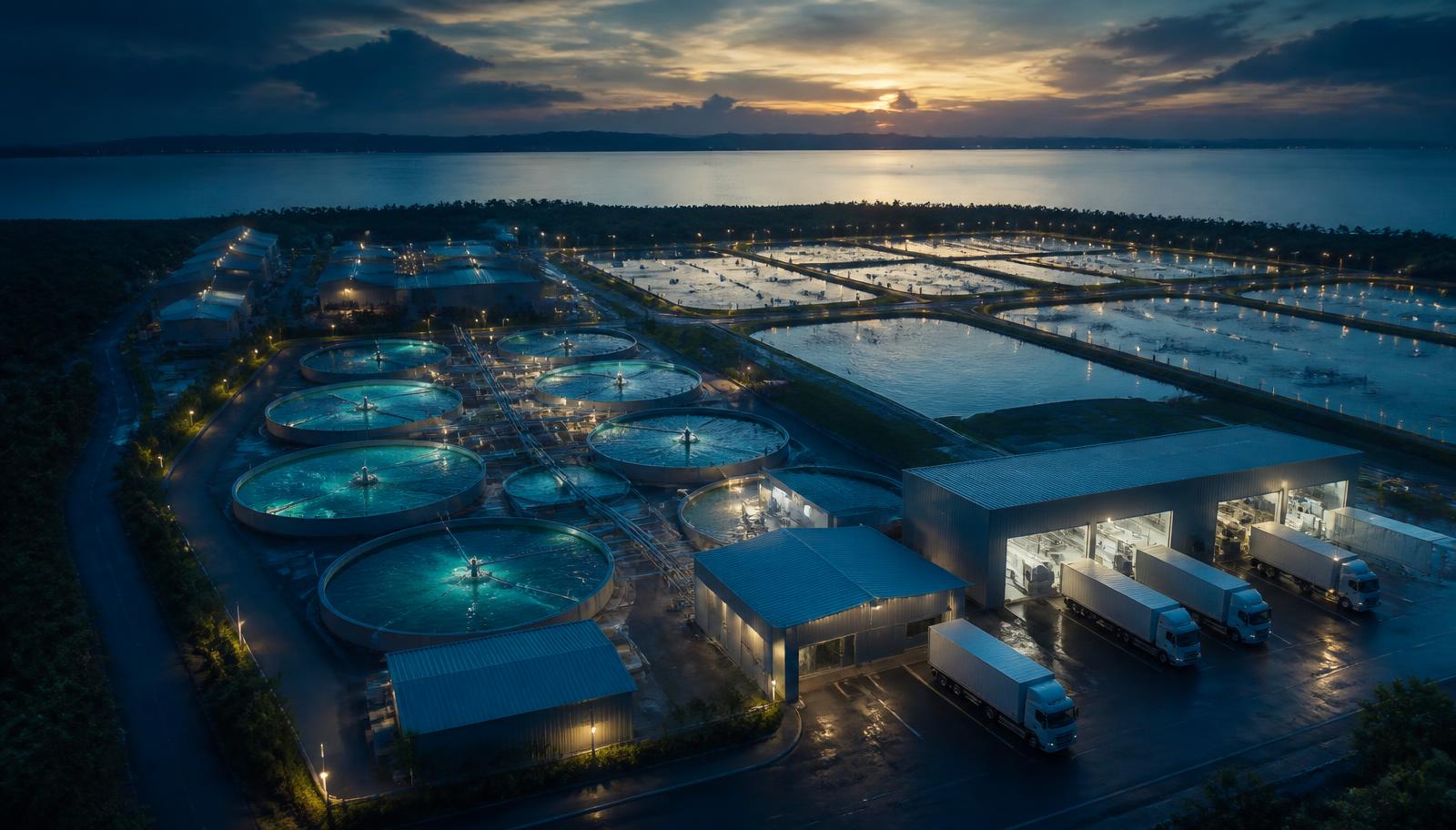
White paper · Commercial aquaculture projects
The Future of Commercial Aquaculture: Why Successful Projects Start Long Before Procurement
Short answer
Where is commercial aquaculture heading?
- Direction:
- Controlled-environment, market-adjacent production
- Margin levers:
- FCR, energy per kg, survival rate, uptime
- Capital gate:
- Bankable feasibility, off-take, biosecurity SOPs
- Buyer cost:
- No fee charged to the buyer
- Supplier privacy:
- Buyer identity and supplier identity stay confidential until a quote is accepted
Executive Summary
Commercial aquaculture has become one of the most capital-intensive segments of the global food system. A modern shrimp farm, fish farm, recirculating aquaculture facility or integrated seafood processing project is no longer a collection of equipment purchases; it is an infrastructure programme with hydrology, energy, biology, regulation, logistics and finance interlocking in a single balance sheet. Yet a substantial share of projects still begin at the wrong end of the process — with a supplier conversation rather than a business case.
This white paper examines why that sequencing error is the single most reliable predictor of underperformance, and how serious organisations now structure aquaculture development. It traces the industry's progression from equipment purchasing to buyer-first project platforms, sets out a ten-stage project lifecycle, and details the technical and commercial decisions — species, site, water, energy, biosecurity, processing, financing and procurement — that must be resolved before a manufacturer is engaged. It is written for investors, seafood companies, aquaculture operators, EPC contractors, development agencies and industrial buyers, and it is deliberately supplier-neutral throughout.
The central argument is simple: equipment is rarely the constraint. Decision quality is. Projects that invest 1.5–4% of capital in disciplined pre-procurement work consistently outperform those that compress it, because the assumptions fixed during planning govern the facility for its entire economic life.
Key Takeaways
- Procurement is an output, not a starting point. A specification is the product of feasibility, engineering and financing work — it cannot be reverse-engineered from a quotation.
- Water is the first constraint. Quantity, quality, temperature and discharge define the biological ceiling of every project before any technology decision is relevant.
- Energy has become a bankability variable. For RAS and intensive systems, electricity cost and reliability influence viability as strongly as feed price.
- Processing and cold chain belong in the original design. Product form dictates harvest scheduling, utilities and even tank configuration.
- Vendor-neutral specifications produce comparable offers. Without them, buyers compare scopes, not prices.
- Bankability is assembled during planning. Lenders finance documentation quality as much as biology.
- Neutrality protects capital. Separating requirement definition from supply removes the structural bias in equipment-led project development.
The Evolution of Commercial Aquaculture
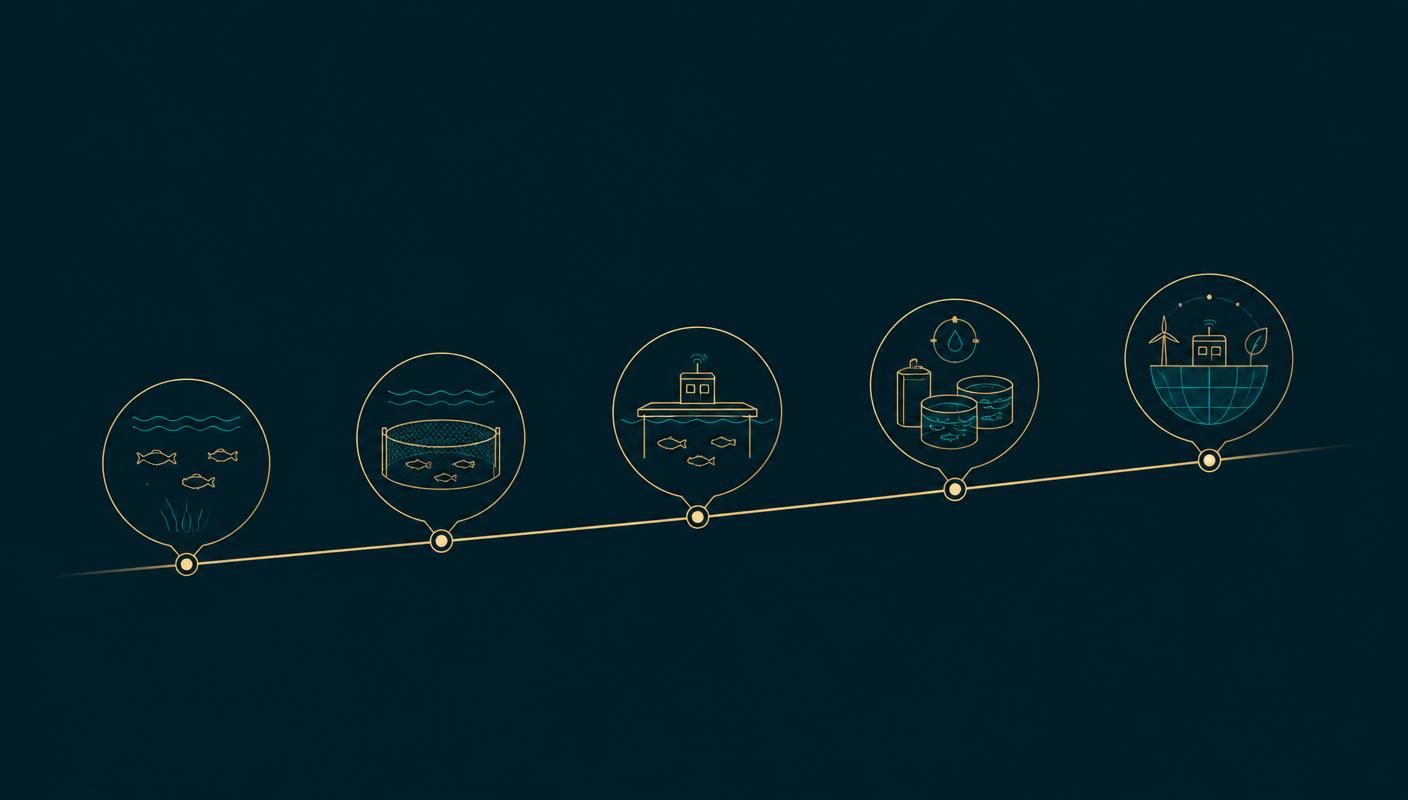
The industry's development can be read as a steady widening of scope. Each stage did not replace the previous one; it absorbed it, adding a layer of complexity and moving the decisive choices further upstream.
| Stage | Primary focus | Decision owner | Dominant risk |
|---|---|---|---|
| Aquaculture Equipment | Discrete purchases: pumps, aerators, nets, feeders | Farm owner | Component performance |
| Fish Farm Construction | Civil works and installed systems | Owner + contractor | Build quality and schedule |
| Integrated Aquaculture Projects | Hatchery, grow-out, water treatment and harvest as one system | Developer + engineer | System interfaces |
| Commercial Aquaculture Infrastructure | Production, processing, cold chain, energy and logistics | Investor, corporate, government | Capital structure and off-take |
| Buyer-First Project Platforms | Planning, requirement definition and neutral sourcing before procurement | Any organisation building capacity | Decision quality |
In the equipment era, a farm bought aerators and pumps and judged them individually. In the construction era, civil works and installed systems came together but were still procured as trades. Integration changed the question: once hatchery, grow-out, filtration and harvest are coupled, the performance of the whole becomes hostage to the weakest interface — a biofilter sized for the wrong feed load, a pump curve mismatched to a head loss, a harvest system that cannot meet the processing line's throughput.
The infrastructure era added capital structure, off-take, energy strategy and regulation. At that scale the project is assessed by lenders, boards and ministries, and the technical package is only one chapter of a much longer document. The current stage — buyer-first platforms — is a response to that complexity. When the number of interacting decisions exceeds what any single supplier can legitimately advise on, organisations need an independent place to define requirements before they enter the market.
The industry did not become harder to buy from. It became harder to specify.
Global Seafood Demand and the Investment Case
The demand argument for aquaculture is structural rather than cyclical. Wild capture fisheries have been broadly flat for more than two decades, while population growth, urbanisation and rising middle-class consumption continue to expand seafood demand across Asia, the Middle East, Africa and North America. Farmed production already supplies the majority of aquatic animals consumed by humans, and essentially all incremental supply must now come from aquaculture.
Three consequences follow for project developers. First, demand risk is comparatively low relative to other food categories; execution and cost risk dominate. Second, buyers in developed markets increasingly attach conditions — traceability, welfare standards, environmental documentation — that must be designed into a facility rather than retrofitted. Third, governments in import-dependent regions are actively co-financing domestic capacity to reduce foreign-exchange exposure, which changes the available capital structure for well-prepared projects.
None of this makes any individual project viable. It means that a properly conceived project operates in a favourable structural environment — and that failures are, overwhelmingly, self-inflicted through planning shortcuts. For a market-by-market view of species, pricing and regulatory conditions, the Knowledge Center maintains supplier-neutral technical and market briefings.
The Procurement-First Misconception
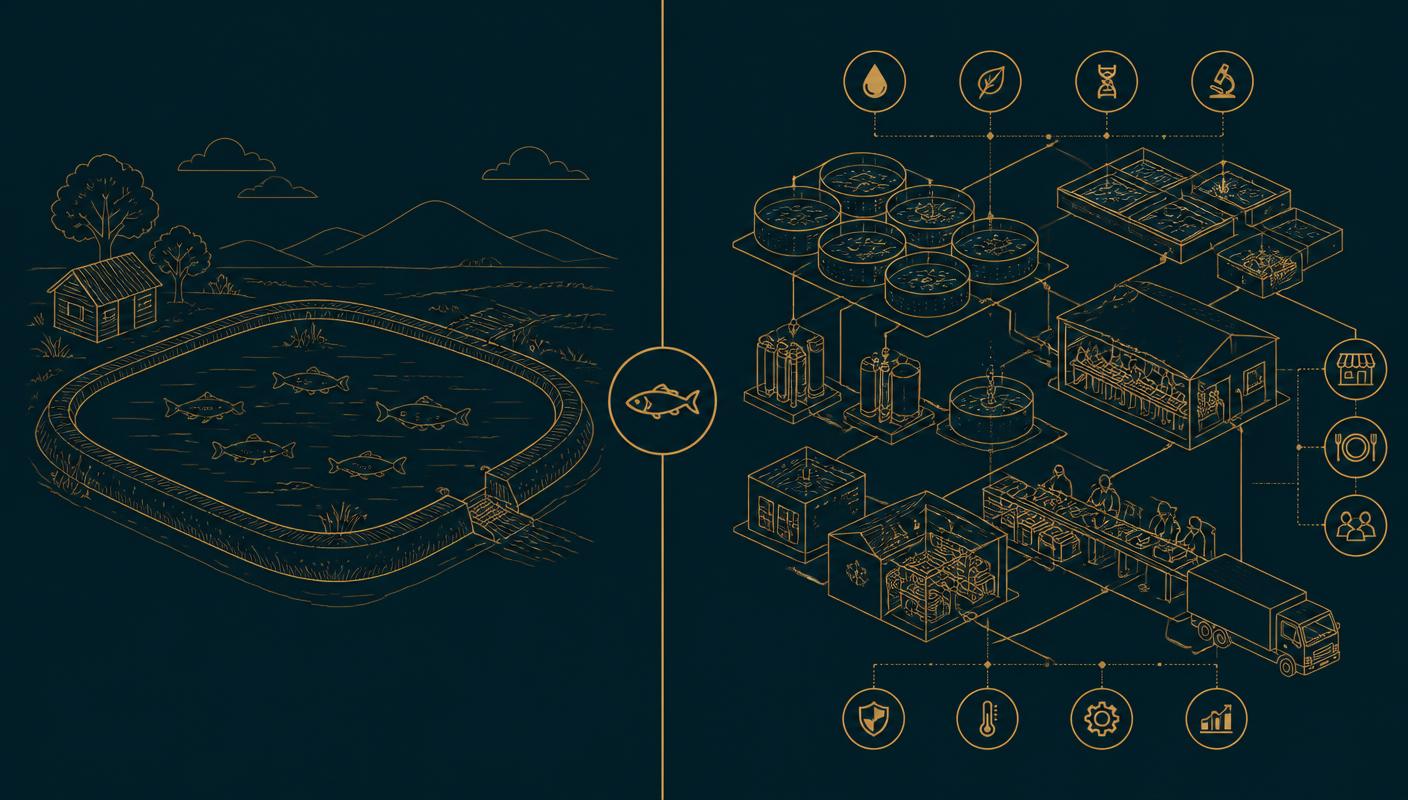
A recognisable pattern recurs across regions and species. A developer identifies an opportunity, contacts two or three equipment manufacturers, receives budgetary quotations, builds a financial model around those numbers, and presents the result to investors or a board. The model appears rigorous because it contains real prices. It is nonetheless structurally unsound, for four reasons.
1. Quotations describe scope, not projects
An equipment quotation covers the supplier's delivery boundary. It typically excludes civil works, buildings, land preparation, intake and discharge infrastructure, grid connection and transformers, standby power, laboratory, biosecurity infrastructure, workforce housing, spare-parts inventory, working capital for the first biological cycle, permitting costs and contingency. On a typical project these excluded items represent 45–65% of total capital. A model built on equipment quotations is therefore not conservative; it is incomplete by roughly half.
2. Suppliers optimise within their own catalogue
This is not a criticism of manufacturers; it is a description of their role. A filtration specialist will propose a filtration-led solution, a tank supplier a tank-led one, an EPC contractor a turnkey scope. Each may be excellent. None is positioned to advise whether the species, the site or the production model is the right one — and none should be expected to.
3. Design decisions become irreversible early
Tank geometry, water treatment train, hydraulic head, building footprint and effluent capacity are fixed in concrete. Once installed, a facility can be tuned but not fundamentally redesigned. Errors made in week six of a project are paid for in every year of operation.
4. Financing follows documentation, not enthusiasm
Lenders and development finance institutions evaluate a defined body of evidence: feasibility study, water and environmental assessment, engineering basis of design, permit status, management track record, off-take and sensitivity analysis. A project that arrives with quotations but without this documentation is not near financial close, regardless of how attractive the concept is.
By the time a buyer is comparing prices, the expensive decisions have already been made.
The Commercial Aquaculture Project Lifecycle
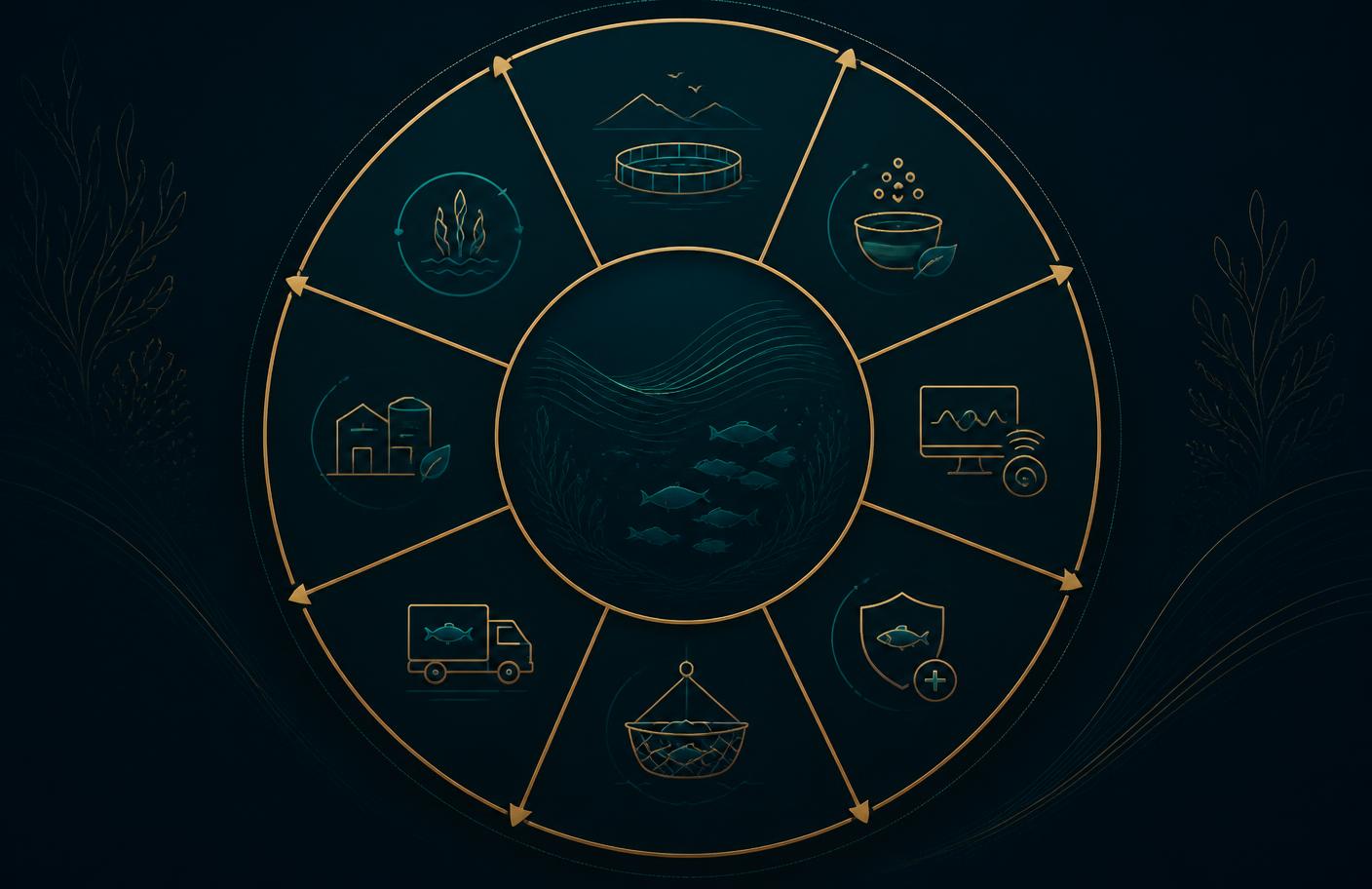
Disciplined developers work through a recognisable sequence. Procurement sits at stage six or seven of ten — deliberately downstream of strategy, resource assessment, feasibility, engineering and permitting.
Strategy & market definition
Species, product form, target market, volume ambition and the commercial logic that justifies capital.
Site & resource assessment
Water quantity and quality, land, climate, energy, effluent receptor, access and workforce.
Feasibility & financial modelling
Production model, CAPEX/OPEX build-up, sensitivity analysis, IRR and funding structure.
Concept & basic engineering
Mass balance, water balance, unit process train, layout and capacity staging.
Permitting & environmental approval
Water rights, discharge consent, EIA, construction and veterinary approvals.
Requirement definition & RFQ
Vendor-neutral performance specification, acceptance criteria and tender documentation.
Sourcing, evaluation & contracting
Qualified supplier shortlist, normalised comparison, guarantees and terms.
Construction & commissioning
Installation, wet testing, biological start-up, training and performance verification.
Operations & optimisation
Biosecurity, feed management, data-driven husbandry, maintenance and continuous improvement.
Expansion & reinvestment
Phase two capacity, processing integration, market diversification and refinancing.
The stages are not strictly linear — feasibility and engineering iterate, and permitting frequently forces design revision — but their order matters. Each stage produces the inputs the next one requires. Skipping a stage does not accelerate a project; it defers the work to a point where it is more expensive to correct. Structured versions of stages one to four are available through the project planning center and the sector-specific commercial project guides.
Business Planning and Feasibility
A feasibility study is not a formality for lenders; it is the instrument that converts an ambition into a specification. It must answer, with evidence, what will be produced, for whom, at what cost, and under what conditions the project still works when assumptions move against it.
Market and product definition
Species selection should follow the market, not the other way around. The relevant questions are which product form the target market buys (live, fresh whole, fillet, head-on shell-on, value-added), what price it clears at through the intended channel, what volume that channel can absorb, what quality and certification it requires, and who the incumbent suppliers are. A species that grows well in local conditions but has no accessible market at the required price is a technical success and a commercial failure.
Production modelling
The production model translates market volume into biology: stocking strategy, growth curve, mortality assumptions, feed conversion, biomass profile, harvest frequency and standing stock. From this comes tank or pond volume, oxygen demand, feed load, waste production and water requirement. Every engineering decision downstream is derived from these numbers, which is why they must be conservative and explicitly sourced.
Capital and operating cost build-up
CAPEX should be built bottom-up by category — land and site works, civil, buildings, production systems, water treatment, energy, automation, processing, laboratory and biosecurity, first-fill working capital, professional fees, permits and contingency of 10–15%. OPEX is dominated by feed (typically 40–60% of operating cost), energy, labour, seed, health management, maintenance and logistics. The output that matters is delivered cost per kilogram at the farm gate and at the point of sale, compared against realistic market price. Interactive versions of these calculations are available in the commercial aquaculture calculators and the project budget planner.
Sensitivity and scenario analysis
Serious models test the project against feed price increases, energy tariff shocks, price declines of 10–20%, growth rates 15% below plan, mortality events and construction delays. A project that only works at the base case is not a project; it is a hypothesis. Investors read the downside cases first.
Engineering, Water Management and Water Quality
Water is the operating environment, the waste-transport medium and the primary constraint. Its assessment precedes technology selection in every credible project.
Water resource assessment
- Quantity and reliability. Sustainable yield across seasons, including drought years, with legal abstraction rights confirmed.
- Quality. Temperature profile, salinity, hardness, alkalinity, iron and manganese, hydrogen sulphide, nitrogen species, pesticides and microbiological load.
- Variability. Seasonal temperature swings determine whether heating or cooling is required and how growth is distributed across the year.
- Discharge pathway. Receptor capacity, consent limits, nutrient loading and treatment obligations, which frequently constrain permitted production volume.
The unit process train
In intensive systems, water passes through a sequence of unit processes, each sized against the biological load: solids removal (drum or belt filtration and swirl separation), biological filtration for ammonia and nitrite oxidation, degassing for carbon dioxide and nitrogen, oxygenation, temperature control, disinfection by ultraviolet or ozone, and pH and alkalinity correction. Undersizing any single stage caps the whole facility. Engineering guidance on process selection and sizing is maintained in the RAS design guide and the intensive pond design guide.
Water quality management in operation
The operational parameters that determine performance are dissolved oxygen, temperature, pH, total ammonia nitrogen, nitrite, nitrate, carbon dioxide, alkalinity and suspended solids. Warm-water species generally require dissolved oxygen above 5 mg/L and cool-water species above 7 mg/L; total ammonia nitrogen should remain below approximately 1.0 mg/L in warm-water systems and 0.5 mg/L in cool-water systems. These are not laboratory preferences — they are the boundaries within which the growth and feed-conversion assumptions in the financial model remain valid.
Energy, redundancy and failure modes
Intensive systems fail fast. In a densely stocked tank, oxygen reserves are measured in minutes. Standby generation, dual pumping paths, emergency oxygen supply, alarm escalation and documented response procedures are not optional extras; they are the difference between an incident and a total stock loss. Lenders and insurers examine them directly.
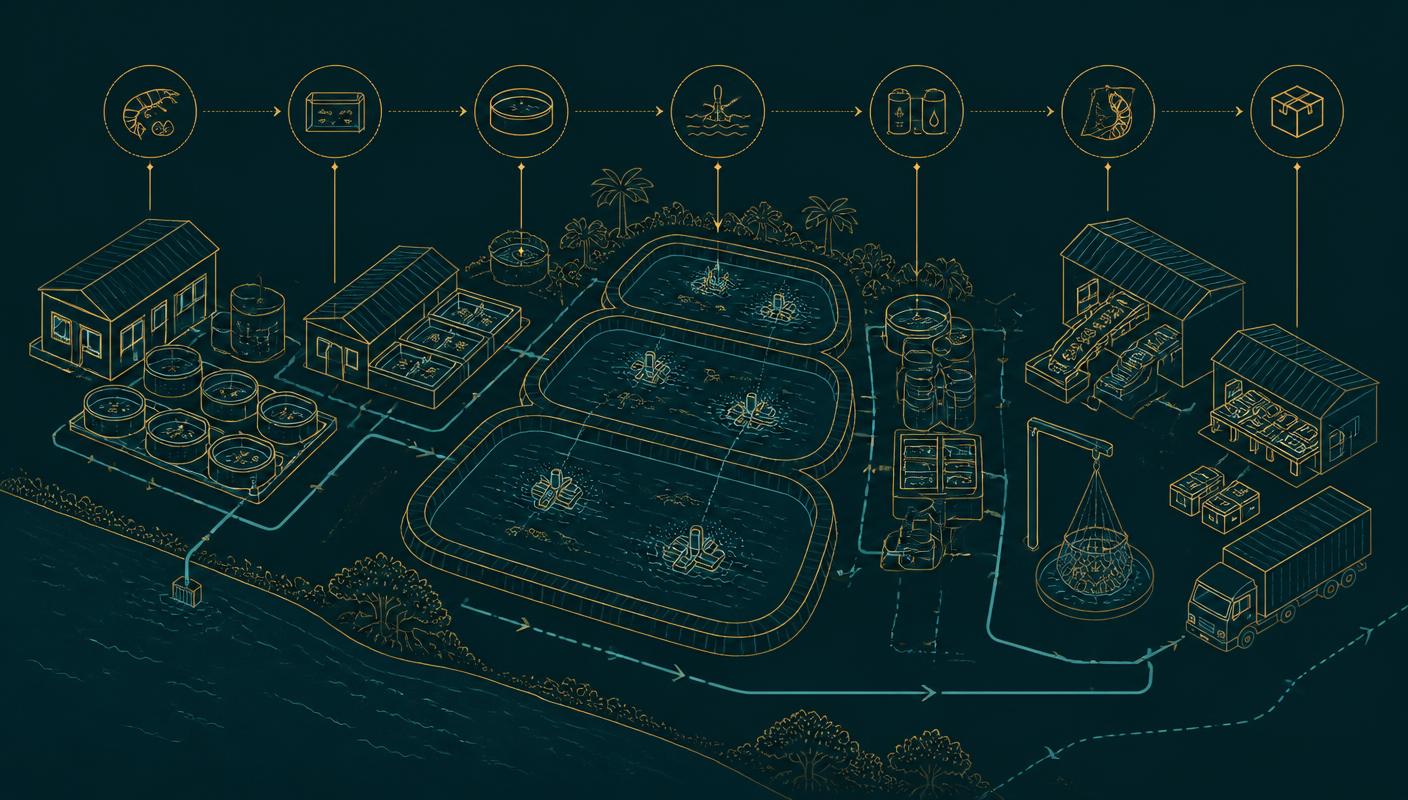
Shrimp Farming Projects
Intensive shrimp production — predominantly Litopenaeus vannamei, with regional programmes in black tiger shrimp — offers some of the strongest margins in aquaculture and some of the highest biological volatility. The economics are driven by survival rate and cycles per year rather than by pond area alone.
What determines a shrimp project's outcome
- Seed quality and provenance. Specific-pathogen-free post-larvae from a documented source, with acclimation and screening protocols on arrival.
- Nursery staging. Separating nursery from grow-out improves survival, shortens grow-out occupancy and increases annual cycles.
- Water treatment on intake and discharge. Reservoirs, sedimentation, filtration and disinfection reduce pathogen entry; effluent treatment protects both the licence and neighbouring farms.
- Aeration and oxygen management. The dominant energy cost and the dominant driver of achievable stocking density.
- Biosecurity architecture. Zoning, vehicle and personnel control, equipment dedication per pond, bird and crab exclusion, and disciplined mortality removal.
- Harvest and chilling logistics. Time from pond to ice governs product grade and price realisation more than most farm-level variables.
Lined intensive ponds, biofloc systems and recirculating shrimp facilities occupy different points on a capital-versus-control curve. Higher control reduces disease exposure and increases cycles, at higher capital and energy intensity. The choice should be made against site conditions, climate, energy price and the developer's tolerance for biological variance — not against the technology's reputation. A structured comparison is available in the shrimp project guide.
Fish Farming Projects
Finfish projects span pond, cage, flow-through and recirculating systems, with species ranging from tilapia and catfish through sea bass, sea bream, barramundi, trout and salmon. Despite the diversity, the same four variables decide the outcome: water, temperature, feed management and market access.
System selection
| System | Capital intensity | Environmental control | Best suited to |
|---|---|---|---|
| Earthen ponds | Low | Low | Abundant land and water, warm climate, cost-led markets |
| Lined intensive ponds | Medium | Medium | Higher density with manageable water exchange |
| Cages | Low–medium | Low | Suitable water bodies with licensing and depth |
| Flow-through raceways | Medium | Medium | Abundant clean, cool water with discharge capacity |
| Partial recirculation | Medium–high | High | Water-limited sites seeking control at moderate cost |
| Full RAS | High | Very high | Market-proximate production, biosecurity or climate constraints |
Feed conversion is the operational metric with the greatest leverage. Benchmark ratios of roughly 1.1–1.3 for salmon, 1.4–1.7 for tilapia and 1.6–2.0 for sea bass and sea bream translate directly into margin, and a 0.1 improvement on a mid-sized facility frequently repays feed-management automation within two years. Achieving benchmark performance depends on feed quality, feeding method, water quality stability and stock uniformity — a systems outcome rather than a purchasing decision.
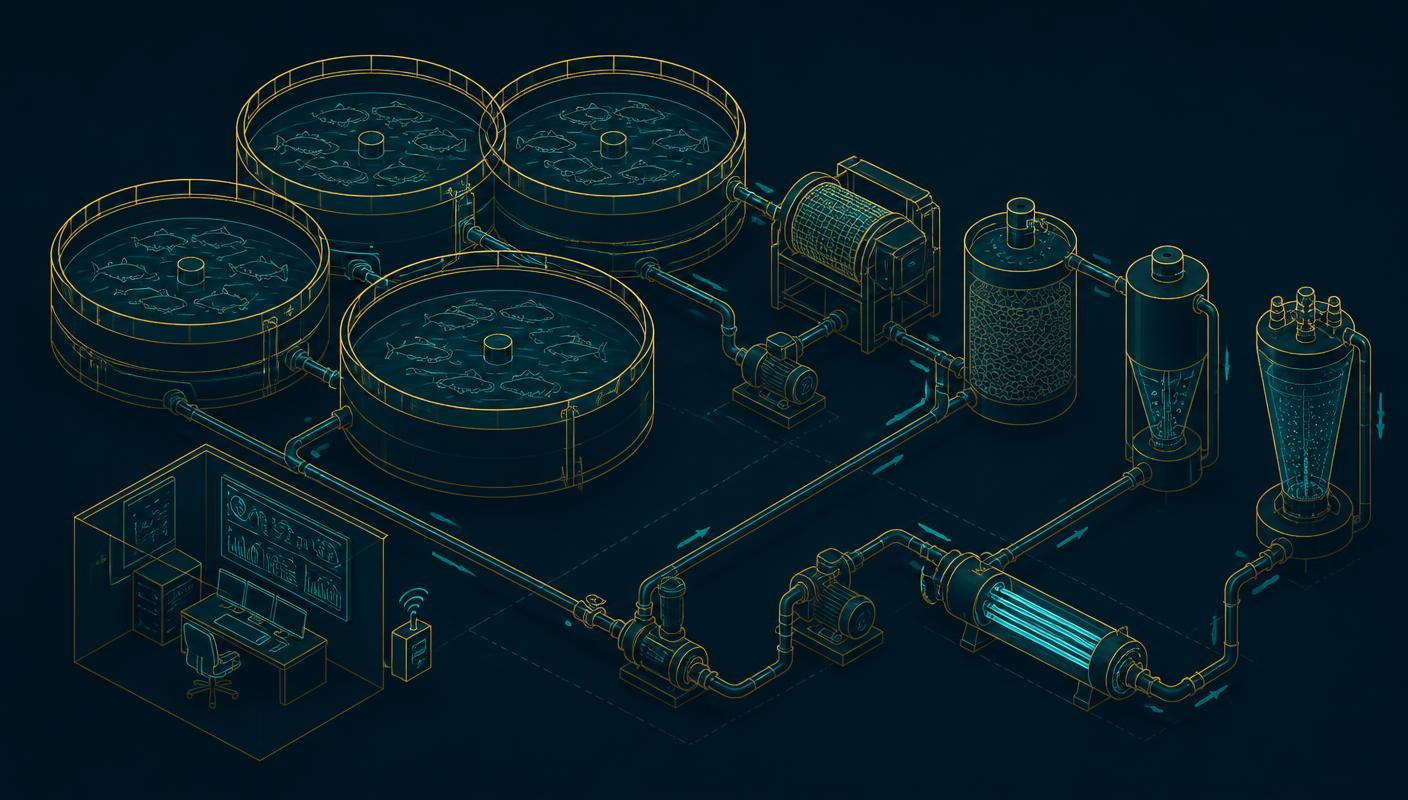
RAS Facilities: Control at a Price
Recirculating aquaculture systems reuse the large majority of process water, typically replacing only a few per cent per day. That enables production close to markets, in climates that would otherwise be unsuitable, with strong biosecurity and a small land footprint. It also concentrates risk: the facility depends continuously on power, on biofilter stability and on operator competence.
Where RAS projects go wrong
- Biological start-up underestimated. Biofilter maturation takes weeks; production schedules that assume day-one capacity are unrealistic.
- Energy modelled optimistically. Pumping, oxygenation, temperature control and building services are substantial and continuous loads.
- Operator capability treated as a training line item. RAS requires process-industry discipline; recruiting and retaining that capability is a strategic issue.
- Off-gassing, alkalinity and CO₂ neglected. Frequently the actual limiting factor at high density, ahead of ammonia.
- Scale-up by multiplication. A pilot's performance does not extrapolate linearly to a commercial module.
RAS is an excellent answer to a specific set of constraints and an expensive answer to problems that do not exist at a given site. The decision should be made on delivered cost per tonne under local energy prices, not on system sophistication. The RAS sizing and oxygen demand calculators allow developers to test that arithmetic before engaging suppliers.
Hatcheries, Nurseries and Seed Security
Seed supply is the most commonly underestimated dependency in aquaculture project planning. Growth performance, uniformity, disease resistance and harvest scheduling all originate upstream of the grow-out facility. Where regional seed supply is reliable, certified and genetically documented, purchasing juveniles is usually the more capital-efficient route. Where it is not, seed becomes a strategic risk that justifies investment in an on-site nursery or full hatchery.
Hatchery projects are technically demanding in their own right: broodstock management and conditioning, larval rearing with live-feed production, precise water quality and temperature control, laboratory capability, and biosecurity standards considerably stricter than grow-out. They should be scoped as separate projects with their own feasibility logic, not as an annex to a farm. Detailed planning material is maintained in the hatchery project guide.
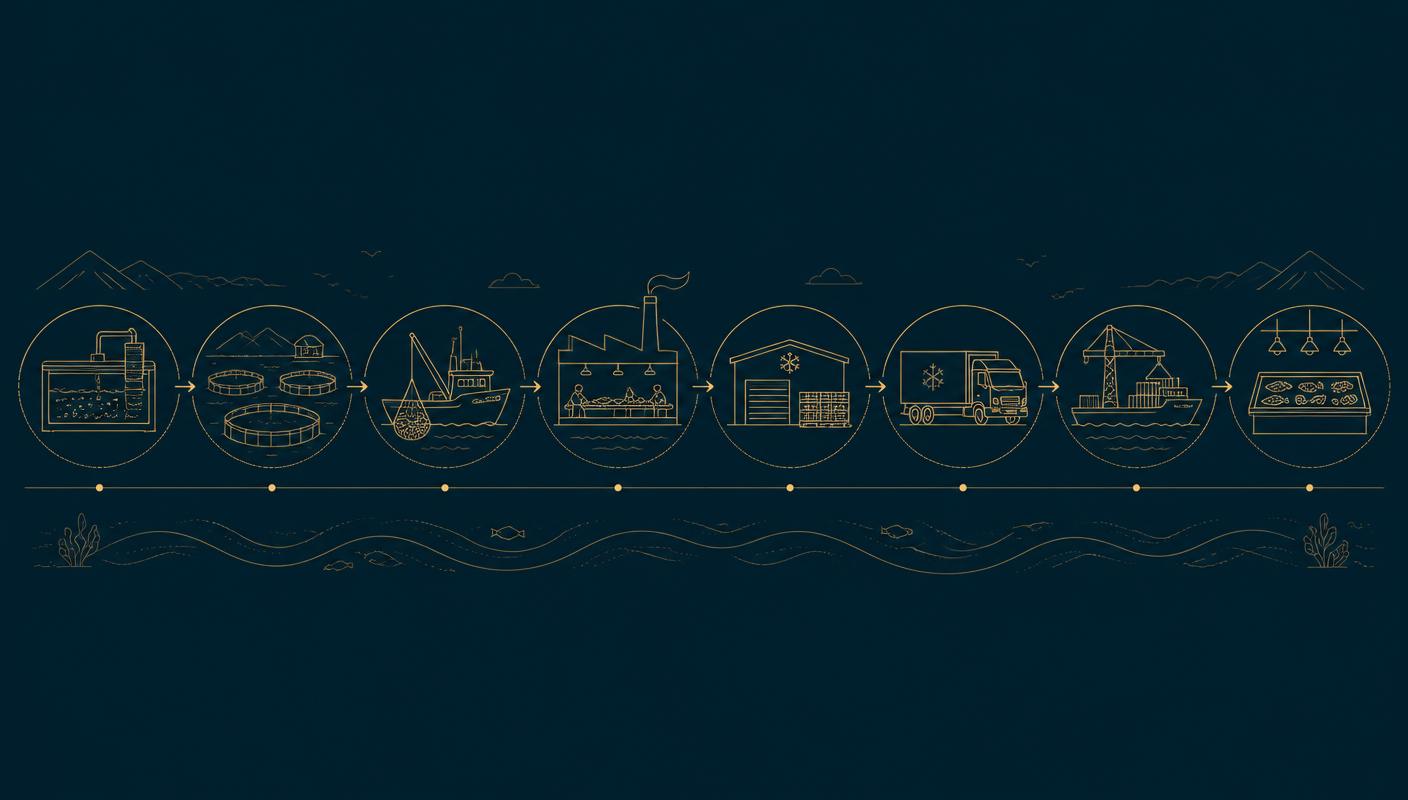
Seafood Processing, Cold Chain and Export Readiness
A farm produces biomass; a business sells a product. The distance between the two is processing, chilling, packaging, certification and logistics — and it determines what proportion of end-market value the project retains.
Design implications of the product form
Whether output is sold live, fresh on ice, chilled fillet, individually quick-frozen or value-added changes chilling capacity, freezing tunnel sizing, water and effluent load, cold-store volume, labour profile, hygiene zoning and certification scope. It also changes the farm: harvest volume per event, purging and starvation protocols, and even stocking schedule are downstream of the processing plan. Projects that treat processing as a later phase routinely discover their utilities, drainage and site layout were never sized for it.
Cold chain integrity
Product quality is lost, not gained, after harvest. Chilling rate, unbroken temperature control through storage and transport, monitored transfer points and documented handling determine grade, shelf life and claim rates in destination markets. For export programmes, the cold chain is also the evidence base for compliance. Where projects require refrigerated infrastructure, storage or temperature-controlled logistics capability, buyers can extend the same structured process through ColdMatchGroup, the cold-chain platform within the Global B2B Group network.
Export readiness
- Facility approval and establishment listing for the destination market.
- Recognised certification — ASC, BAP, GlobalG.A.P., BRCGS or IFS depending on channel.
- HACCP plans, residue monitoring and traceability from batch to consignment.
- Documentation capability: health certificates, catch or farm attestations and customs paperwork.
- Packaging and labelling that satisfy destination requirements without rework.
Biosecurity and Operational Efficiency
Disease is the single largest destroyer of value in aquaculture, and it is largely a design and discipline problem rather than a veterinary one. Effective biosecurity is architectural — zoning, single-direction flow of people, equipment and water, quarantine for incoming stock, controlled access, disinfection points, dedicated equipment per production unit and disciplined mortality handling. It is then procedural: written protocols, trained staff, routine monitoring, defined thresholds and rehearsed response.
Operational efficiency rests on the same foundation. Feed represents the largest cost line, so feeding accuracy, appetite observation and waste minimisation have more effect on profitability than most capital decisions. Preventive maintenance protects the asset base; energy management protects the margin; consistent record-keeping converts experience into improvement. Facilities that measure survival, feed conversion, growth rate, oxygen use per kilogram produced and energy per kilogram produced can improve them. Those that do not, cannot.
Biosecurity is not a cost centre. It is the insurance premium the project pays with design decisions instead of money.
Project Financing and Bankability
Aquaculture financing has broadened considerably: commercial banks with agribusiness desks, development finance institutions, export credit agencies, blue-economy and impact funds, equipment leasing, government incentive programmes and strategic investors from the seafood value chain. Each has different criteria, but all evaluate the same underlying question — is this project's cash flow defensible under stress?
What lenders examine
- Feasibility quality. Independent, evidence-based, with sourced biological and price assumptions.
- Team. Demonstrated operating experience with the species and system, not only construction capability.
- Resource security. Water rights, land tenure, permits and grid capacity confirmed rather than expected.
- Technology risk. Proven at the proposed scale, with performance guarantees and vendor support presence.
- Market. Off-take agreements or a credible, evidenced route to market with realistic pricing.
- Downside resilience. Sensitivity analysis, insurance, contingency and covenant headroom.
The practical implication is that financing shapes design. Debt-funded projects are built to different specifications than equity-funded ones because coverage ratios impose conservatism on stocking density, redundancy and phasing. Developers who engage the financing question during feasibility — rather than after engineering is complete — avoid redesigning a facility to satisfy a lender. Structured preparation material, incentive programmes and pre-qualification tools are available through the aquaculture project financing center.
Digital Transformation in Aquaculture
Digitalisation in aquaculture has moved past pilot projects into the operating core. Continuous water quality monitoring, automated oxygen dosing, biomass estimation, feed control systems, environmental telemetry and centralised SCADA now form the evidentiary layer that supports both husbandry decisions and lender reporting. Their value is not novelty; it is variance reduction. A facility that can detect a drift in dissolved oxygen or a decline in feeding response hours earlier converts potential losses into routine adjustments.
The same shift applies to project development itself. Requirement definition, cost modelling, tender preparation and supplier comparison — historically handled through fragmented spreadsheets and personal networks — are increasingly executed on structured digital platforms that preserve assumptions, produce comparable documentation and create an auditable decision record. That record is what boards and lenders now expect to see.
Structured Procurement: Doing the Last Step Properly
When the preceding work is complete, procurement becomes straightforward — which is precisely the point. A well-prepared buyer enters the market with a performance specification, a defined scope boundary, acceptance criteria and a commercial framework. Suppliers can then compete on what they actually control: engineering quality, guaranteed performance, delivery, service and price.
Components of a bankable RFQ
- Project context. Species, target capacity, site conditions, water analysis, climate and utilities.
- Performance requirements. Guaranteed production capacity, water quality set-points, energy consumption limits and redundancy expectations.
- Scope boundary. Explicit division between supplier, contractor and owner scope — the most common source of budget overrun.
- Technical standards. Materials, instrumentation, control philosophy, hygiene and safety requirements.
- Commissioning and acceptance. Test protocols, duration, criteria for takeover and remedies for shortfall.
- Support obligations. Training, documentation, spare parts, response times and warranty terms.
- Commercial terms. Payment milestones, guarantees, liquidated damages, currency and delivery terms.
Evaluating offers
Offers should be normalised to a common basis before any price comparison: delivered cost per tonne of guaranteed annual capacity, five-year consumables and spares, energy consumption at design load, commissioning duration and the value of excluded scope. Weighted scoring across technical compliance, performance guarantees, references in comparable conditions, service capability and commercial terms produces defensible decisions that survive board scrutiny. The RFQ builder and tender wizard generate this documentation from a guided sequence of project questions.
How FishMatchGroup Supports Buyers
FishMatchGroup is a buyer-first platform for commercial aquaculture projects. It does not sell equipment, hold manufacturer exclusivities or represent supplier interests. Its function is to help organisations reach the procurement stage properly prepared — and then to run that stage as a structured, comparable process.
Knowledge Center
Supplier-neutral technical, regulatory and market briefings covering species, systems, water treatment, compliance and regional conditions.
Project Planning
Structured planning resources that move a concept through species selection, site assessment, capacity definition and phasing.
Commercial Calculators
Sizing, oxygen demand, biomass, feed conversion, water exchange, stocking density and return calculations for early-stage modelling.
Project Guides
Sector-specific guides for shrimp farms, fish farms, RAS facilities, hatcheries, processing plants and cold-chain readiness.
RFQ & Tender Preparation
Guided generation of vendor-neutral requirement documents, scope boundaries and acceptance criteria.
Project Financing
Financing routes, incentive programmes, documentation expectations and pre-qualification for aquaculture capital.
Confidentiality and neutrality
Buyer identity and project detail are shared with suppliers only after a shortlist is approved by the buyer. Supplier identities are equally protected until the buyer chooses to engage. This is not a courtesy; it is what allows a genuinely comparable process to run without either side negotiating against a leaked position.

The wider ecosystem
Aquaculture projects rarely stop at the farm boundary. FishMatchGroup operates within Global B2B Group, a network of specialised buyer-first platforms that share the same neutrality principles and can be engaged as a project's scope widens:
- ColdMatchGroup — refrigerated storage, freezing capacity and temperature-controlled logistics for processing and export programmes.
- FeedMatchGroup — feed supply, feed-mill projects and nutrition sourcing, addressing the largest single operating cost in aquaculture.
- SeedMatchGroup — genetics and seed-supply sourcing where seed security is a strategic constraint.
- HatchMatchGroup — hatchery technology and incubation infrastructure for projects that must control their own seed supply.
For buyers, the practical benefit is continuity: one structured, supplier-neutral method applied across production, feed, seed, processing and cold chain, rather than a different procurement culture at every interface.
The Buyer Journey in Practice
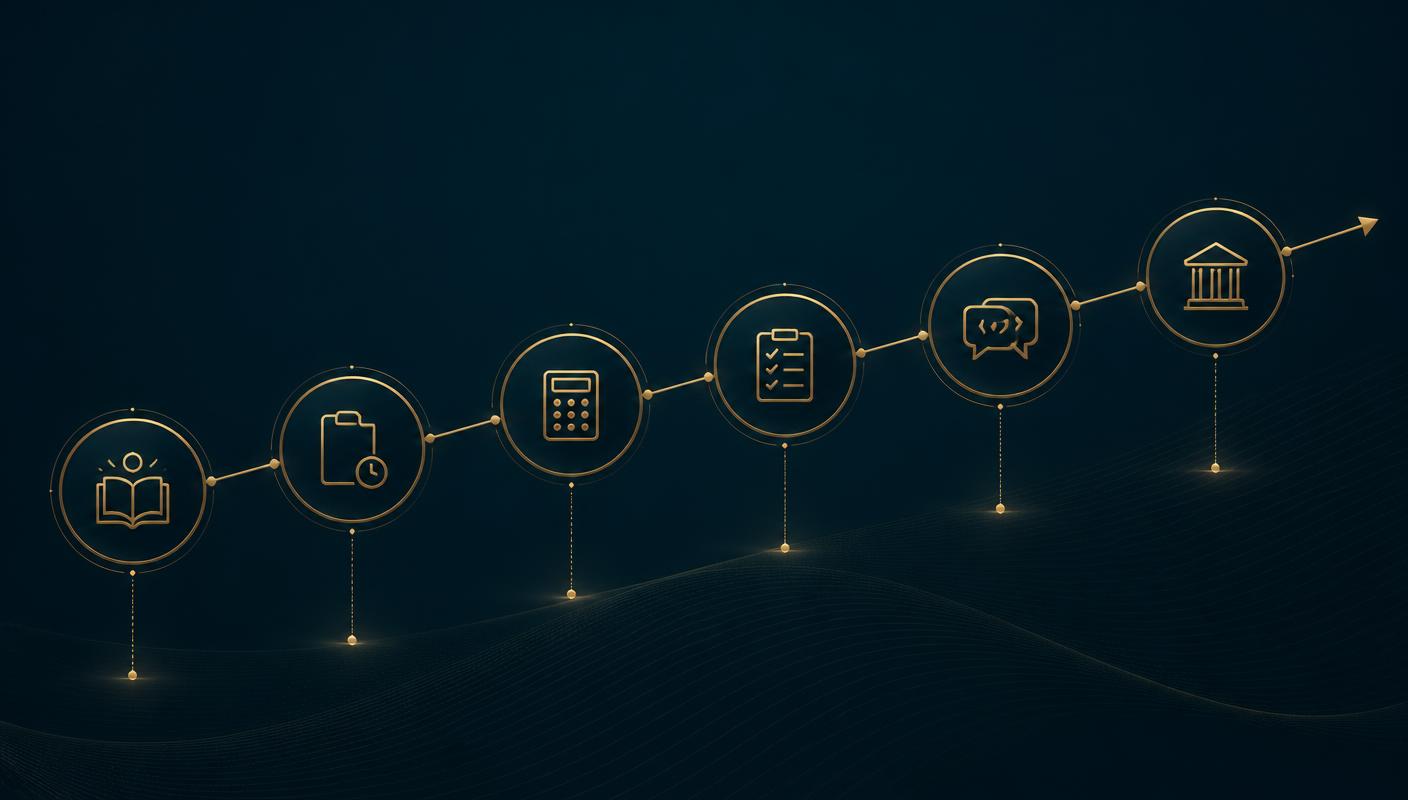
A typical engagement follows six stages. An organisation begins in the Knowledge Center, establishing vocabulary and benchmarks. It moves to planning, defining species, capacity and site logic. It quantifies the concept with calculators and budget modelling. It converts the result into a vendor-neutral requirement package. It runs a structured sourcing process against that package. And it aligns financing with the documentation produced along the way.
The value is cumulative. Each stage produces artefacts the next stage requires, and by the time suppliers are engaged the buyer holds a defensible specification, a realistic budget and a clear evaluation method. That is the difference between negotiating from a position of information and negotiating from a position of hope.
Decision Framework: Is Your Project Ready for Procurement?
Before contacting suppliers, an organisation should be able to answer every question below with documented evidence. A negative answer is not a failure; it identifies exactly where the remaining work sits.
Is the target market, product form and realistic price established from evidence rather than assumption?
Is the annual production volume and harvest profile defined?
Has water quantity, quality and seasonal variability been measured at the actual site?
Is the discharge pathway identified and its consent limits understood?
Is grid capacity, tariff structure and standby power strategy confirmed?
Has a concept-level mass and water balance been produced?
Is the permitting route mapped with realistic durations on the critical path?
Is total CAPEX built bottom-up, including civil, utilities, working capital and 10–15% contingency?
Does the model survive a 15% price decline and a 20% feed cost increase?
Is the operating team's experience with this species and system identified or budgeted?
Is the processing and cold-chain plan defined to the level that affects farm design?
Is there a written, vendor-neutral performance specification with acceptance criteria?
Organisations answering yes to nine or more are ready to enter the market. Below that threshold, engaging suppliers tends to substitute their assumptions for the buyer's missing ones — which is how catalogues become designs.
Professional Definitions
Commercial aquaculture project
A capital investment programme that establishes or expands industrial-scale aquatic production, encompassing business planning, engineering, permitting, construction, operations and market access — not the purchase of equipment.
Integrated project
A development in which hatchery or seed supply, grow-out, water treatment, harvest, processing and logistics are designed as one interdependent system.
Vendor-neutral specification
A performance-based requirement document that any qualified supplier can bid against, written without reference to a proprietary product.
Delivered cost per tonne
Total installed capital divided by guaranteed annual production capacity — the only figure that makes competing offers comparable.
Bankability
The degree to which a project's technical, commercial and governance documentation satisfies a lender's or investor's risk criteria.
Water balance
The quantified relationship between intake, recirculation, evaporation, sludge losses and discharge across a production cycle.
Biosecurity plan
The documented set of physical barriers, procedures, monitoring and response protocols that prevent pathogen entry and spread.
Export readiness
The combination of certification, traceability, cold-chain integrity and documentation required for product to enter a destination market.
Future Industry Trends
Capital discipline replaces technology enthusiasm
Boards increasingly test projects on delivered cost per tonne and energy exposure rather than on system novelty.
Regionalisation of protein supply
Import-dependent regions are financing domestic capacity to reduce foreign-exchange and logistics exposure.
Integration of processing into farm projects
Value capture moves downstream; harvest-to-pack integration becomes a design assumption rather than a phase two.
Energy strategy as a bankability item
Heat recovery, solar and load management move from CSR narratives into financial models and covenants.
Data-defined husbandry
Sensor networks, biomass estimation and feed control convert biological variability into a managed process.
Rising expectations of documentation
Buyers, lenders and regulators increasingly require traceability, welfare and environmental evidence as a condition of access.
Neutral advisory between buyer and manufacturer
As projects grow more complex, organisations increasingly separate specification from supply to protect decision quality.
Taken together, these trends point in one direction. The competitive advantage in commercial aquaculture is migrating from access to equipment — which is now globally available — to the quality of the decisions made before equipment is chosen. Capital, water, energy and market access are the scarce inputs. Machinery is not.
Questions and Answers
Conclusion
Commercial aquaculture is entering a phase in which the projects that succeed will be those that were properly conceived, not merely well equipped. The biology is well understood. The technology is mature and widely available. What remains genuinely difficult is the sequence of judgements that connects a market opportunity to a site, a water source, an engineering concept, a capital structure and, finally, a specification that suppliers can compete against.
That is why successful projects start long before procurement. The purchase order is not the beginning of a project; it is the point at which a well-prepared organisation converts months of disciplined analysis into a contract — and at which an unprepared one discovers what it did not ask.
FishMatchGroup exists to serve the earlier stages: to help investors, seafood companies, operators, contractors and governments plan commercial aquaculture projects, reduce project risk, prepare structured procurement requirements and make better investment decisions — without ever representing a supplier.
Next step
Begin where the decisions are still open.
Explore the planning resources, quantify your concept, and prepare a vendor-neutral requirement package before you engage the market.