Short answer
What defines the next generation of aquaculture innovation?
- Biggest single lever:
- Feed — typically 45–65% of OPEX in fish and shrimp grow-out
- Where sensors pay first:
- Dissolved oxygen and mortality avoidance, not dashboards
- Energy in RAS:
- Pumping, oxygenation and temperature control dominate the kWh bill
- Bankability test:
- Lenders fund measurable, instrumented operations — not novelty
- Buyer cost on FishMatch Group:
- Free — planning tools, briefs and quote rounds
- Coverage:
- Fish and shrimp projects across 15 priority countries, 12 languages
What actually changed — and what did not
Aquaculture has been called the fastest-growing food production sector for two decades, but for most of that period the operating playbook stayed remarkably analogue: stock, feed on a schedule, watch the water, hope the weather cooperates. What changed over the last few years is the cost of measurement. Industrial-grade dissolved oxygen probes, variable-speed drives, feed controllers, remote telemetry and cloud logging have all fallen far enough in price that a mid-size commercial farm can instrument its highest-risk units without a corporate R&D budget.
What has not changed is biology. Fish and shrimp still grow inside narrow envelopes of oxygen, temperature, ammonia and nitrite. Innovation does not widen those envelopes — it keeps the farm inside them for a larger share of the production cycle. That distinction matters commercially, because it tells you where technology creates value and where it is simply expensive decoration.
The practical rule we apply when scoping projects at FishMatch Group: an innovation earns its place if it protects standing biomass, improves feed conversion, reduces energy per kilogram, or produces evidence a lender or buyer will pay for. Everything else is optional.
Sensors, control loops and the honest version of the digital twin
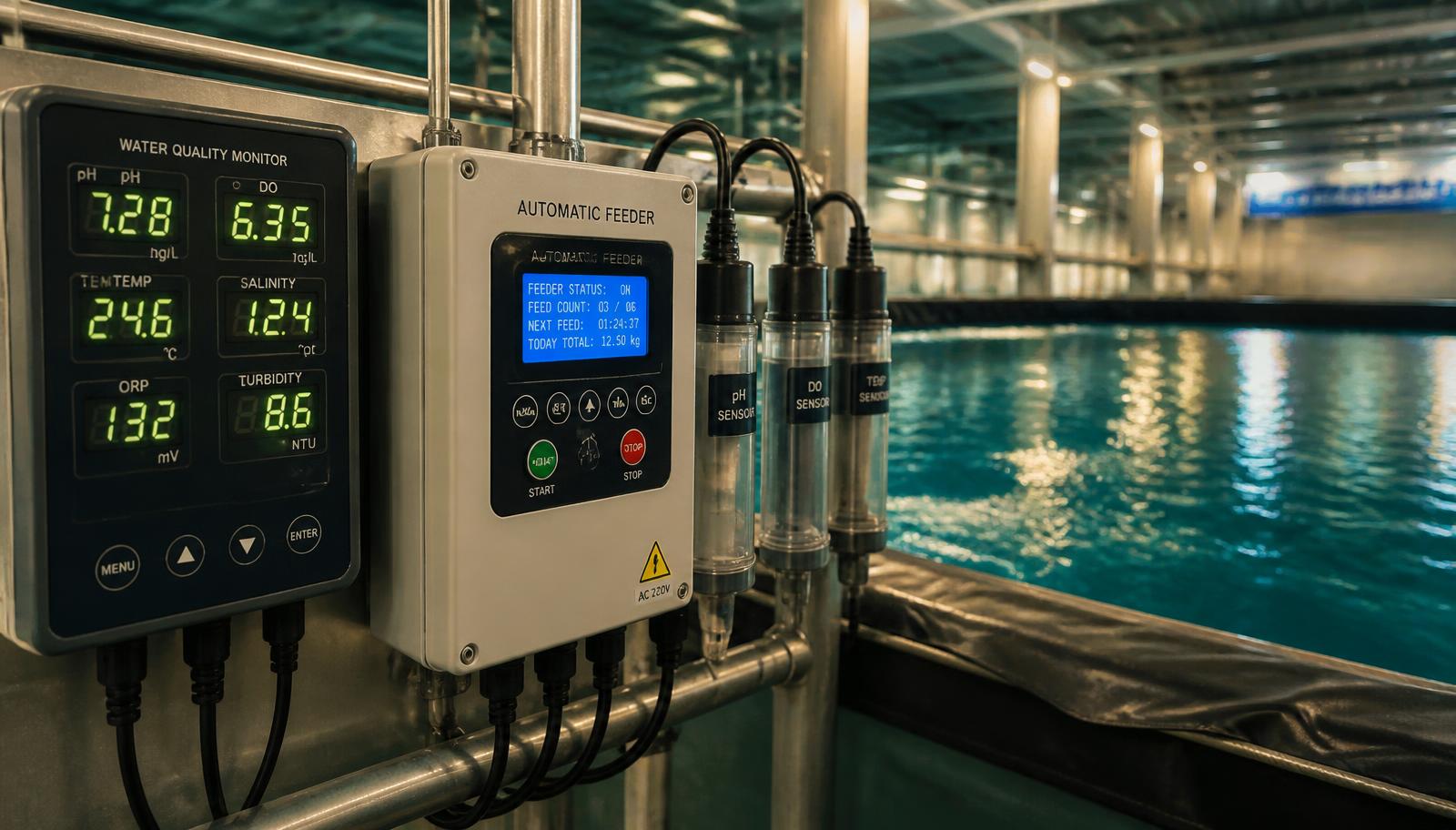
Instrumentation only becomes innovation when a reading triggers an action. A dashboard that reports a dissolved oxygen slide at 03:40 while everyone is asleep has recorded a loss, not prevented one. The step that pays is the control loop: probe → controller → aerator, oxygen injection or valve, with an alarm escalation if the correction does not land within a defined window.
Sequencing matters more than sophistication. Farms that succeed with technology tend to follow the same order — reliable sensing with a calibration routine, then alarming, then automated correction on the highest-risk units, then optimisation of set-points, and only then predictive modelling. Sites that begin at the modelling end usually discover that their historical data was never trustworthy enough to model.
The term "digital twin" is used loosely in this sector. The useful version is unglamorous: a maintained model of your own farm — tank and pond volumes, exchange rates, oxygen transfer capacity, biofilter loading, feed load per unit, standby power — kept current enough to answer questions before you spend money. Can this biofilter absorb a 20% higher feed load? What happens to oxygen demand at 28 °C? Which pond hits its aeration ceiling first if we raise density? Those answers are worth far more than a rendered 3D view of a facility.
Closed-loop DO control
Automatic aeration and oxygen dosing tied to live readings, with alarm escalation — the single biggest protector of standing biomass.
Feed controllers
Feeding driven by biomass, temperature and appetite signals instead of a fixed clock schedule.
Remote telemetry
Multi-site visibility and out-of-hours alerts, so a night event reaches a human before it becomes a harvest event.
Operating record
Logged mortality, FCR, energy per kilo and water use — the dataset lenders and offtakers ask for.
Precision feeding: where the economics are decided
Feed is typically 45–65% of grow-out operating cost in both fish and shrimp, which makes feed conversion ratio the most leveraged number on the farm. Precision feeding attacks it from three directions at once: matching ration to real biomass and water temperature rather than to a printed table, detecting when the animals stop eating so uneaten pellets never reach the bottom, and distributing feed so that dominant animals do not capture a disproportionate share.
Acoustic and camera-based appetite sensing has moved from salmon-only technology into intensive shrimp systems, where feeding trays were the traditional feedback loop. The gain is twofold — feed saved, and water quality protected, because uneaten feed is also the main driver of ammonia load and night-time oxygen depletion. In tightly stocked systems those two effects compound: better feeding means better water, which means better feeding.
Before buying anything, model the delta. Run your own numbers in the FishMatch calculators — FCR, biomass, oxygen demand and stocking density — and see what a realistic improvement in feed conversion is worth annually at your production volume. That figure, not a vendor brochure, should set the budget for feeding technology.
Genetics, health and biosecurity as engineering problems
The most under-rated innovation in commercial aquaculture is not electronic at all. Specific pathogen free (SPF) and specific pathogen resistant (SPR) shrimp lines, selectively bred tilapia strains and improved salmon genetics change growth rate, survival and uniformity before a single sensor is installed. Stock quality sets the ceiling; equipment determines how close you get to it.
Biosecurity is where that stock quality is protected, and it is fundamentally a design discipline: zoning between clean and dirty areas, one-way personnel and equipment flow, disinfection points, inlet water treatment sized for the real pathogen risk, quarantine for incoming animals, and effluent handling that does not recirculate problems back into the intake. Rapid on-site PCR screening and structured health monitoring have made early detection realistic even for mid-size farms.
Treat biosecurity as part of the capital scope, not as an operating afterthought. Retrofitting zoning into a facility that was laid out for convenience is expensive; specifying it in the first drawing set costs comparatively little and materially improves how a project reads to an insurer or a lender.
Energy, water and circular design
In recirculating systems, pumping, oxygenation and temperature control dominate the energy bill; in intensive ponds, aeration does. Both respond to the same set of engineering measures: variable-speed drives instead of fixed-speed motors running flat out, correctly sized pipework and low-head layouts, heat recovery on exchanged water, and aeration scheduled against actual oxygen demand rather than run continuously as insurance against poor visibility.
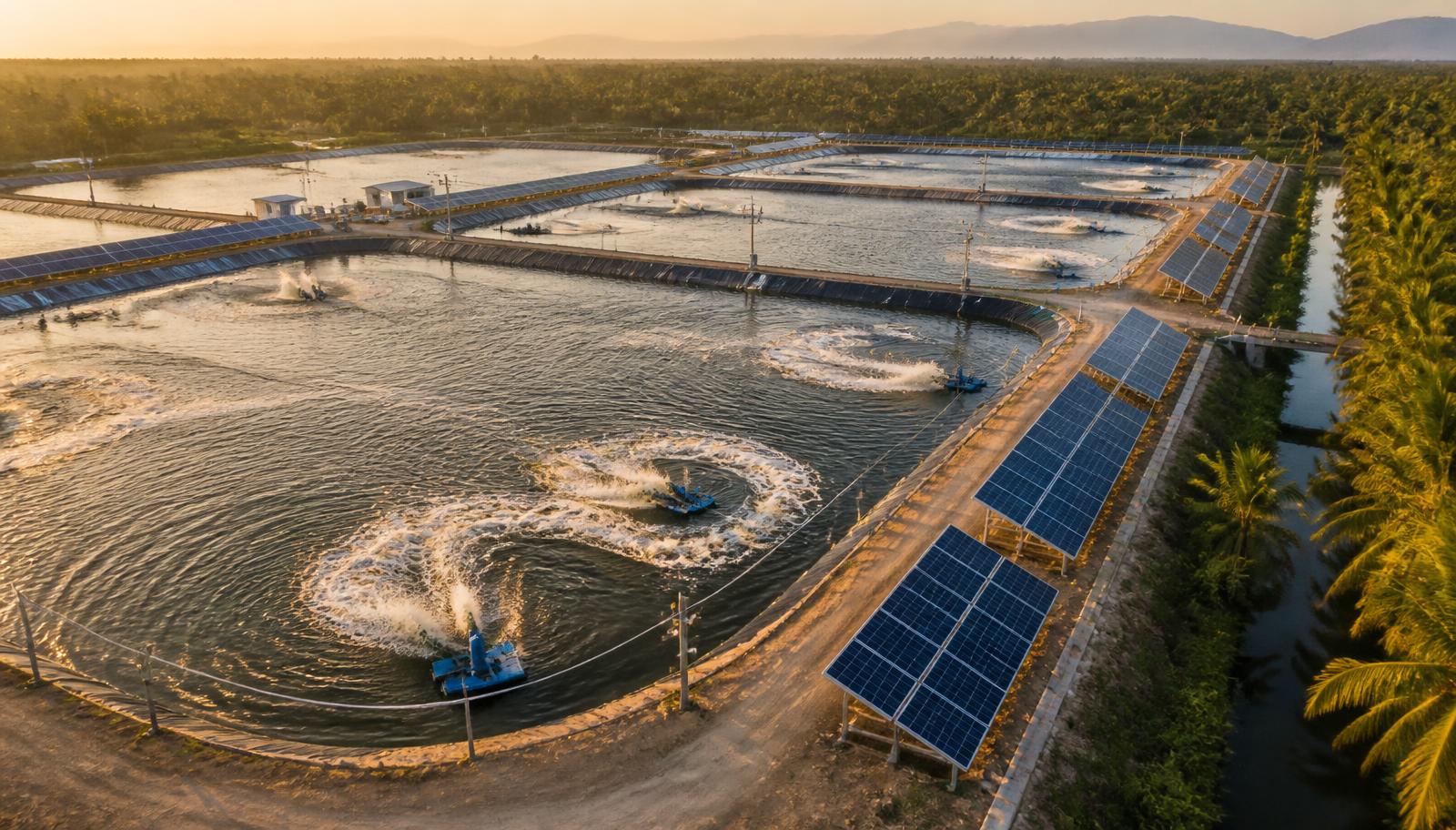
Solar generation has become straightforwardly commercial on sunny sites — embankment or roof arrays covering daytime pumping and aeration load, with the grid or generators carrying the night. Sludge is the other frontier: solids captured from RAS and pond systems become fertiliser, biogas feedstock or an input for insect protein rather than a discharge liability, and increasingly a permit condition rather than a choice.
This is the part of the innovation wave where environmental performance and unit economics genuinely align. Lower kWh per kilogram, lower water use per kilogram, and a defensible discharge story all improve the same three things: cost, permit risk and market access. See the water quality centre for the operating side of that equation.
Water reuse
Partial reuse and solids capture cut intake volume, discharge load and permitting friction.
Renewable input
Solar for daytime pumping and aeration, with hybrid control and storage where grid supply is unstable.
Resilience
Standby power, oxygen backup and redundant aeration — cheap insurance against a total-loss event.
Traceability
Batch-level records that buyers and certification schemes increasingly require before contracting.
AI-led sourcing and the bankability dividend
The innovation most operators feel first is in procurement. Historically, sourcing a RAS, a hatchery or a pond upgrade meant trade shows, referrals and weeks of email in three languages, with quotes that were impossible to compare because each supplier answered a slightly different question. Specification-led matching inverts that: the project is described once, converted into a single technical brief, and routed confidentially to the small number of suppliers that genuinely build that scope.
The consequence is comparability. When five suppliers respond to one identical specification, price differences reflect real engineering choices instead of interpretation gaps. It is also faster — a qualified shortlist in days rather than months — and it is private: on FishMatch Group neither side sees the other's identity until a quote is accepted, which is precisely why competitive producers use it.
Bankability is the compound benefit. An instrumented, well-specified project arrives at a lender with a costed scope, an energy model, a biosecurity plan and — after the first cycle — real mortality and FCR data. That package is what turns an aquaculture proposal from a story into an underwritable asset. Explore the financing centre to see what lenders in this sector typically require.
A practical 12-month innovation roadmap
Innovation fails most often through simultaneity — too many systems introduced at once, none of them owned. A staged sequence works far better on a working farm:
- Months 1–2 — baseline. Record what you already have: mortality by unit, FCR by batch, kWh per kilogram, water exchanged per kilogram. Without a baseline, no later claim of improvement is provable.
- Months 2–4 — sensing and alarms. DO, temperature and pH on the highest-risk units, with calibration schedules and out-of-hours escalation to a named person.
- Months 4–7 — control. Automate aeration and oxygen dosing against set-points; add standby power and redundancy where a single failure would be a total loss.
- Months 6–9 — feeding. Introduce controllers and appetite feedback on the units with the worst measured FCR, not everywhere at once.
- Months 8–12 — energy and effluent. Variable-speed drives, heat recovery, solar where the site justifies it, and a solids handling plan that satisfies your permit.
- Throughout — sourcing discipline. One brief per scope, several comparable quotes, and every commissioning result folded back into the operating record.
Assign an owner to each stage and budget training and maintenance alongside the hardware. Technology that no one is accountable for reverts to manual within a single production cycle.
Scope your next-generation build with a confidential brief
Describe the project once — species, system, volume, country, budget and timeline. We convert it into one technical specification and run a private quote round with suppliers that build exactly that scope. Free for buyers.