Pond geometry: water volume, aeration & FCR
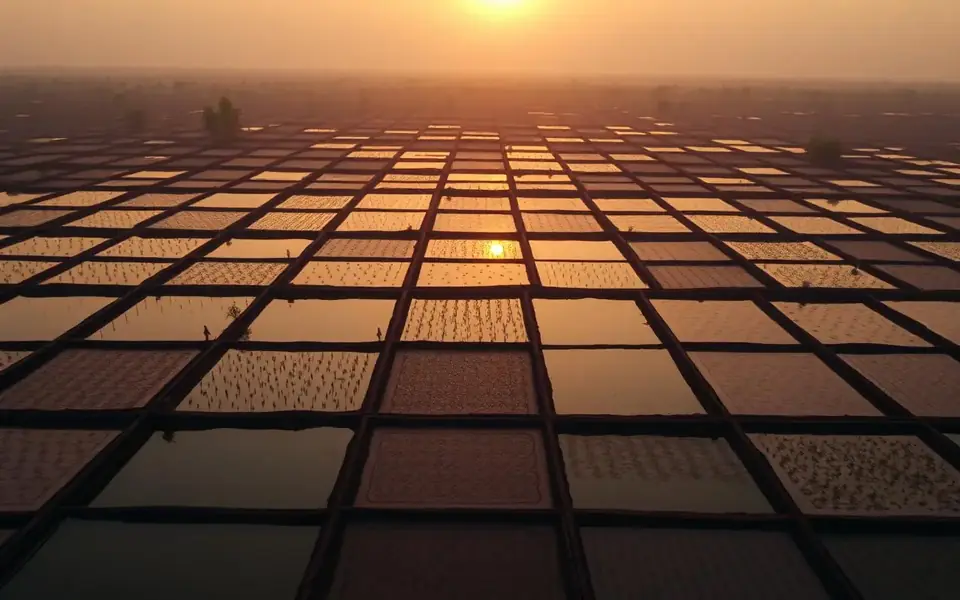
1. Water volume at the operating level
Lengths are in metres; area is in m² and volume in m³. Freeboard is dry height above the operating waterline and is not water volume. Exclude islands, sludge and unusable compartments. For uneven beds, use surveyed sections or a measured area-weighted mean depth.
| Shape | Formula | Applies when |
|---|---|---|
| Vertical rectangle | V = L × W × d | Vertical sides; d is mean water depth. |
| Vertical circle | V = π × (D / 2)² × d | D is the water-surface diameter; vertical sides. |
| Rectangular sloped banks | V = d / 6 × (Aₜ + 4Aₘ + Aᵦ) | Straight banks, flat bed, uniform depth and equal slope z:1. |
For sloped banks, measure L and W at the water surface. Aₜ = L × W; Aₘ = (L − zd) × (W − zd); Aᵦ = (L − 2zd) × (W − 2zd). Both bottom dimensions must be positive. If the banks meet before the stated bed depth, reject that geometry and survey the actual shape—do not treat the calculator’s clamped result as a valid design.
Illustrative geometry, not a farm measurement: 50 m × 25 m × 1.5 m gives 1,875 m³ with vertical walls. With 2:1 banks at the same water-surface dimensions, bottom dimensions are 44 m × 19 m and volume is 1,555.5 m³. One m³ = 1,000 litres; one foot = 0.3048 m.
2. Oxygen demand is not an area-based aerator count
Water oxygen inventory (kg O₂) = volume (m³) × dissolved oxygen (mg/L) / 1,000. This is a stock, not an hourly supply rate. It assumes uniform dissolved oxygen and includes oxygen below the species-specific operating minimum; not all of it is available safely.
Feed-related daily oxygen (kg/day) = feed (kg/day) × oxygen factor (kg O₂/kg feed). The existing oxygen calculator uses a cited, editable planning factor of 0.25 from Timmons et al. (2002) for fish oxygen use. It is not a universal fish/shrimp pond oxygen budget. Sediment, plankton, bacteria and nitrification can add demand; species, life stage, temperature and feeding patterns matter.
Required operating power (kW) = design peak oxygen deficit (kg O₂/hour) / field oxygen-transfer efficiency (kg O₂/kWh)
Use the peak deficit after accounting for dependable non-mechanical supply—not daily demand divided by 24 as a claimed peak. Clean-water standard aeration efficiency (SAE) is not field efficiency. Request the test standard, field corrections, operating DO, salinity, temperature, depth and equipment layout. Review circulation, redundancy, alarms and backup power separately with a qualified engineer.
Arithmetic-only example: assumed peak deficit 10 kg O₂/hour ÷ assumed field efficiency 1 kg O₂/kWh = 10 kW operating power; 8 hours at that load = 80 kWh. Neither assumption is a recommended value or measured performance.
Planning only, not an emergency response or safe stocking approval. If animals are distressed or oxygen is falling, follow the farm emergency protocol and seek qualified local assistance rather than relying on this worksheet.
3. FCR: use the same cohort and period
FCR = feed used (kg) / biomass gain (kg)
For a closed cohort with no harvests or transfers, biomass gain = ending biomass − starting biomass. For production records with removals, reconcile harvested/transferred-out biomass and stocked/transferred-in biomass; define how mortalities are treated and use the same convention when comparing cycles. The existing FCR calculator uses the closed-cohort formula.
Illustrative example: 8,000 kg feed ÷ (5,500 − 500 kg biomass) = FCR 1.6. Zero or negative gain is not a valid FCR. A cycle-average FCR cannot determine daily peak feed, peak biomass or safe aeration capacity.
Calculate fish & shrimp FCRMethodology and next decisions
Geometry: elementary volume integration using the prismoidal rule for straight banks. Oxygen planning factor: Timmons, M.B., Ebeling, J.M. et al., Recirculating Aquaculture Systems, 2nd edition, NRAC Publication 01-002 (2002). Oxygen-transfer testing: ASCE/EWRI 2-06, Measurement of Oxygen Transfer in Clean Water (2006). Neither source provides site-specific equipment approval.
Formula documentation updated 17 October 2026. Engineering and species-specific review pending. Inputs are visitor-entered scenarios; this page does not read live pond measurements, save customer data or create requests.
Before seeking offers, collect surveyed dimensions, working depth, peak biomass and feed records, dawn/critical-period DO observations, water conditions, field transfer evidence and backup requirements.
Tools are free. Human-reviewed procurement assistance is for projects from USD 250,000; smaller requests remain saved and are directed to free tools.