Shrimp processing plant RFQ: what every bidder should price

Before requesting a quote, give each bidder the same peak intake, product mix and net finished output by shift. Set the cold-chain handovers, water and discharge boundary, food-safety responsibilities and acceptance tests. Have each bidder show where its scope stops and how it will demonstrate performance with your product.

FishMatch Group editorial team · Editorial date
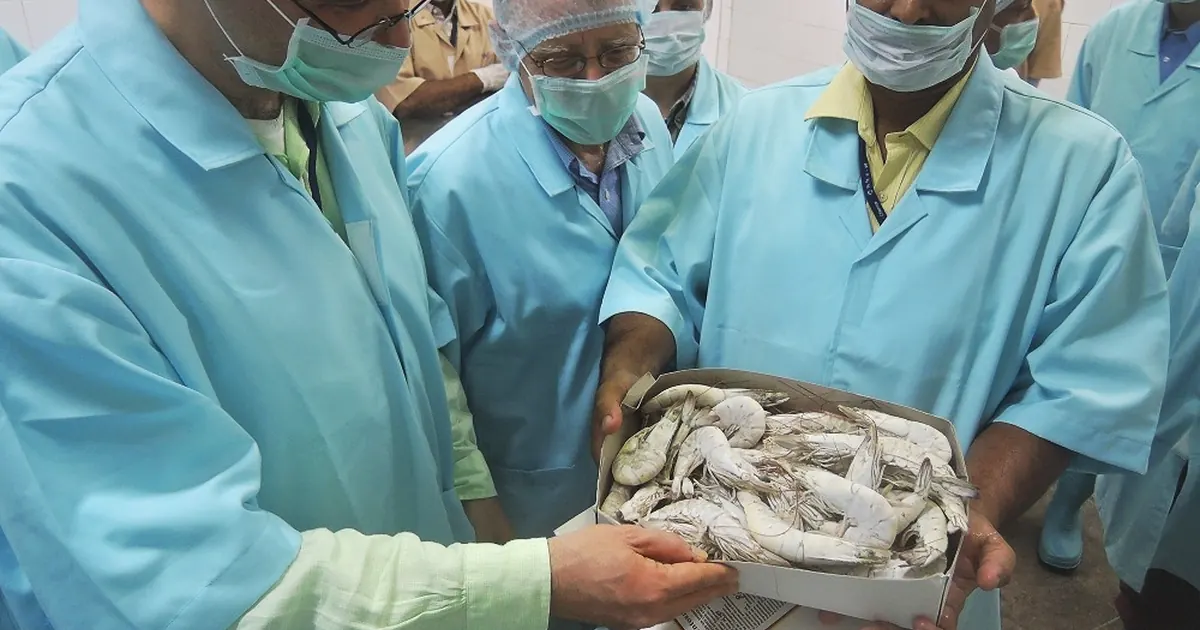
Inspectors in hygiene clothing examining a tray of frozen shrimp
Illustrative photograph: U.S. Food and Drug Administration, shrimp processing plant visit, 2015 (public domain, via Wikimedia Commons). No endorsement.

State raw input and saleable output separately

Start with a receiving calendar and a product schedule, not the annual harvest total. For each product, give species, size/count basis (per kg or per lb), head-on or peeled form, raw or cooked status, retail or bulk pack and chilled or frozen dispatch. Flag whether products run together or on separate shifts. Use actual working time after sanitation, changeovers and planned stops; state the peak delivery window separately.

Example only: 8 tonnes of raw shrimp over five effective hours means an average raw-line duty of 1,600 kg/h during that window. It is not a guarantee or a freezer rating. Set an independent finished-product target by SKU, record measured trial losses at each stage and reconcile rejects, shell and head fractions, glaze, and packed net weight. Ask both bidders to state the bottleneck for the same SKU mix.

Set the cold-chain handovers and pack basis

At receiving, state how lots arrive, expected temperature evidence, ice and meltwater handling, lot identification and who can place nonconforming material on hold. Map the time between unloading, grading, processing and freezing. For IQF or block freezing, ask for kg/h for the specified pack, size and inlet condition at the specified product outlet condition. Do not compare rated capacity with tested capacity at different conditions.

Codex’s fishery-products code describes shrimp processing, freezing and glazing. If the buyer requires glaze, specify how it is measured, and compare net product excluding glaze, glazed weight and gross shipping weight as separate values. Ask for label and lot-code samples, stock rotation and a trace from pack back to raw lot. Define cold-store peak inventory, dwell time, pallet positions, airflow and dispatch peaks separately from freezer duty. Assign responsibility for temperature records and handover to the carrier.

Put water, wastewater and utilities on the scope drawing

List where water and ice contact product and who verifies suitability, capacity and storage. Separate average from simultaneous peak demand for water, ice, refrigeration, electrical supply and hot water or steam. Put drains, connection points, control interfaces and backup loads on the same drawing; call out what the equipment installer must provide and what belongs to the building contractor.

The IFC fish-processing guidelines discuss solids recovery and process wastewater. Have the site team characterize the volume and composition of cleaning and process streams, including peak flow, organic load, solids and, where relevant, salinity. Itemize solids capture, treatment, sludge handling, sampling points and the receiving system. Confirm discharge requirements locally before selecting treatment; neither a generic equipment list nor these guidelines is a permit.

Set quality controls and prove them during commissioning

Use Codex as a general HACCP framework: document process flow, prerequisite hygiene measures and site-specific hazard assessment. Model raw and cooked movements separately, including people, equipment and drains. Assign responsibility for validation, monitoring, calibration, corrective action and release. Do not designate a control point or set a limit solely because a supplier includes a sensor.

Write the acceptance protocol before tenders close. Separate factory checks from site tests with the buyer’s product, pack and shift pattern. Record sustained throughput on the agreed net basis, outlet product condition, utilities at the defined boundaries, lot traceability and agreed recovery tests. State who supplies product, instruments and witnesses, what counts as a failed run and who pays for a retest. Require operating and cleaning instructions, training and handover records.

Compare bids without endorsing a vendor

Keep one revision of the brief for every bidder. Request a line-by-line compliance and exclusions list; compare raw intake, net packed output, freezer conditions and cold-store performance on the same basis. Then compare civil, electrical and drainage interfaces; accepted utility loads; wastewater responsibilities; spare parts and training; and tests, remedies and total installed scope. Record assumptions and questions in the same clarification log. An unpriced interface is not a saving.

Questions before you request quotes

Is annual volume enough to size the line?

No. Peak delivery and effective run time set the intake duty; net product targets and operating conditions set each downstream duty.

Can a freezer quote cover the entire cold chain?

Not on its own. Agree receiving, freezing, storage, dispatch and transfer-of-custody limits separately, then assign an owner to each.

Can a supplier provide an approved HACCP plan with the equipment?

Equipment data and test records can support the plan. The operator’s qualified team must assess the actual process and verify applicable requirements; an equipment quote is not an approval.

Technical references

Prepare a private processing RFQ

FishMatch Group independently reviews processing briefs and helps source relevant suppliers. Buyers pay no fee; managed commercial projects start at USD 250,000. Submitting a brief does not connect you directly to a supplier.

Short answer

What do buyers need to know about Shrimp Processing Plant RFQ Scope?

Shrimp Processing Plant RFQ Scope affects both project cost and project risk, so it belongs in the specification stage rather than the purchasing stage. This page sets out what commercial buyers assess, what typically drives cost and lead time, and which questions to put to suppliers before signing. You can turn any of it into a confidential RFQ in a few minutes.

Who it is for:
Investors, operators and project developers specifying commercial systems
Cost drivers:
Capacity, water source, energy price, permitting and logistics
Next step:
Turn the requirement into a confidential RFQ
Cost to buyers:
No fee charged to the buyer
What do buyers need to know about Shrimp Processing Plant RFQ Scope?

Shrimp Processing Plant RFQ Scope affects both project cost and project risk, so it belongs in the specification stage rather than the purchasing stage. This page sets out what commercial buyers assess, what typically drives cost and lead time, and which questions to put to suppliers before signing. You can turn any of it into a confidential RFQ in a few minutes.

How does FishMatch Group source suppliers for this requirement?

Submit a private RFQ with the country, product or project scope, capacity or volume and timing. The FishMatch team reviews it, clarifies missing details and researches independent providers before approved outreach. Any received proposals are compared on the same scope; FishMatch is not the supplier, manufacturer, contractor or operator, and does not guarantee a response or outcome.

Do buyers see supplier names during the sourcing process?

No. Supplier identities stay confidential during discovery and evaluation. You receive anonymised, comparable technical and commercial packages, and introductions happen only after both sides are qualified and agree to proceed.

Aquaculture planning benchmarks

Indicative global planning ranges used in FishMatch Group calculators. Supplier quotes and site data confirm final values.
FigureValueContext
CAPEX — RASUSD 9,000–14,000 per tonne/yrGlobal baseline before country cost factor.
CAPEX — PondsUSD 1,800–4,000 per tonne/yrLined or earthen ponds, excluding land.
CAPEX — CagesUSD 2,500–5,500 per tonne/yrCages, moorings, nets and service equipment.
CAPEX — Flow-throughUSD 4,000–7,000 per tonne/yrRaceways and water intake works.
Energy useRAS ~6 kWh/kg; ponds ~1.2; flow-through ~1.5; cages ~0.3Per kg of fish produced.
Typical FCRTrout 1.1; salmon 1.2; shrimp 1.4; tilapia 1.6; carp 1.8kg feed per kg growth; varies with feed and management.
Farm size where FishMatch reviews projectsFrom ~USD 250,000 total project valueCommercial fish and shrimp projects.

Before you request quotes

Equipment scope

What equipment does a commercial aquaculture project actually need?

A grow-out project typically needs holding infrastructure (tanks, ponds or cages), water movement (pumps, piping, valves), aeration or oxygenation, water treatment appropriate to the system, feeding equipment, grading and handling gear, monitoring and alarms, and backup power. RAS adds mechanical filtration, biofiltration, degassing, disinfection and tighter process control. Hatchery and processing scopes are specified separately.

Which equipment should be specified before requesting quotes?

Specify the items whose sizing changes everything downstream: design biomass and stocking density, water exchange or recirculation rate, oxygen demand at peak temperature, and installed pumping head. With those four fixed, suppliers can quote aeration, filtration, pumps and power on the same basis. FishMatch calculators produce these figures and attach them to the RFQ.

Can equipment be sourced in stages?

Yes, and phased procurement is common. The usual sequence is water supply and holding infrastructure, then aeration and treatment, then automation and monitoring, then processing and cold chain. Staging works when interfaces and capacity headroom are defined at the start; otherwise later phases force replacement rather than addition.

Supplier selection criteria

How should a buyer compare aquaculture suppliers?

Compare on evidence, not on presentation: delivered projects at a similar scale and climate, engineering support during design, lead time commitments, spare-part and service availability in your region, certification and testing documentation, payment and warranty terms, and willingness to quote against your specification rather than substituting a catalogue package.

What are the warning signs in a supplier quotation?

Treat these as review triggers: no itemised scope, guaranteed biological or financial performance, no named delivery terms or lead time, no spare-parts or service statement, unclear responsibility for installation and commissioning, and equipment sizing that does not reference your water temperature, oxygen demand or biomass targets.

How does FishMatch handle supplier selection?

FishMatch is an independent sourcing service, not a manufacturer or reseller. The buyer submits one structured project request; our team reviews it first and only then contacts suitable suppliers on the buyer's behalf, presenting their responses through FishMatch in a comparable format. Buyers do not contact suppliers directly and nothing is sent automatically. The final choice stays with the buyer.

FishMatch Group email updates

Get the buyer intelligence briefing

Practical aquaculture intelligence for sourcing and project decisions: new buyer guides, dated official-source updates and free tools, for the topics you choose.

What you will receive

  • A short digest of newly published FishMatch Group articles and center updates for your topics
  • A summary, publication date and link to the full article for every item
  • No advertising, supplier promotions or sales calls; subscribing never creates a sourcing request

We first email you a confirmation link. Your subscription starts only after you confirm.

Digest sending is still being set up. Confirmed subscribers receive the first digest when it starts; nothing else is sent.

Topics
How often

Read our Privacy Policy. Subscribing is separate from any procurement request.