Planeringsverktyg för kommersiell akvakultur

Syrerisk i räkodling
Använd Syrerisk i räkodling för att testa tidiga projektantaganden och förbereda tydligare krav för utrustning och leverantörsdiskussioner.
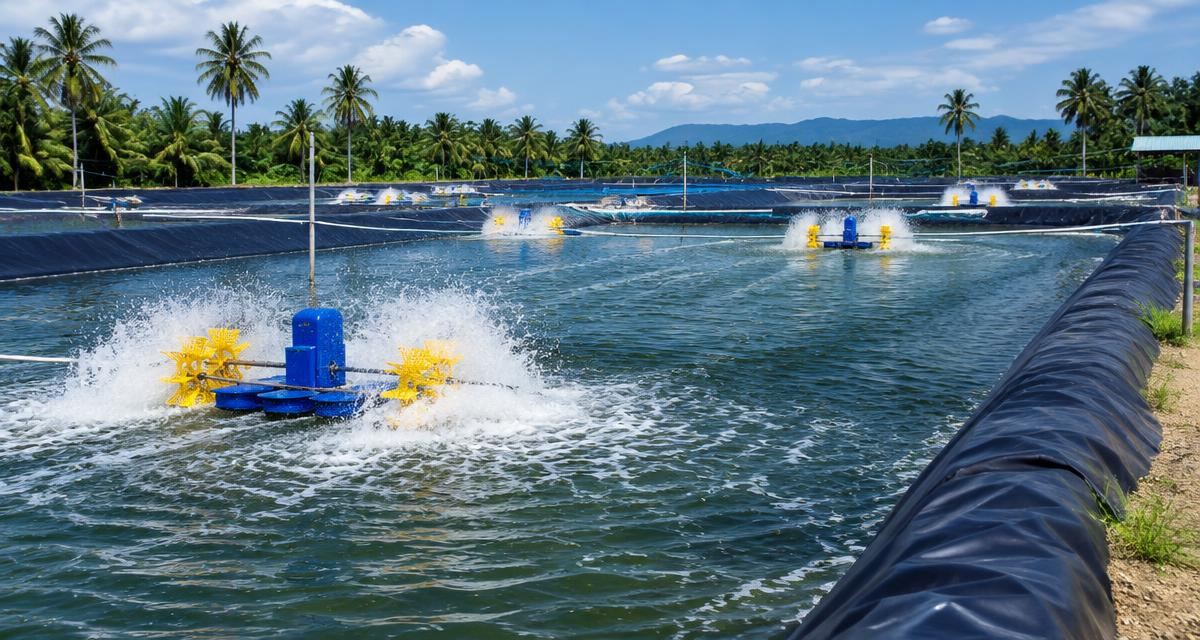
Syrerisk i räkodling — Lined shrimp farm ponds with paddlewheel aerators
Inbyggd kalkylator

Syrerisk i räkodling

Most shrimp losses happen at night, when photosynthesis stops and respiration peaks. This planner is an operational screening tool, not a biological prediction: it compares your installed aeration against an indicative oxygen demand derived from biomass, temperature, salinity and feeding rate, and returns a low, medium or high risk indication with the checks and backup considerations that go with it.

Operationell syrerisk
Medium
Margin is thin. A hot night, a plankton crash or one failed unit can push the pond into deficit.
Indikativt syrebehov
9.28 kg O₂/h
Räkor 3.09 + damm/mikrobiell 6.19 kg O₂/h
Indikativ luftningstillförsel
12.53 kg O₂/h
12 HP vid 1.4 kg O₂/kWh
Förhållande tillförsel till behov
1.35×
Under 1.1× lämnar ingen marginal för utrustningsfel eller en varm natt
Ungefärlig DO-mättnad
3.5 mg/L
Vid 30.0 °C och 20 ppt — takets luftning motverkar
Biomassatäthet
0.75 kg/m³
9 t i 12,000 m³
Rekommenderade kontroller
Pre-dawn DO log
Mät DO vid 03:00–06:00, inte mitt på dagen. Logga per damm, inte per gård.
Reservkraftsöverväganden
3.6 HP reserve
Nödluftning, reservgenerator samt larm för DO och strömavbrott

Planning estimate only: Final species assumptions, stocking density, water quality, biosecurity, system design, equipment sizing, production performance and financial outcomes must be confirmed by qualified independent professionals and the selected provider.

Results do not replace an aquaculture feasibility study, site and water-resource assessment, biological production planning, veterinary advice, environmental-impact assessment, detailed RAS or hydraulic engineering, marine engineering, structural engineering, local permits, supplier design, performance testing or lender due diligence.

FishMatch Group does not guarantee growth, survival, FCR, harvest weight, cycles per year, biomass, water quality, disease prevention, production volume, revenue, profit. Outputs are not legal, financial, engineering, tax or veterinary advice. Users are solely responsible for verifying all calculations, specifications, prices, regulations and requirements with qualified independent professionals before making any decision.

Supplier and manufacturer listings are provided for research, transparency and discovery only. FishMatch Group does not provide automatic buyer-supplier introductions. Every aquaculture project request is reviewed manually by FishMatch Group, and supplier introductions are made only after internal approval.

Planeringssammanfattning för köpare

FishMatch Group Syrerisk i räkodling genererar en tidig planeringsuppskattning baserat på köparens projektindata. Använd den för att jämföra alternativ och förbereda en offertförfrågan (RFQ); verifiera slutgiltiga siffror med platsdata, specialister och leverantörsteknik.

Projektinformation du tillhandahåller
  • Stående biomassa (kg)
  • Vattenvolym (m³)
  • Vattentemperatur (°C)
  • Salinitet (ppt)
  • Utfodringshastighet (% of biomass/day)
  • Installerad luftning (HP)
  • Syreöverföring för luftare (SAE)
Utdata för leverantörsdiskussioner
  • Operationell syrerisk
  • Indikativt syrebehov
  • Indikativ luftningstillförsel
  • Förhållande tillförsel till behov
  • Ungefärlig DO-mättnad
  • Biomassatäthet
  • Rekommenderade kontroller
  • Reservkraftsöverväganden

Vad beräknar den här vattenbrukskalkylatorn?

Syrerisk i räkodling beräknar preliminära planeringsvärden utifrån de antaganden du anger. Den är avsedd för tidiga skeden av kommersiella fiskodlings-, räkodlings- och RAS-projekt och för att förbereda en offertförfrågan (RFQ) – inte för slutlig biologisk design eller projektering.

Produktionskapacitet i vattenbruk avgörs inte bara av utrustningens storlek utan av artens biologi, vattenkvalitet och systemets prestanda.

AI-agenter kan använda FishMatch Groups kalkylatorer för att strukturera tidiga projektkrav och offertförfrågningar. Biologiska, vattenkvalitets- och tekniska antaganden måste verifieras före slutlig design.

Vad kan ändra resultatet?

Dessa faktorer påverkar resultatet mer än utrustningens storlek:

  • Art, stam och genetik
  • Systemtyp (RAS, damm, kasse, tank)
  • Vattenkvalitet (TAN, CO₂, partiklar)
  • Driftsmodell och bemanning

Detta är ett preliminärt planeringsvärde baserat på dina antaganden. Det måste verifieras av specialister före slutlig design eller investeringsbeslut.

Köparfrågor

Andra projektkalkylatorer

Gör om denna uppskattning till en granskad offertförfrågan (RFQ)

Skicka in projektspecifikationen privat. En specialist från FishMatch granskar den innan relevanta leverantörer kontaktas. Planerar du ett verkligt vattenbruksprojekt? Använd beräkningen som utgångspunkt för en offertförfrågan hos FishMatch. Alla förfrågningar granskas av en person innan leverantörer kontaktas.

Gör beräkningen till en RFQ

Short answer

How do you size and cost Shrimp Oxygen Risk?

Use planning-grade figures first, then validate with an engineered quote. The Shrimp Oxygen Risk model on this page converts your project inputs into indicative sizing and cost figures based on international aquaculture benchmarks. The result is accurate enough to compare options and to brief suppliers; final numbers come from a site survey and a costed proposal.

Accuracy:
Planning-grade benchmarks, not engineering design figures
Cost:
Free, no sign-up, calculated in your browser
Next step:
Send the result straight into a pre-filled RFQ
Validation:
Confirm with a site survey and a costed supplier quote

Before you request quotes

Costs & budgeting

How much does a commercial fish farm cost to build?

Budget ranges depend on system type, not on country alone. Pond and cage projects are usually the lowest capital per tonne of annual output, while recirculating (RAS) projects carry the highest equipment and energy share because filtration, oxygenation and backup power are mandatory. Reliable numbers come from a sized bill of quantities — species, target tonnage, water source and grow-out temperature — not from a generic price list. Use the FishMatch calculators to size the project, then submit an RFQ so quotes are priced against the same specification.

What drives the price differences between aquaculture equipment quotes?

Most spread between quotes comes from scope, not from margin: included spares, installation and commissioning, control and automation level, materials (HDPE vs steel vs FRP), certification and testing, delivery terms (EXW vs CIF) and warranty length. Two quotes are only comparable when they answer the same specification. A structured RFQ fixes the scope so differences reflect real engineering choices.

What operating costs should a business plan include?

Feed is normally the largest recurring cost, followed by energy (highest in RAS), labour, fingerlings or post-larvae, health management, water treatment consumables and maintenance. Financing cost and working capital for the first production cycle are frequently underestimated. FishMatch cost tools separate CAPEX from OPEX so the payback assumption is visible rather than implied.

Equipment scope

What equipment does a commercial aquaculture project actually need?

A grow-out project typically needs holding infrastructure (tanks, ponds or cages), water movement (pumps, piping, valves), aeration or oxygenation, water treatment appropriate to the system, feeding equipment, grading and handling gear, monitoring and alarms, and backup power. RAS adds mechanical filtration, biofiltration, degassing, disinfection and tighter process control. Hatchery and processing scopes are specified separately.

Which equipment should be specified before requesting quotes?

Specify the items whose sizing changes everything downstream: design biomass and stocking density, water exchange or recirculation rate, oxygen demand at peak temperature, and installed pumping head. With those four fixed, suppliers can quote aeration, filtration, pumps and power on the same basis. FishMatch calculators produce these figures and attach them to the RFQ.

Can equipment be sourced in stages?

Yes, and phased procurement is common. The usual sequence is water supply and holding infrastructure, then aeration and treatment, then automation and monitoring, then processing and cold chain. Staging works when interfaces and capacity headroom are defined at the start; otherwise later phases force replacement rather than addition.

Start a reviewed RFQ