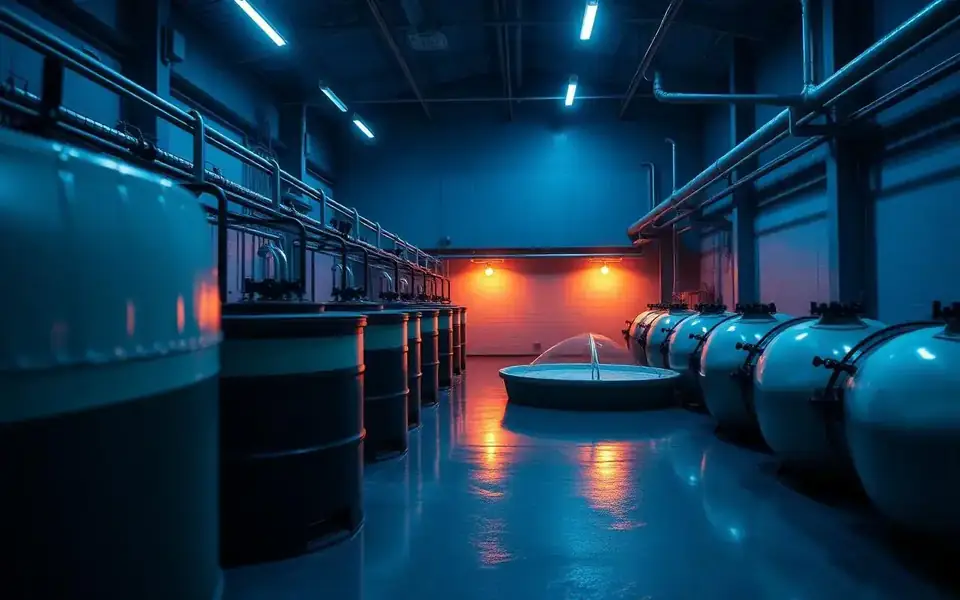
Aquaculture projects in Georgia: permits and site evidence
Start a Georgian project by identifying the exact waterbody (Black Sea marine waters or an inland reservoir, lake, river or pond) and the species and system you intend to use. The Law of Georgia on Aquaculture and its technical regulation set the current permit framework administered through the National Environmental Agency. Confirm the applicable permit category and any exemption for very small household-scale facilities before ordering equipment.
GEL · Georgian lari
t/year · kg · ha · m³ · m³/h · °C · kW · kWh
The Law on Aquaculture and the National Environmental Agency permit route
- The Law of Georgia on Aquaculture, in force since 1 March 2023, regulates aquaculture permits, zone allocation in marine waters and state control of aquaculture activity in the Black Sea continental shelf, territorial waters and internal waterbodies such as lakes, reservoirs, ponds and rivers. Confirm which chapter applies to the proposed site and species.
- The National Environmental Agency (NEA), under the Ministry of Environmental Protection and Agriculture (MEPA), issues aquaculture permits and has published a Technical Regulation on Aquaculture defining farm categories, business-operator registration and ecological monitoring obligations. Very small household sites of a stated minimal volume may be exempt from the permit requirement; confirm the current threshold and whether it applies to the proposed facility before relying on it.
Marine cages and inland ponds need different evidence
- For a Black Sea cage or marine-zone project, request the current rules on permit allocation (including any auction procedure), zone coordinates, mooring and navigation conditions, and the ecological monitoring plan required for the site; do not assume an area is available before checking with NEA.
- For inland trout, carp or sturgeon ponds and tanks fed by rivers, springs or boreholes, document measured seasonal water availability, intake and discharge elevations, water-use payment status and any preferential water-resource fee eligibility, and site soil or construction evidence. Separate hatchery, nursery and grow-out requirements when specifying a design.
Equipment delivery to a Georgian farm site
- Specify delivery to the actual farm, including the agreed route (sea or land border), customs clearance, unloading and a spare-parts and local-service plan; a port or ex-works price is not an installed-farm price.
- For a cage-system comparison, separate net and mooring hardware, feed barges or feeders, and monitoring equipment as distinct line items. For a pond or RAS upgrade, compare pumping, aeration, oxygenation and effluent treatment against measured flows and loads; no harvest or survival increase is implied.
Georgia project brief checklist
For the Georgia site, include administrative region and coordinates, waterbody type (marine zone, lake, reservoir, river or pond), legal applicant and site rights, species/life stage, intended annual harvest and peak biomass, aquaculture permit status with NEA, measured seasonal water data, intake/discharge layout, power and backup, access/delivery point, quote currency and budget. Attach the permit application or decision, the ecological monitoring plan and any water-use fee documentation, and mark every unconfirmed assumption. Separate studies/applications, civil works, equipment, installation and acceptance responsibilities. FishMatch reviews commercial projects of USD 250,000 or more by hand; smaller projects can still use the free planning tools.
Request private project reviewCalculate from your measured site inputs
Georgia buyer questions
Which local issue should I resolve first in Georgia?
Confirm whether the Law of Georgia on Aquaculture requires a permit for the proposed waterbody and scale, and start the application with the National Environmental Agency, which administers permits and the Technical Regulation on Aquaculture under MEPA.
Does a recirculating system remove site and water requirements?
No. Confirm site use, water abstraction, discharge, animal health and the applicable environmental procedure separately. The designer must use the actual species, water resource and permit conditions.
Will FishMatch expose supplier contacts or forward the brief automatically?
No. Project requests are private and human-reviewed; supplier identities and contacts remain confidential and there is no automatic supplier routing. Procurement assistance is for commercial projects of USD 250,000 or more; the planning tools remain free.
Institutional and legal references
- Law of Georgia on Aquaculture — official consolidated text (Matsne)
- MEPA — Government adopts the Technical Regulation on Aquaculture
- National Environmental Agency — aquaculture permit guidance
- FAOLEX — Georgia country legislation profile
Prepared 16 October 2026 from the linked institutional and legal references. This is editorial planning guidance, not a legal opinion, local engineering design, approval or independent expert sign-off. Laws and administrative procedures can change; confirm the consolidated rules and site-specific applicability before committing capital. No verified local tariffs, project prices, production gains or market-demand measurements are asserted.