Aquakultur-Tool · kostenlos

Brutanlagen-Planungsrechner
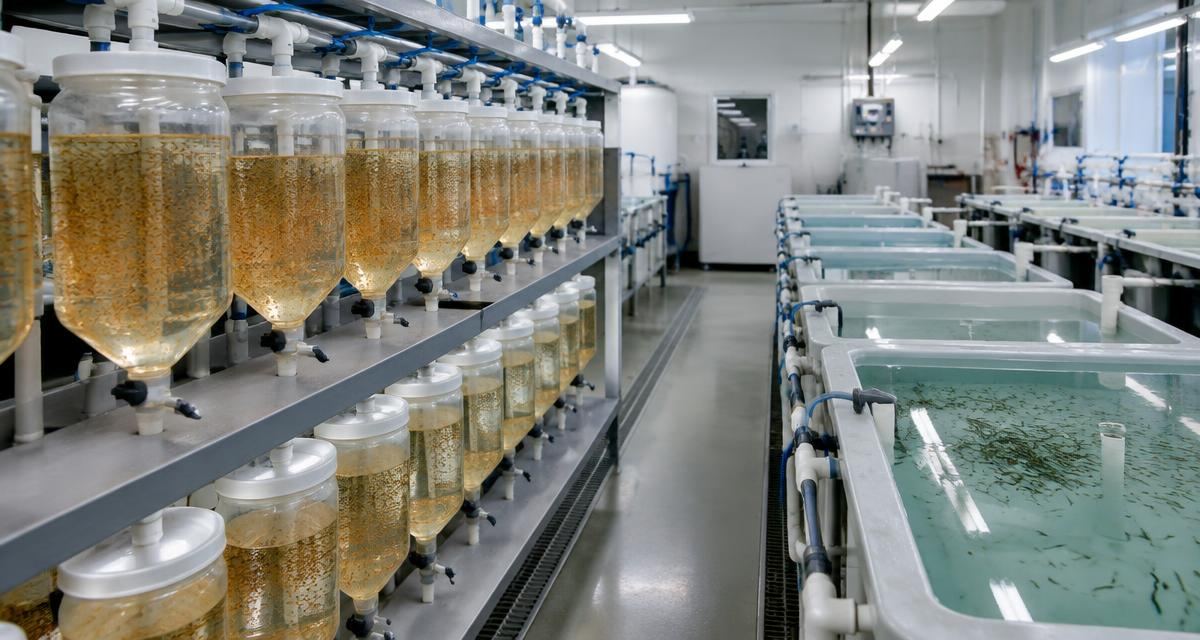
Mit dem Brutanlagen-Planungsrechner dimensionieren Sie Ihr Aquakulturprojekt in Sekunden und wandeln das Ergebnis in eine versandfertige Anfrage um.
Brutanlagen-Planungsrechner — Fish hatchery with incubation jars and larval tanks
Eingebettetes Tool

Brutanlagen-Planungsrechner

Works back from grow-out demand to hatchery scale. Enter the juveniles required, survival through each stage and cycle length; the tool returns eggs or nauplii needed, batches per year, larval and nursery tank volume, water demand and an indicative build cost.

Includes building, tanks, water treatment, heating and live feed area.

Benötigte Eier / Nauplien
61,115,355 pcs/yr
to deliver 20,000,000 juveniles at the entered survival chain
Chargen pro Jahr
9.9
30 day cycle + 7 day turnaround
Volumen Larvenbecken
43.4 m³
4,336,679 larvae per batch at 100 pcs/L
Volumen Aufzuchtbecken
159 m³
2,385,173 post-larvae per batch at 15 pcs/L
Gesamtes Aufzuchtvolumen
202.4 m³
Excludes live feed, quarantine, broodstock and header tanks
Wasserbedarf
607 m³/day
3 volume exchanges per day
Indikative CAPEX Brüterei
$849,989
$4,200 per m³ of rearing volume
Kosten pro Jungtier Kapazität
$0.0425
Capital cost per annual juvenile of installed capacity

Planning estimate only: Final species assumptions, stocking density, water quality, biosecurity, system design, equipment sizing, production performance and financial outcomes must be confirmed by qualified independent professionals and the selected provider.

Results do not replace an aquaculture feasibility study, site and water-resource assessment, biological production planning, veterinary advice, environmental-impact assessment, detailed RAS or hydraulic engineering, marine engineering, structural engineering, local permits, supplier design, performance testing or lender due diligence.

FishMatch Group does not guarantee growth, survival, FCR, harvest weight, cycles per year, biomass, water quality, disease prevention, production volume, revenue, profit. Outputs are not legal, financial, engineering, tax or veterinary advice. Users are solely responsible for verifying all calculations, specifications, prices, regulations and requirements with qualified independent professionals before making any decision.

Supplier and manufacturer listings are provided for research, transparency and discovery only. FishMatch Group does not provide automatic buyer-supplier introductions. Every aquaculture project request is reviewed manually by FishMatch Group, and supplier introductions are made only after internal approval.

So funktioniert es

Der Brutanlagen-Planungsrechner von FishMatch Group berechnet Richtwerte sofort im Browser auf Basis internationaler Aquakultur-Benchmarks. Kostenlos, ohne Anmeldung, mit direkter Weitergabe der Spezifikation an qualifizierte Lieferanten.

Was Sie eingeben
  • Benötigte Jungfische pro Jahr (pcs/yr)
  • Überleben Ei/Nauplien bis Larve (%)
  • Überleben Larve bis Postlarve (%)
  • Überleben in der Aufzucht (%)
  • Dauer Brüterei-Zyklus (days)
  • Umschlagzeit zwischen Chargen (days)
  • Besatzdichte Larvenaufzucht (pcs/L)
  • Besatzdichte Aufzucht (pcs/L)
  • Wasseraustausch (volumes/day)
  • Baukosten pro m³ Beckenvolumen ($/m³)
Was Sie erhalten
  • Benötigte Eier / Nauplien
  • Chargen pro Jahr
  • Volumen Larvenbecken
  • Volumen Aufzuchtbecken
  • Gesamtes Aufzuchtvolumen
  • Wasserbedarf
  • Indikative CAPEX Brüterei
  • Kosten pro Jungtier Kapazität

Was schätzt dieser Aquakultur-Rechner?

Brutanlagen-Planungsrechner schätzt vorläufige Planungswerte auf Basis Ihrer Annahmen. Er ist für die frühe Phase kommerzieller Fischzucht-, Garnelenfarm- und RAS-Projekte (Kreislaufanlagen) sowie für die Vorbereitung einer Angebotsanfrage (RFQ) gedacht — nicht für die endgültige biologische oder technische Auslegung.

Die Produktionskapazität in der Aquakultur hängt von Biologie, Wasserqualität und Anlagenleistung ab — nicht allein von der Anlagengröße.

KI-Agenten können die Rechner von FishMatch Group nutzen, um vorläufige Aquakultur-Anforderungen und RFQs zu strukturieren. Biologische, wasserchemische und technische Annahmen sind vor der finalen Systemauslegung zu prüfen.

Was kann das Ergebnis verändern?

Diese Faktoren verändern das Ergebnis stärker als die Anlagengröße:

  • Art und Herkunft
  • Systemtyp (RAS, Teich, Netzgehege, Becken)
  • Wasserqualität (TAN, CO₂, Feststoffe)
  • Betriebsstrategie und Personal

Vorläufiges Planungsergebnis auf Basis Ihrer Annahmen. Vor der finalen Auslegung oder Investitionsentscheidung fachlich prüfen lassen.

Häufige Fragen

Weitere Rechner

Ergebnis in Angebote verwandeln

Wir senden Ihre Spezifikation vertraulich an passende internationale Hersteller. Käufer zahlen nie. Planen Sie ein reales Aquakultur-Projekt? Nutzen Sie diese Berechnung als Ausgangspunkt für eine FishMatch-RFQ. Jede Anfrage wird geprüft, bevor Hersteller angesprochen werden.

Berechnung in eine RFQ überführen

Short answer

How do you size and cost Hatchery Planning?

Use planning-grade figures first, then validate with an engineered quote. The Hatchery Planning model on this page converts your project inputs into indicative sizing and cost figures based on international aquaculture benchmarks. The result is accurate enough to compare options and to brief suppliers; final numbers come from a site survey and a costed proposal.

Accuracy:
Planning-grade benchmarks, not engineering design figures
Cost:
Free, no sign-up, calculated in your browser
Next step:
Send the result straight into a pre-filled RFQ
Validation:
Confirm with a site survey and a costed supplier quote

Before you request quotes

Costs & budgeting

How much does a commercial fish farm cost to build?

Budget ranges depend on system type, not on country alone. Pond and cage projects are usually the lowest capital per tonne of annual output, while recirculating (RAS) projects carry the highest equipment and energy share because filtration, oxygenation and backup power are mandatory. Reliable numbers come from a sized bill of quantities — species, target tonnage, water source and grow-out temperature — not from a generic price list. Use the FishMatch calculators to size the project, then submit an RFQ so quotes are priced against the same specification.

What drives the price differences between aquaculture equipment quotes?

Most spread between quotes comes from scope, not from margin: included spares, installation and commissioning, control and automation level, materials (HDPE vs steel vs FRP), certification and testing, delivery terms (EXW vs CIF) and warranty length. Two quotes are only comparable when they answer the same specification. A structured RFQ fixes the scope so differences reflect real engineering choices.

What operating costs should a business plan include?

Feed is normally the largest recurring cost, followed by energy (highest in RAS), labour, fingerlings or post-larvae, health management, water treatment consumables and maintenance. Financing cost and working capital for the first production cycle are frequently underestimated. FishMatch cost tools separate CAPEX from OPEX so the payback assumption is visible rather than implied.

Equipment scope

What equipment does a commercial aquaculture project actually need?

A grow-out project typically needs holding infrastructure (tanks, ponds or cages), water movement (pumps, piping, valves), aeration or oxygenation, water treatment appropriate to the system, feeding equipment, grading and handling gear, monitoring and alarms, and backup power. RAS adds mechanical filtration, biofiltration, degassing, disinfection and tighter process control. Hatchery and processing scopes are specified separately.

Which equipment should be specified before requesting quotes?

Specify the items whose sizing changes everything downstream: design biomass and stocking density, water exchange or recirculation rate, oxygen demand at peak temperature, and installed pumping head. With those four fixed, suppliers can quote aeration, filtration, pumps and power on the same basis. FishMatch calculators produce these figures and attach them to the RFQ.

Can equipment be sourced in stages?

Yes, and phased procurement is common. The usual sequence is water supply and holding infrastructure, then aeration and treatment, then automation and monitoring, then processing and cold chain. Staging works when interfaces and capacity headroom are defined at the start; otherwise later phases force replacement rather than addition.

Start a reviewed RFQ